Best Espresso Machines Under $500
Under $500 is the bracket where home espresso stops being a novelty and starts being repeatable. It is also the bracket with the widest gap between what a machine promises on the box and what it does on a Tuesday morning, because almost every model here uses a single heating element and a portafilter that will outlive it. The real decision is not which machine pulls the best shot in ideal conditions, but which one holds a stable temperature, gives you enough feedback to correct a bad shot, and steams milk without a five-minute wait. We compared the five machines most consistently recommended at this price against their published specifications, long-term owner reports and independent expert testing. One warning before the list: the grinder matters more than any machine on it.
As an Amazon Associate, Cafe & Crema earns from qualifying purchases. This never affects the price you pay. How we make money.
| Rank | Product | Score | Best for | Link |
|---|---|---|---|---|
| #1 | Breville Bambino Plus Espresso Machine BES500Top pick | 9.4 | Anyone who wants milk drinks on a weekday morning without a warm-up wait or a texturing learning curve | Check price → |
| #2 | Gaggia Classic Evo Pro Espresso MachineBest to learn on | 9.2 | Someone who wants to actually learn espresso and keep the machine for a decade | Check price → |
| #3 | Breville the Infuser Espresso Machine BES840XLBest feedback | 8.8 | The learner who wants the machine to tell them why the last shot was wrong | Check price → |
| #4 | Breville Bambino Espresso Machine BES450Best value | 8.6 | Buyers who drink mostly straight espresso, or who want to learn milk texturing by hand | Check price → |
| #5 | De'Longhi Dedica Arte Espresso Machine EC885MBest for tight counters | 8.2 | Small kitchens where six inches of counter is the actual constraint | Check price → |
#1 · Our PickTop pick
Breville Bambino Plus Espresso Machine BES500
Best for: Anyone who wants milk drinks on a weekday morning without a warm-up wait or a texturing learning curve
What we like
- ThermoJet heating reaches extraction temperature in about three seconds
- Automatic milk texturing with three temperature and three froth settings
- Digital PID temperature control and low-pressure pre-infusion
- Steam wand purges itself after every use
- Manual steam mode is there when you want to learn texturing yourself
What we don't
- 54mm portafilter, so the large 58mm accessory market does not fit
- No pressure gauge, so grind feedback comes from the shot rather than the machine
- Plastic body panels at a price where the Gaggia is steel
- Shallow drip tray fills quickly
- No grinder, and the machine is only as good as the one you pair with it
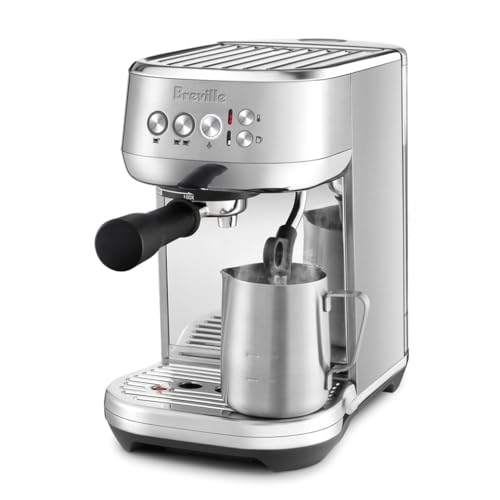
The reason most home espresso machines end up pushed to the back of the counter is not shot quality. It is the fifteen minutes of warm-up before you can use one, and the fact that steaming milk properly is a skill you have to acquire before your first coffee is drinkable. The Bambino Plus is built specifically against both. Breville's ThermoJet element heats only the water passing through it, and reaches extraction temperature in roughly three seconds from cold, which turns espresso from a weekend project into something you can do before work. The automatic milk texturing is the other half: you set a temperature and a froth level, drop the wand in, and it stops on its own.
What you are buying underneath that convenience is more serious than the plastic panels suggest. Digital PID control holds brew temperature rather than letting a thermostat swing around it, and low-pressure pre-infusion ramps the water in gently before full pressure, which is the single most effective defence against channelling for someone still learning to distribute and tamp evenly. It ships with both pressurised and non-pressurised baskets, and the non-pressurised ones are the ones that matter — they are what let a real grinder show what it can do. The automatic milk mode also does not lock you out of learning; there is a manual steam setting, and owners who start on auto and move to manual over a few months are a common pattern in long-term reports.
The compromises are real and worth naming. The portafilter is 54mm, which is Breville's own size rather than the 58mm commercial standard, so the enormous aftermarket of bottomless portafilters, precision baskets and distribution tools is much thinner for you than it is for a Gaggia owner. There is no pressure gauge, so when a shot runs fast you diagnose it from the cup and the timer rather than from the machine. The body is plastic where the Gaggia below is stainless steel, and the drip tray is shallow enough to need emptying often. None of that changes the recommendation for most people. If you want espresso and milk drinks reliably, quickly, and without a project attached, this is the machine in this bracket that gets used every day rather than admired occasionally.
The machine that removes the two things that stop people using an espresso machine: the wait and the milk. It gives up gauges and steel to do it, and for most buyers that is the right trade.
Check price on Amazon →#2Best to learn on
Gaggia Classic Evo Pro Espresso Machine
Best for: Someone who wants to actually learn espresso and keep the machine for a decade
What we like
- 58mm commercial portafilter, the standard the entire accessory market is built around
- Brass group head with real thermal mass, upgraded from the previous aluminium
- Factory pressure set to 9 bar rather than the inflated figures cheaper machines advertise
- Commercial steam wand with genuine steaming power
- The largest modification and upgrade community of any machine at this price
What we don't
- No PID from the factory, so brew temperature needs managing rather than setting
- Wants ten to fifteen minutes of warm-up before it is thermally stable
- Single boiler means waiting between brewing and steaming
- The learning curve is the point, which is the wrong answer if you want coffee now
- Manual texturing only, with no automatic milk mode
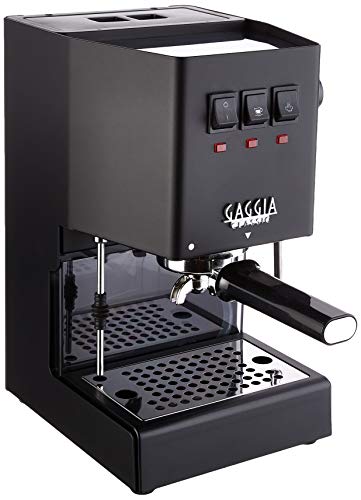
The Gaggia Classic has been in more or less continuous production since 1991, and the reason is the 58mm portafilter. That single specification connects the machine to the entire commercial accessory ecosystem: bottomless portafilters that show you exactly where a shot is channelling, precision baskets, distribution tools, tampers that actually fit. Every other machine in this roundup uses a proprietary size, which means the parts you buy for them are the parts the manufacturer chose to sell. The Evo Pro adds a brass group head in place of the aluminium one, which holds heat far better between shots, and sets pump pressure at 9 bar from the factory instead of the 15 or 20 bar that cheaper machines advertise as a feature and that is, for espresso, simply too much.
What that adds up to is the machine with the highest ceiling in the bracket, and the community around it is a genuine part of what you are buying. PID kits, flow-control devices and pressure-profiling projects are all documented and widely used, so a Gaggia bought today can be a materially better machine in two years without being replaced. Owner reports going back over a decade are the strongest long-term reliability signal of anything here, and parts availability is the reason: this is a machine people repair rather than discard.
The cost is patience, and it is charged up front. There is no PID as it ships, so the boiler cycles around a thermostat and you learn to time your shot relative to that cycle, a technique usually called temperature surfing. It wants ten to fifteen minutes to come up to a stable temperature, not three seconds. The single boiler has to switch between brew and steam temperatures, so milk drinks involve waiting. The steam wand is powerful and entirely manual, which means your first several attempts at microfoam will be disappointing. If you read all of that as a list of chores, buy the Bambino Plus. If you read it as the actual craft, this is the machine, and it is the only one here that will still be interesting to you in five years.
The one machine here you can grow into rather than out of. It asks more of you than anything else in this bracket and gives back more if you supply it.
Check price on Amazon →#3Best feedback
Breville the Infuser Espresso Machine BES840XL
Best for: The learner who wants the machine to tell them why the last shot was wrong
What we like
- Front-mounted pressure gauge shows what is happening during extraction
- PID temperature control adjustable in 2°F increments
- Low-pressure pre-infusion before full pressure
- Programmable volumetric control for one and two-cup shots
- Auto-purge drops the thermocoil to brew temperature after steaming
What we don't
- Thermocoil heating means a real warm-up wait, not the Bambino's three seconds
- The gauge reads system pressure, which is a guide to your grind rather than a precise measurement
- 54mm portafilter, same limited accessory market as the other Brevilles
- Manual steam wand only, with no automatic milk mode
- Larger footprint than the Bambino for broadly similar brewing
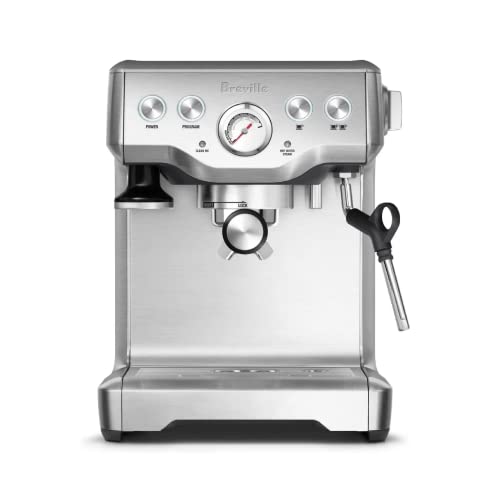
Dialling in espresso means adjusting your grind until the shot runs at the right speed, and the hardest part of learning it is that a bad shot and a good shot look similar until you taste them. The Infuser's answer is the pressure gauge on the front panel. Grind too coarse and the needle sits low as the water rushes through; grind too fine and it pins high while barely anything comes out. That is a signal you can read during the shot rather than a verdict you get afterwards, and for someone in their first few months it shortens the feedback loop dramatically. The PID is adjustable in 2°F increments, so once you find a temperature that suits your beans you can set it rather than surf it.
Around that sits a well-judged set of features that have been on this platform long enough to be proven. Low-pressure pre-infusion ramps the water in gradually, volumetric control lets you program one and two-cup volumes so shots repeat, and the auto-purge drops the thermocoil back from steam temperature to brew temperature automatically instead of leaving you to run water through until it stops hissing. It is an older design than the Bambino and it shows in the best way: the long-term owner record is deep, and the failure modes people report are the ordinary serviceable ones rather than anything structural.
The honest limits start with heat-up. The Infuser uses a thermocoil, not the ThermoJet, so you wait — not the Gaggia's fifteen minutes, but not three seconds either. The gauge is reading system pressure rather than the true resistance of the puck, so treat it as a well-calibrated guide to your grind rather than an instrument. The portafilter is 54mm, so the accessory ceiling is Breville's rather than the commercial standard's, and the steam wand is manual with no automatic mode. It also takes up meaningfully more counter than the Bambino while brewing to a similar standard. Buy it for the gauge, because the gauge is genuinely what it is for.
The teaching machine of the Breville line. The gauge turns dialling in from guesswork into a readable signal, which is worth more to a beginner than three-second heat-up.
Check price on Amazon →#4Best value
Breville Bambino Espresso Machine BES450
Best for: Buyers who drink mostly straight espresso, or who want to learn milk texturing by hand
What we like
- The same ThermoJet element and three-second heat-up as the Bambino Plus
- PID temperature control and low-pressure pre-infusion at a much lower price
- Genuinely compact, among the smallest footprints of any real espresso machine
- Auto-purge after steaming
- Manual steam wand teaches texturing properly
What we don't
- No automatic milk texturing, which is the main reason to pay more for the Plus
- Single brew temperature rather than the Plus's three settings
- Smaller water tank means refilling more often
- 54mm portafilter and no pressure gauge
- Light enough that the portafilter lock can shift the machine on the counter
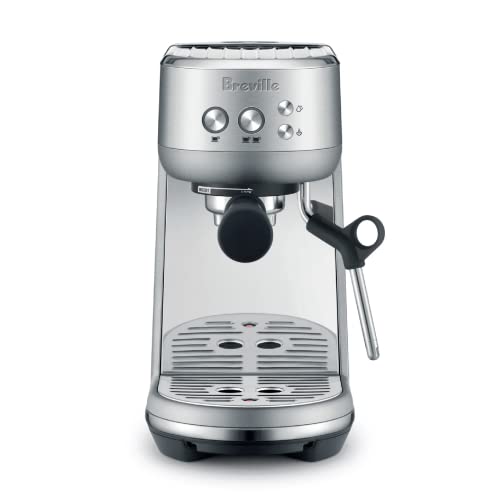
The Bambino and the Bambino Plus share the part that actually makes the coffee. Same ThermoJet element, same three-second heat-up, same digital PID temperature control, same low-pressure pre-infusion, same 54mm basket sizes. If you pull a shot on each and taste them side by side, you are tasting the same machine. The difference sits almost entirely in the milk: the Plus texturises automatically to a temperature and froth level you choose, and the Bambino gives you a manual wand and expects you to learn.
That makes the buying decision unusually clean, which is rare at this price. If you drink espresso, americanos or the occasional flat white you are happy to practise for, the Bambino is the better purchase and the saving is real money that belongs in your grinder instead. If your household drinks cappuccinos every morning and nobody wants to become a barista to get one, the Plus earns its premium. Nothing about the Bambino's shots is a compromise version of the Plus's.
The smaller details are where the price shows. There is one brew temperature rather than three, so you cannot nudge it for a lighter or darker roast the way you can on the Plus. The water tank is smaller and you will refill it more often. It is a very light machine, light enough that locking a portafilter in firmly can slide it on a smooth counter, which is an odd thing to have to hold with your other hand. And it inherits the family limitations: 54mm portafilter, no pressure gauge, plastic panels. For someone whose priority is getting the best possible shot per dollar spent across machine and grinder together, this is the most efficient use of the budget in the roundup.
The same brewing engine as our top pick for substantially less money. What you give up is the automatic milk, and whether that matters depends entirely on what you drink.
Check price on Amazon →#5Best for tight counters
De'Longhi Dedica Arte Espresso Machine EC885M
Best for: Small kitchens where six inches of counter is the actual constraint
What we like
- Six inches wide, narrower than any other real espresso machine here
- My LatteArt steam wand is a proper commercial-style wand, not a frothing aid
- Three selectable brew temperatures
- Automatic flow stop for repeatable shot volumes
- Stainless steel front and a removable 35oz tank
What we don't
- 51mm portafilter, an unusual size with the thinnest accessory market of the five
- Pressurised baskets are the default, and they mask what your grinder is doing
- Thermoblock temperature stability trails the PID-controlled machines
- The non-pressurised basket takes a small dose, which limits what you can pull
- Clip-on plastic tamper is not a serious tool
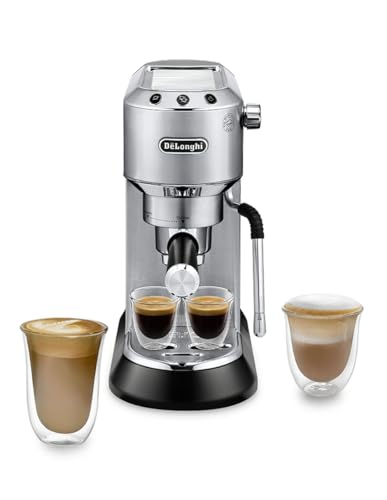
Most espresso machines assume you have counter space. The Dedica Arte assumes you do not, and at six inches wide it fits places nothing else in this roundup will go. The impressive part is how little De'Longhi gave up to get there. The My LatteArt wand is a real commercial-style steam wand rather than the panarello frothing sleeve that used to come on machines at this level, and that distinction matters: a panarello injects air and makes bubbly foam, while a proper wand lets you build actual microfoam and pour a pattern with it. Three brew temperatures and an automatic flow stop round out a specification that is more serious than the footprint suggests.
It heats quickly, it is solidly built at the front where you touch it, and the removable 35oz tank is easy to live with. For an apartment kitchen, a small office, or anywhere a Gaggia simply will not fit, it is the answer, and owner reports of long service are common enough to trust.
The reasons it ranks fifth rather than higher are all about the ceiling rather than the floor. The portafilter is 51mm, which is neither the commercial 58mm nor Breville's 54mm, so the accessory market available to you is the thinnest of any machine here. Pressurised baskets are the default fitment, and a pressurised basket works by forcing crema through a restrictor rather than by extraction, which means it makes a mediocre grinder look acceptable and an excellent grinder look identical — precisely the feedback you need when learning. The non-pressurised basket is available but takes a small dose, capping what you can pull. Heating is a thermoblock rather than a PID-controlled system, so temperature stability trails the Brevilles. And the tamper clips onto the machine and is made of plastic. Buy the Dedica Arte because six inches is your real constraint, not because it is the best brewer on the list.
The machine to buy when width decides the purchase. Within that brief it is well made and genuinely capable of latte art; outside it, the others brew better.
Check price on Amazon →Buy the grinder first
The most expensive mistake in home espresso is spending the whole budget on the machine. Espresso is the brew method least tolerant of an inconsistent grind: the water is under pressure and will find any path of least resistance through the puck, so a grind containing both dust and boulders produces a shot that runs fast, tastes thin and sour, and cannot be fixed by anything the machine does. Every machine on this list will make disappointing coffee with a bad grinder, and the differences between them only become visible once the grinder is good enough to expose them. If your total budget is $500, spend it as roughly $300 on the machine and $200 on the grinder rather than $500 and nothing.
Feedback matters more than features at this level
What separates the machines here is not shot quality in ideal conditions but how quickly they tell you when conditions are not ideal. The Infuser’s pressure gauge shows a bad grind while the shot is running. The Gaggia’s non-pressurised commercial baskets and 58mm bottomless portafilter market let you see channelling directly. The Bambino’s pre-infusion quietly forgives uneven distribution rather than reporting it. A pressurised basket, at the other extreme, actively hides the information you need. Decide which of those you want, because a beginner improves at the speed their equipment lets them diagnose problems.
Convenience is a legitimate specification
There is a tendency in espresso to treat anything automatic as a compromise, and it is worth resisting. A machine that takes fifteen minutes to warm up and demands manual texturing will produce better coffee than a Bambino Plus in skilled hands, and a machine that is ready in three seconds and steams its own milk will produce more coffee, because it gets used on the mornings the other one does not. Both of those are real outcomes. Be honest about which household you are before you buy, because the best machine here is the one you will still be using in a year.
The machine sets your ceiling, but the grinder decides whether you ever reach it — see our guide to building a home espresso setup for how to stage the whole purchase, and in what order.
Frequently asked questions
Do I really need a separate grinder?
Yes, and it is the single most consequential decision in home espresso. Espresso extraction is controlled by grind size, and the adjustment steps you need are finer than pre-ground coffee or a general-purpose grinder can provide. A blade grinder cannot do it at all, because it chops rather than mills and produces a mixture of dust and boulders that water channels straight through. If money is tight, buy a cheaper machine and a better burr grinder rather than the other way around. Pre-ground coffee with a pressurised basket will produce a drink, but it will not produce espresso you can improve.
Does the 54mm versus 58mm portafilter difference actually matter?
Not for the shot itself, but very much for what you can do afterwards. 58mm is the commercial standard, so bottomless portafilters, precision baskets, distribution tools and quality tampers are all made for it in quantity and at competitive prices. Breville's 54mm has a real but smaller aftermarket. The 51mm size on the Dedica has very little. If you expect to stay with the basket that came in the box, it does not matter. If you expect to be diagnosing channelling with a bottomless portafilter in a year, it matters a lot.
What is a pressurised basket, and should I use one?
A pressurised basket has a restrictor behind the holes that builds back-pressure artificially, so that coffee which is too coarse or unevenly ground still emerges with foam on top. It makes bad inputs look acceptable, which is genuinely useful if you are using pre-ground coffee. The cost is that it disconnects the result from your technique: better beans, a better grind and better distribution all produce roughly the same cup. Start on it if you must, but the point of a non-pressurised basket is that it tells you the truth, and you cannot improve without that.
Can I make cappuccinos and lattes on these?
All five can steam milk, but they differ in how much you have to learn. The Bambino Plus texturises automatically to a temperature and froth level you select. The other four have manual wands, which produce better milk once you can use them and disappointing milk until you can. Every machine here has a single boiler, which means it heats to brew temperature or steam temperature but not both at once, so milk drinks involve a switchover wait — seconds on the Brevilles, longer on the Gaggia.
How long should one of these last, and what maintenance do they need?
Descaling on the schedule in the manual is what decides the answer, and hard water shortens every interval. Scale accumulates inside the heating element and is the most common cause of a machine that gradually loses temperature and pressure before failing outright. Backflush or rinse the group and basket regularly, run a cleaning tablet cycle if the machine supports one, and use filtered water if yours is hard. Machines with a long parts and service record, the Gaggia in particular, are the ones people repair after several years rather than replace.
Is the Bambino Plus worth the extra money over the Bambino?
Only for the milk. The two machines share the heating system, PID control, pre-infusion and basket sizes, so their espresso is the same. The Plus adds automatic milk texturing with selectable temperature and froth levels, plus three brew temperature settings and a larger tank. If your household drinks milk-based coffee daily and does not want to learn to steam, that is worth the difference. If you drink espresso or americanos, put the saving into your grinder.