Best Milk Frothers and Pitchers
There are two entirely different products on this page and they solve different problems. An automatic frother heats and textures milk on its own, which is the answer if your machine has no steam wand or if the steam wand it has is not worth fighting; a steaming pitcher does nothing by itself and is the answer if your machine does. Buying the wrong one is the most common mistake in this category. We compared these on the texture they actually produce — microfoam that pours against stiff foam that sits on top — plus capacity against the size of drink you make, how many parts have to be washed and whether milk can burn onto them, cold-froth capability for iced drinks, and in the case of pitchers, spout shape and volume relative to your steam wand.
As an Amazon Associate, Cafe & Crema earns from qualifying purchases. This never affects the price you pay. How we make money.
| Rank | Product | Score | Best for | Link |
|---|---|---|---|---|
| #1 | Breville Milk Cafe Milk Frother BMF600XL, Stainless SteelTop pick | 9.2 | Households with a pod machine or a drip setup who make several milk drinks at a time | Check price → |
| #2 | Nespresso Aeroccino 3 Milk Frother, BlackBest for pod machines | 8.8 | Anyone with a Nespresso or other pod machine who wants milk drinks with no thought involved | Check price → |
| #3 | Update International EP-12 Stainless Steel Frothing Pitcher, 12 oz, SilverBest steaming pitcher | 8.4 | Anyone with a steam wand who is still frothing in whatever jug they own | Check price → |
| #4 | Bodum Latteo Manual Milk Frother, 8 Ounce, BlackBest without electricity | 8.0 | Small kitchens, and anyone who does not want another appliance on the counter | Check price → |
| #5 | Aerolatte Steam-Free Milk Frother, Satin Finish, 18/8 Stainless Steel Whisk, Battery Powered | 7.4 | Occasional milk drinks, travel, and anyone who wants foam without owning anything | Check price → |
#1 · Our PickTop pick
Breville Milk Cafe Milk Frother BMF600XL, Stainless Steel
Best for: Households with a pod machine or a drip setup who make several milk drinks at a time
What we like
- Adjustable temperature dial rather than a single fixed setting, which matters for hot chocolate and for tea drinks
- Cold-froth setting works without heating, so iced lattes and frappes are covered
- Induction heating with a non-stick jug that milk does not scorch onto
- 600ml capacity — enough for three or four drinks in one cycle, unlike the pod-machine frothers
- Two whisk discs, one for latte-style texture and one for stiff cappuccino foam
What we don't
- Large footprint for a single-purpose appliance, and it is not a small one
- The jug is not dishwasher safe and the non-stick surface has to be treated carefully
- Nothing here produces true microfoam for latte art — it is aerated milk, not steamed milk
- Considerably more expensive than the pod-machine frothers it competes with
- The whisk discs are small and easy to lose
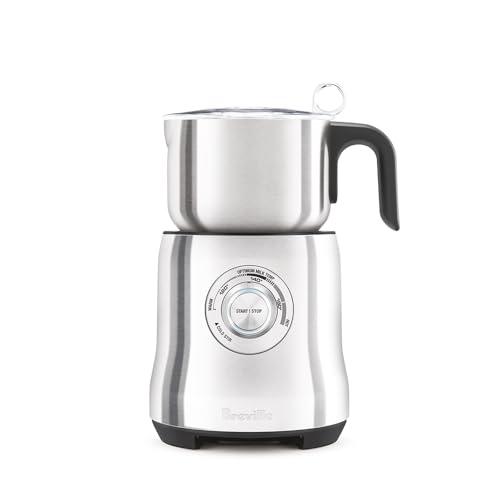
The Milk Cafe is the automatic frother that behaves like an appliance rather than an accessory. Where most of the category offers one button and one result, this has a temperature dial covering roughly the range from warm to properly hot, two whisk discs for different foam densities, and a cold setting that textures milk without heating it at all.
Capacity is the practical argument. At 600ml it makes three or four drinks per cycle, where the frothers bundled with [pod machines](/best-pod-and-capsule-machines) are sized for one. If two people want cappuccinos at the same time, that is the difference between one cycle and three. The induction base and non-stick jug also mean milk does not weld itself to the bottom, which is the usual reason a cheap frother ends up in a cupboard.
What it does not do is produce microfoam. No whisk-in-a-jug frother does — steam injects air while heating and shears it into progressively finer bubbles, and a spinning disc simply beats air in. The result is good aerated milk that sits well on a cappuccino and mixes fine into a latte, but it will not pour a rosetta and it is thinner in the mouth than steamed milk. It is also a large object to keep on a counter for one job. If your machine already has a competent steam wand, buy a pitcher instead and save the space.
The most capable automatic frother by a clear margin — capacity, temperature control and cold froth in one unit.
Check price on Amazon →#2Best for pod machines
Nespresso Aeroccino 3 Milk Frother, Black
Best for: Anyone with a Nespresso or other pod machine who wants milk drinks with no thought involved
What we like
- One button, two results — hold for cold froth, press for hot, and nothing else to learn
- Genuinely fast, at roughly a minute and a half for a hot cycle
- Small enough to live next to a pod machine without dominating the counter
- Non-stick interior wipes clean in seconds, which is why people keep using it
- The de facto standard, so replacement whisks and seals are easy to find
What we don't
- Fixed temperature with no adjustment at all
- Roughly one drink per cycle at the froth line — smaller than the marked capacity suggests
- Not dishwasher safe despite how simple it looks
- The base and jug are a matched pair; losing or damaging either means replacing both
- The magnetic whisk is easy to lose down a sink
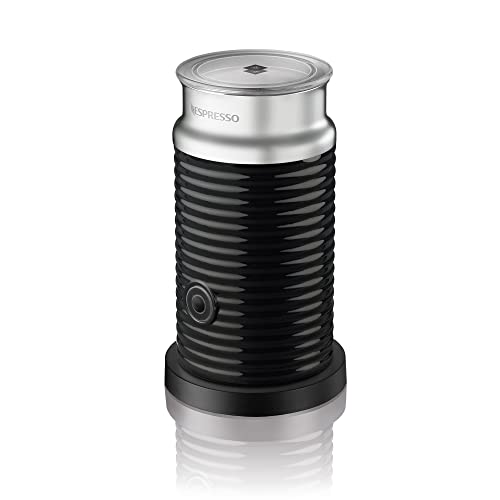
The Aeroccino's design decision is to remove every choice. There is one button. Press it and you get hot frothed milk; hold it and you get cold froth. There is no temperature dial, no timer and no texture selection, and the reason it is the most widely owned frother in the world is that nothing about it is a decision.
It is fast and it cleans in seconds, which are the two things that decide whether an appliance survives on a counter. A hot cycle runs in around ninety seconds while the machine behind it makes the coffee, and the non-stick jug wipes out with a cloth rather than needing a soak. Owners consistently report the same pattern: bought as an accessory, used daily for years.
The limits are capacity and control. The froth line sits well below the rim, and the practical yield is one drink — two small ones at a push. There is no adjustment if you find the fixed temperature too hot or not hot enough, which is a real complaint among people who drink flat whites rather than cappuccinos. And like every device here it produces aerated rather than steamed milk. For a pod setup that is exactly the right level of ambition; for an [espresso machine with a steam wand](/best-espresso-machines-under-500) it is redundant.
The one that gets used. Fixed settings, one drink at a time, and almost no friction.
Check price on Amazon →#3Best steaming pitcher
Update International EP-12 Stainless Steel Frothing Pitcher, 12 oz, Silver
Best for: Anyone with a steam wand who is still frothing in whatever jug they own
What we like
- The correct size for one drink, which is what actually makes texturing repeatable
- Sharp, well-defined spout that pours a controlled stream rather than a dribble
- 18/8 stainless with no coating to wear off — this is catering equipment, not a consumer product
- Costs a fraction of the branded barista pitchers and does the same job
- Dishwasher safe and effectively indestructible
What we don't
- Does nothing on its own — requires a machine with a working steam wand
- No thermometer and no marked fill line, so temperature is judged by hand on the side
- 12 oz is too small for two drinks at once
- Plain finish scratches and dulls quickly, though it does not affect performance
- The handle gets warm during a long steam
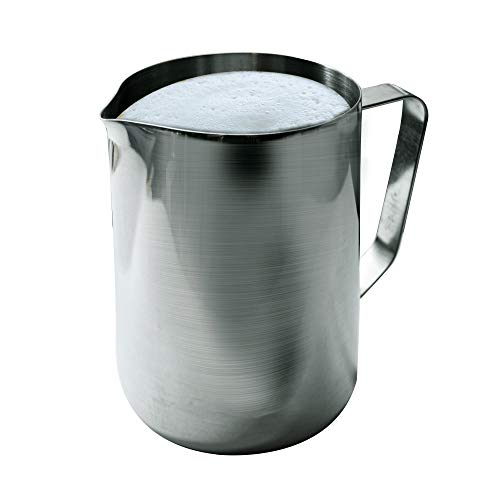
This is the pitcher that sits in commercial kitchens, and it is on this page as the corrective to the rest of it. If your machine has a steam wand, no automatic frother will improve your milk — a two-figure stainless pitcher will, and by a wide margin.
Size is the reason. Texturing milk properly needs the jug roughly a third to half full so the whirlpool can form, and most people are frothing a single drink's worth of milk in a jug built for four. A 12 oz pitcher with about 150ml of milk in it puts the wand tip at the right depth and gives the milk somewhere to roll, which is most of what separates smooth microfoam from a stiff head of bubbles. The spout does the rest: a defined point pours a thin, controllable stream, which is the difference between foam that integrates and foam that lands in a lump.
The honest limitation is that it is a piece of metal. It has no thermometer, so temperature is judged by holding the side until it becomes uncomfortable — which works, and is what most baristas do, but it is a skill rather than a setting. At 12 oz it makes one drink; a second person means a second round. And it is useless with a pod machine or a drip brewer. Pair it with the [dial-in fundamentals](/espresso-dial-in-grind-dose-yield) and it is the least money that changes a milk drink most.
The cheapest meaningful upgrade to milk texturing there is, provided you have a steam wand to use it with.
Check price on Amazon →#4Best without electricity
Bodum Latteo Manual Milk Frother, 8 Ounce, Black
Best for: Small kitchens, and anyone who does not want another appliance on the counter
What we like
- No power, no motor and nothing to break — it is a plunger in a glass jug
- Produces denser, drier foam than most electric whisk frothers
- Borosilicate glass, so it can be warmed and every part goes in the dishwasher
- Silent, which matters more than expected first thing in the morning
- Costs less than almost anything else that makes decent foam
What we don't
- The milk must be heated separately — in a pan or a microwave — which is an extra step and an extra washing-up
- 8 oz is one drink, and it must not be filled past a third
- Pumping is manual effort and takes thirty to sixty seconds of it
- Glass, and the base is exposed if it is knocked off a counter
- Overworking it produces stiff, dry foam that will not pour
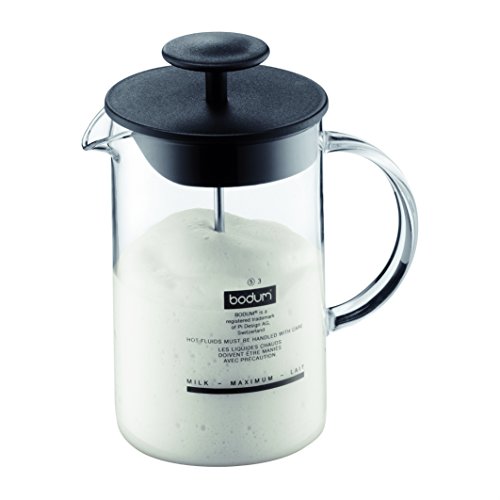
The Latteo is the same idea as a [French press](/best-french-presses) applied to milk: a borosilicate jug and a plunger with a fine mesh disc. Warm the milk, pour it in, and pump the plunger for half a minute. Air is forced through the mesh into the milk, and the foam that results is denser and drier than most electric frothers manage — closer to cappuccino foam than to the loose bubbles a spinning disc produces.
Its appeal is entirely about what it is not. There is no motor, no base, no non-stick coating to fail, and nothing to plug in. It stores in a cupboard, it is silent, and every part goes in the dishwasher. For a small kitchen or for someone who makes one milk drink at the weekend, an appliance is hard to justify and this is not one.
The cost is the extra step. The milk has to be heated separately, which means a pan or a microwave and something else to wash, and getting the temperature right is on you — too hot and the foam collapses, too cool and it never sets. The jug takes one drink's worth and must not be filled beyond about a third, and pumping is a genuine, if brief, physical effort. Overwork it and you get foam so stiff it sits on the spoon rather than pouring. It rewards a light touch.
A French press for milk. Works genuinely well, asks you to heat the milk yourself.
Check price on Amazon →#5
Aerolatte Steam-Free Milk Frother, Satin Finish, 18/8 Stainless Steel Whisk, Battery Powered
Best for: Occasional milk drinks, travel, and anyone who wants foam without owning anything
What we like
- Costs less than a bag of good coffee
- Works in any vessel — a mug, a jug, a glass — so nothing extra needs washing
- Stainless whisk rather than plastic, and it rinses under a tap in two seconds
- Packs into a bag, which no other frother here does
- Also froths cold milk, and is the usual tool for whisking matcha at home
What we don't
- No heating at all — the milk must be hot before it goes anywhere near this
- Produces loose, bubbly foam that collapses faster than any other option here
- Battery powered, and the batteries do run down
- Will spray milk across a counter if switched on before the whisk is submerged
- Not remotely a substitute for a steam wand or a proper frother
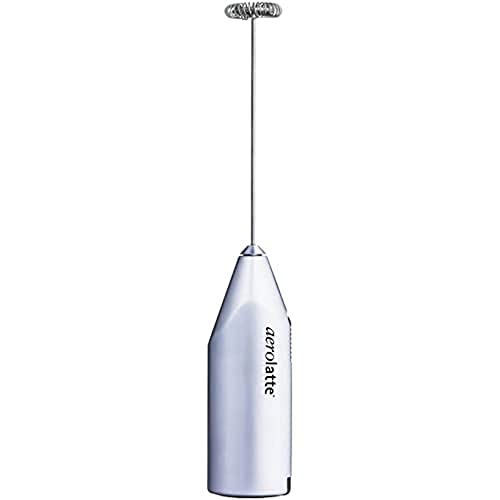
The Aerolatte is a battery-powered whisk with a stainless coil on the end, and it has been sold essentially unchanged for two decades because nothing simpler does the job. Heat the milk however you like, submerge the whisk, hold the button for twenty seconds. Rinse under a tap. That is the entire interaction.
What makes it worth listing alongside appliances costing many times more is that it adds no washing-up and takes no space. It works directly in the mug the drink is going into, which means there is no jug to clean, and it lives in a drawer or a bag. For someone who makes a milky coffee twice a week, that is a better proposition than an appliance that must be earned back in use.
The foam is the compromise and it is a real one. A whisk beats large bubbles into the surface of the milk rather than shearing fine ones through the body of it, so the result is light, loose and visibly coarse, and it collapses within a minute or two. It cannot heat, so a pan or microwave is still involved. And it will decorate your kitchen if switched on above the milk line rather than in it. Judged as a cheap way to put foam on a coffee it is fine; judged against a steam wand it is not the same activity.
A whisk on a stick. It makes bubbles on a coffee for very little money, and it makes no other claims.
Check price on Amazon →Two different products, one page
An automatic frother heats and textures milk by itself. A steaming pitcher does nothing at all until you point a steam wand into it. They are on the same page because people shop for them with the same words, and buying the wrong one is the most common mistake in this category.
The rule is short. If your machine has a steam wand, buy a pitcher. No automatic frother makes milk as good as a mediocre wand does, and the pitcher costs a fraction of the price. If it does not — a pod machine, a drip brewer, most bean-to-cup units under a certain price — an automatic frother is your only option, and a good one is worth having.
Microfoam and froth are not the same thing
This is where the marketing in this category is at its least honest.
Steam injects hot vapour under the surface of the milk and shears air into bubbles too small to see. The milk stays liquid, pours in a thin controlled stream, and feels heavy and glossy in the mouth. That is microfoam, and it is what latte art is poured with.
A whisk beats air in from above. The bubbles are visible, the foam sits as a distinct layer on top of the drink, and it collapses within a few minutes.
Froth is perfectly good on a cappuccino. It is not what makes a flat white a flat white, and nothing driven by a spinning disc will get there. Judge the frothers on this page against each other, not against a steam wand.
Buy the pitcher small
The single most common reason home milk texturing fails is a pitcher three times too big.
Milk needs to fill roughly a third to a half of the jug. That leaves room for it to expand and, more importantly, room for the whirlpool that folds the injected air through the whole body of the milk rather than leaving it on top. Put one drink’s worth of milk into a 20 oz pitcher and it sits too shallow for the wand tip to do anything useful.
One drink means 12 oz. Two drinks means 20 oz. If you make one at a time and own one pitcher, buy the small one.
Read the froth line, not the capacity
Automatic frothers advertise a jug capacity and then mark a much lower fill line for frothing, because the milk has to have somewhere to expand into.
A frother described as 250ml will typically froth to about half that, which is one drink. If two of you want a cappuccino at the same time, that is two cycles and several minutes. The larger units on this page exist entirely for that reason, and they take up the counter space to prove it.
Cleaning is what decides whether you keep it
Milk protein bakes onto hot metal and turns rancid quickly, and a frother that needs soaking after every use will be in a cupboard within a month.
Non-stick interiors that wipe out with a cloth are why the popular models stay popular. Almost none of these are dishwasher safe, whatever their simplicity suggests, and the ones with a heating base cannot be immersed at all. Rinse immediately, every time — the difference between a frother that lasts years and one that smells is entirely about what happens in the sixty seconds after you pour.
The milk matters more than the machine
Whole dairy milk foams most easily. Skimmed produces stiffer, drier foam. Among plant milks the barista editions of oat and soy contain added protein and stabilisers specifically so they hold structure under heat, and the standard versions frequently will not.
If your foam is collapsing and you have already checked the temperature, change the milk before you change the device. And if you are choosing between a better frother and a better grinder, the grinder changes the coffee underneath the milk far more than the foam on top of it ever will.
Frequently asked questions
Do I need a frother if my espresso machine has a steam wand?
No, and buying one would be a downgrade. A steam wand injects hot vapour beneath the surface of the milk and shears air into microscopic bubbles as it heats, producing the glossy, liquid microfoam that pours as latte art and feels heavier in the mouth. Automatic frothers whisk air in from above, which makes foam but not microfoam. If you have a wand, spend the money on a correctly sized pitcher instead — it is the cheapest upgrade in this category by a wide margin.
What is the difference between microfoam and froth?
Bubble size, and it changes everything downstream. Microfoam has bubbles too small to see individually, so the milk stays liquid, pours in a controlled stream, and integrates with the espresso rather than sitting on it. Froth has visible bubbles, sits as a distinct layer on top of the drink, and collapses within a few minutes. Cappuccinos work fine with froth. Flat whites and latte art require microfoam, and only steam produces it.
What size milk pitcher should I buy?
Smaller than most people expect. The milk should fill roughly a third to a half of the pitcher so there is room for it to expand and roll in a whirlpool, which means a 12 oz pitcher suits one drink and a 20 oz pitcher suits two. Using a large pitcher for a single drink is the most common reason home texturing fails — the milk sits too shallow for the wand tip to work, and you get bubbles instead of foam. If you mostly make one drink at a time, buy the small one.
Which milk froths best?
Whole dairy milk is the most forgiving, because its protein gives foam structure and its fat gives the texture body. Skimmed milk actually produces more foam and stiffer foam, but it is drier and tastes thinner. Among plant milks, the barista editions of oat and soy foam far better than the standard versions — they contain added protein and stabilisers specifically to hold structure under heat. Standard almond and rice milk are difficult with any device on this page.
How hot should frothed milk be?
Around 60 to 65C, which is hot enough to feel properly hot in the cup and cool enough to keep the milk sweet. Past about 70C the lactose starts to taste scalded and the foam structure breaks down, which is why milk that has been overheated tastes flat and will not hold a pattern. Most automatic frothers are fixed somewhere in the right range. With a steam wand and no thermometer, the standard approach is to hold the side of the pitcher and stop when it becomes uncomfortable to keep your hand there.
Can I froth milk for iced coffee?
Yes, but only with a device that has a specific cold setting, because cold foam requires running the whisk without the heating element. The Breville and the Aeroccino both do this, and a handheld whisk will do it in any glass. Cold foam is denser and holds much longer than hot foam, which is why it sits on top of an iced latte as a distinct layer rather than mixing in immediately.
Why does my frothed milk collapse so quickly?
Usually bubble size — large bubbles are unstable and burst quickly, which is inherent to whisk-type frothers and cannot be fixed by technique. If a steam wand is collapsing, the likely causes are overheating the milk past about 70C, introducing air too late in the process, or letting the foam sit in the pitcher instead of pouring promptly. Swirling the pitcher and tapping it on the counter before pouring redistributes the foam and buys some time. Low-protein plant milks collapse fastest of all.
Is a manual frother good enough?
For cappuccino-style foam, genuinely yes — a plunger frother forces air through a fine mesh, which produces a denser and drier foam than most electric whisks manage. What it does not do is heat the milk, so a pan or microwave is still part of the routine, and it is limited to one drink at a time. If counter space or noise matters more to you than convenience, it is a reasonable primary choice rather than a compromise.