Best Coffee Canisters
Roasted coffee has four enemies — oxygen, moisture, heat and light — and a canister can only do something about the first and the last. That is worth being clear about before spending money, because a container cannot make old beans fresh and buying smaller bags more often will always beat buying a better jar. What a good canister does is slow the decline, and the designs split into three approaches: push the air out, let CO2 out without letting oxygen in, or simply seal well and keep the light off. We compared these on how they handle oxygen specifically, whether the seal survives daily opening, capacity against the bag sizes coffee is actually sold in, and how easily coffee oil is cleaned out of the mechanism.
As an Amazon Associate, Cafe & Crema earns from qualifying purchases. This never affects the price you pay. How we make money.
| Rank | Product | Score | Best for | Link |
|---|---|---|---|---|
| #1 | Planetary Design Airscape Stainless Steel Coffee Canister, Medium, Brushed SteelTop pick | 9.2 | Anyone buying coffee by the bag who wants the headspace problem actually solved | Check price → |
| #2 | Friis Coffee Vault Canister, 16 oz, Stainless Steel with CO2 Freshness ValveBest CO2 valve | 8.8 | People buying freshly roasted beans within days of the roast date | Check price → |
| #3 | Prepara Evak Fresh Saver Airless Canister, Glass and Stainless Steel, LargeBest glass | 8.4 | Kitchens where seeing the coffee level matters and the canister lives in a cupboard | Check price → |
| #4 | OXO Steel POP Coffee Storage Container with Scoop, Airtight Food StorageBest for the counter | 8.0 | Supermarket or older beans, and kitchens where the canister lives out on display | Check price → |
| #5 | OXO Good Grips POP Container, Airtight Food Storage, 2.4 Qt | 7.4 | Bulk supermarket coffee, a second canister, or anyone testing whether they care about this at all | Check price → |
#1 · Our PickTop pick
Planetary Design Airscape Stainless Steel Coffee Canister, Medium, Brushed Steel
Best for: Anyone buying coffee by the bag who wants the headspace problem actually solved
What we like
- Inner plunger lid physically pushes the air out rather than sealing air in with the beans
- The headspace shrinks as the coffee is used, so a half-empty canister is not half full of oxygen
- Opaque stainless body blocks light completely
- Audible hiss as air escapes, which is a genuinely useful confirmation that the seal is working
- Stainless and glass construction with no plastic in contact with the beans
What we don't
- Two lids to handle every time — the plunger and the outer cap
- The plunger gasket picks up coffee oil and needs regular cleaning to keep sealing
- Opaque, so you cannot see how much is left without opening it
- The medium size holds roughly a 1 lb bag and no more
- More expensive than a plain sealed jar by a considerable margin
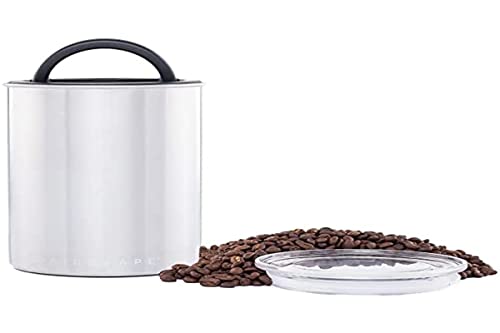
The Airscape solves the problem the rest of the category ignores. A sealed jar traps whatever air was inside when you closed it, and as the beans are used up the volume of trapped air grows — so a canister that was nearly airtight when full is sealing a large volume of oxygen against a small quantity of coffee by the end of the bag.
The inner plunger lid is pushed down onto the beans, forcing the air out through a one-way valve with an audible hiss, and then latched. The outer cap goes on over it. The headspace shrinks as the coffee does, which means the last few doses of a bag are stored about as well as the first. The hiss is more useful than it sounds: it is direct confirmation that air was there and has gone, which no sealed jar gives you.
The costs are handling and cleaning. Two lids is one more than most people want at seven in the morning, and the plunger gasket sits directly against the beans and picks up oil, so it needs washing periodically or the seal degrades. The stainless body is opaque, which is correct for light exclusion and inconvenient for knowing when to reorder. The medium size takes roughly a 1 lb bag, so a larger purchase means two canisters. Storing whole beans in it and [grinding to order](/best-coffee-grinders) remains far more important than the container itself.
The only common design that addresses oxygen as the coffee is used rather than only at the moment of closing.
Check price on Amazon →#2Best CO2 valve
Friis Coffee Vault Canister, 16 oz, Stainless Steel with CO2 Freshness Valve
Best for: People buying freshly roasted beans within days of the roast date
What we like
- One-way valve vents the CO2 that fresh coffee releases without letting oxygen back in
- The correct design for beans roasted within the last week or two, which are still degassing heavily
- Clamp lid with a proper gasket, opened and closed one-handed
- Opaque stainless body, and the interior wipes clean easily
- Includes a scoop and a date-tracking system, which is more useful than it sounds
What we don't
- Replacement valves are a recurring cost and are specified to be changed periodically
- Does nothing about the headspace problem — air volume grows as the coffee is used
- 16 oz is exactly one standard bag with no margin
- The valve is the failure point and cannot be inspected easily
- Costs more than sealed canisters of similar size
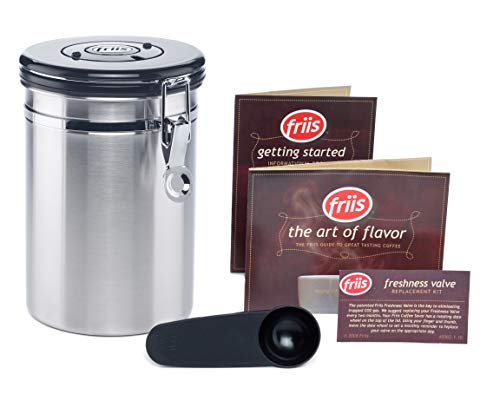
Freshly roasted coffee releases carbon dioxide for a week or more after roasting, which is why roasters ship in bags with a one-way valve. Seal that coffee into a rigid airtight container and the pressure builds — enough to distort a lid or to force it open on some designs. The Friis applies the roaster's solution: a one-way valve that lets CO2 out and admits nothing on the way back in.
That matters mainly if you buy from a roaster rather than a supermarket. Coffee that has been on a shelf for two months finished degassing long ago and gains nothing from a valve. Coffee bought four days off the roast is still actively outgassing, and the valve is the difference between a canister that works and one that becomes a pressure vessel. The date tracker on the lid is aimed at the same customer and is genuinely useful, because roast date is the number that matters and it is the one nobody remembers.
The honest limitation is that it addresses degassing but not headspace. Once the CO2 has vented, the canister still contains ordinary air, and that volume grows as the beans are used. The valve is also a consumable — Friis specify periodic replacement, which is a recurring cost and a component that can fail silently. At 16 oz it takes one standard bag exactly, with nothing spare.
The right answer for genuinely fresh coffee. The valve solves degassing; it does not solve headspace.
Check price on Amazon →#3Best glass
Prepara Evak Fresh Saver Airless Canister, Glass and Stainless Steel, Large
Best for: Kitchens where seeing the coffee level matters and the canister lives in a cupboard
What we like
- Twin-valve plunger forces air out on the way down and releases the vacuum on the way up
- Borosilicate glass body, so nothing porous or plastic touches the coffee
- One-handed operation — push down to close, pull up to open, with no separate lid
- Glass means you can see how much is left without breaking the seal
- Dishwasher safe apart from the valve assembly
What we don't
- Glass admits light, which is one of the four things that stale coffee
- Glass breaks, and the body is the expensive part
- The twin-valve mechanism is intricate and coffee oil in it will stop it sealing
- Narrower than it is tall, which makes scooping from the bottom awkward
- Costs considerably more than a plain glass jar of the same volume
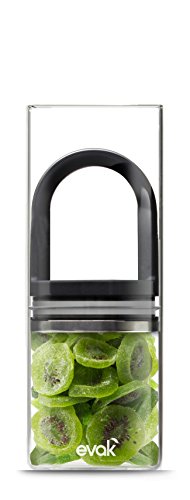
The Evak is the neatest of the air-removal designs. The lid is a plunger with two valves: pushing it down forces the air out past one, and pulling it up admits air through the other so it releases cleanly instead of fighting a vacuum. There is no separate lid to put somewhere, and the whole operation is one hand and one movement.
Like the Airscape, it addresses the headspace problem rather than merely sealing it in, and it does so with less handling. The borosilicate glass body is inert, easy to clean and lets you see the level, which sounds trivial until you have opened an opaque canister three times in a week to check whether you need to order more.
Glass is also the compromise. Light degrades coffee — not as fast as oxygen, but it is one of the four factors — so a glass canister needs to live in a cupboard rather than on a sunny counter, which partly defeats the point of being able to see into it. It breaks, and the body is the costly part. The valve assembly is intricate and coffee oil accumulating in it will eventually stop it sealing properly, so it wants periodic attention; the rest goes in a dishwasher. The shape is also taller than it is wide, which makes getting a scoop into the bottom of a nearly empty one more awkward than it should be.
The most elegant mechanism here and the fastest to use. Glass is the compromise you accept for it.
Check price on Amazon →#4Best for the counter
OXO Steel POP Coffee Storage Container with Scoop, Airtight Food Storage
Best for: Supermarket or older beans, and kitchens where the canister lives out on display
What we like
- Push-button lid seals with one hand and the button doubles as the handle
- Square footprint stacks and lines up efficiently — the reason people buy the whole range
- Includes a scoop that clips into the lid instead of living loose in the beans
- Steel-trimmed lid looks like kitchen equipment rather than storage
- Body is dishwasher safe and wipes clean easily
What we don't
- Seals air in rather than pushing it out, so headspace grows as the coffee is used
- No CO2 valve, so it is the wrong container for very freshly roasted beans
- Translucent body admits light
- The button mechanism has crevices that collect coffee oil and dust
- Only the body is dishwasher safe — the lid must be washed by hand
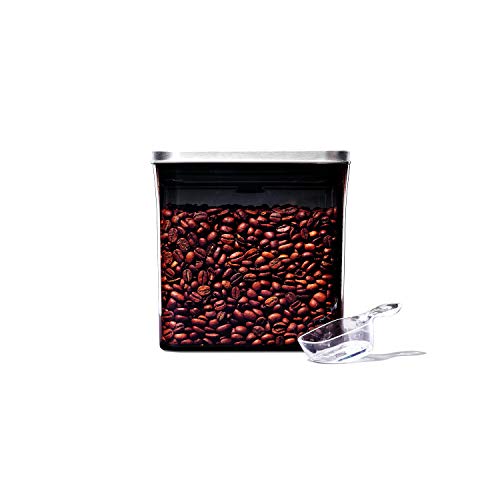
The POP lid is the best pure interaction on this page. One push of the button and it seals; push again and it releases, with the button rising to become the handle. There is no plunger to press, no clamp to unlatch and no second lid, and for a container opened twice a day that matters more than a spec sheet suggests.
The square footprint is the other reason these sell. Round canisters waste shelf space; POP containers line up and stack, which is why they tend to arrive in kitchens as a set rather than singly. The included scoop clips into the lid rather than being buried in the beans, and the steel-trimmed version is finished well enough to leave on a counter.
What it does not do is anything about oxygen beyond keeping more of it out. The seal is good — this is genuinely airtight, not merely closed — but the air already inside stays inside, and the proportion of air to coffee rises through the bag. There is no CO2 valve either, so beans within a few days of roasting will pressurise it. The body is translucent, which means keeping it out of direct sun. And the lid mechanism, like every push-button seal, has crevices that accumulate oil and needs hand washing while the body goes in the dishwasher.
A genuinely good airtight seal with the best day-to-day handling here. It does not address oxygen after closing.
Check price on Amazon →#5
OXO Good Grips POP Container, Airtight Food Storage, 2.4 Qt
Best for: Bulk supermarket coffee, a second canister, or anyone testing whether they care about this at all
What we like
- Same push-button airtight lid as the steel version at a much lower price
- 2.4 qt is large enough for a 2 lb bag, which most canisters here are not
- Fully transparent, so the level is obvious at a glance
- Body is dishwasher safe and the shape stacks with the rest of the range
- Cheap enough to buy two and keep one for decaf or a second roast
What we don't
- Plastic, which will pick up coffee oil and eventually hold a smell
- Clear body offers no light protection at all
- No air removal and no CO2 valve — it seals, and that is all it does
- The wide square shape leaves a lot of headspace once half used
- Lid hand wash only, like the rest of the POP range
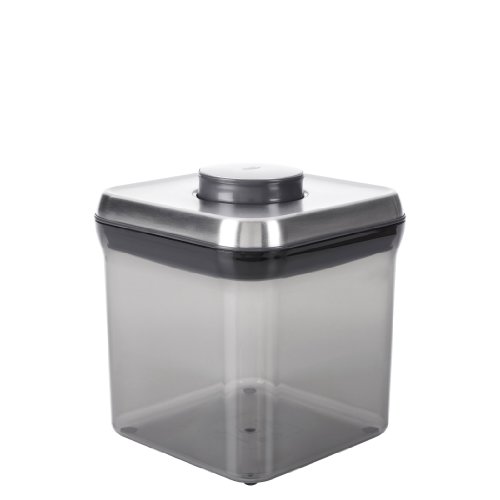
This is the standard POP container rather than the coffee-specific one, and for storing beans it does the same job the steel version does at a fraction of the price. The push-button lid is identical, the seal is genuinely airtight rather than merely closed, and the square body stacks with everything else in the range.
Capacity is the practical argument. At 2.4 qt it swallows a 2 lb bag comfortably, where most dedicated coffee canisters are sized around a single pound and force you into buying two. For anyone who buys supermarket coffee in larger bags, that is the difference between one container and a shelf of them.
The compromises are the ones you would expect at the price. It is plastic, and plastic in contact with coffee oil eventually takes on a smell that washing does not fully remove — a couple of years is a realistic life before it starts affecting the beans. It is completely transparent, so it must live in a cupboard rather than a windowsill. It does nothing about headspace, and a wide square container half full of beans is holding a lot of air. And, like all POP lids, the mechanism needs hand washing. As a first canister to find out whether storage makes a noticeable difference to your coffee, it is the sensible thing to buy — and if the answer is yes, the Airscape is the upgrade.
The seal is genuinely airtight and the price is a third of the alternatives. Everything else is a compromise.
Check price on Amazon →What a canister can and cannot do
Roasted coffee degrades from four things: oxygen, moisture, heat and light. A canister addresses two of them.
It cannot make old beans fresh, and it cannot stop the coffee getting older. If your coffee tastes flat, the roast date explains it far more often than the container does — and buying a smaller bag more often will improve your cup more than anything on this page.
What a good canister does is slow the decline between the day you open the bag and the day you finish it. That is a real benefit and a modest one.
Three designs, and they suit different coffee
The category looks like one product and is actually three.
Air removal — a plunger pushes the air out and the headspace shrinks as the beans are used. This is the only approach that stores the last of a bag as well as the first, because in a sealed jar the ratio of air to coffee climbs steadily as you work through it.
CO2 valve — a one-way valve lets the gas from freshly roasted beans escape without letting oxygen in. This matters specifically for coffee within a week or two of roasting, which is still outgassing and will pressurise a rigid sealed container.
Sealed — a good gasket and a positive closure, and nothing more. Perfectly adequate for supermarket coffee that finished degassing months ago.
Match the design to where your coffee comes from. A roaster subscription wants a valve or a plunger. A supermarket bag wants a seal.
Headspace is the problem nobody mentions
A canister that was nearly airtight when full is, by the end of the bag, sealing a large volume of oxygen against a small quantity of coffee.
This is why the air-removal designs exist and why a sealed jar is a partial solution. It is also the argument for buying smaller canisters than seems sensible: two containers holding a bulk purchase, one of them sealed and untouched, store it better than a single large one opened every morning.
Opaque beats attractive
Glass and clear plastic look better on a counter and let you see when to reorder. Both admit light, and light is one of the four things degrading the beans.
If you buy a clear canister, keep it in a cupboard — at which point the visibility you paid for is doing nothing. Opaque stainless in a cool dark cupboard is the correct answer, and checking the level occasionally is a small price.
Not the fridge, though. A fridge is humid, coffee absorbs moisture and smells readily, and taking a cold container in and out causes condensation on the beans.
Clean the mechanism, not just the body
Coffee oil accumulates in gaskets, valves and button assemblies. It goes rancid, it taints the beans, and eventually it stops the seal working.
Almost every lid here is hand wash only even when the body is dishwasher safe, and the parts that matter are the ones that are fiddly to reach. Treat plastic bodies as having a life measured in a few years — they absorb oil and eventually hold a smell that washing does not remove.
Store beans, not grounds
A canister slows a process that takes weeks in whole beans and hours in ground coffee.
Grinding multiplies the surface area exposed to oxygen enormously, and most of the aroma is gone within a few hours regardless of what the grounds are kept in. Storing ground coffee well is damage limitation; storing beans well is worthwhile.
Which makes this the same conclusion as most pages on this site: if the choice is between a better canister and a grinder that lets you grind to order, the grinder is not close.
Frequently asked questions
Does a coffee canister actually keep coffee fresher?
Yes, but less than the marketing implies and far less than buying fresher coffee does. A good airtight canister meaningfully slows oxidation compared with a folded-over bag or a jar with a loose lid, and an air-removal design does better still because it reduces the oxygen in contact with the beans as they are used. What no canister does is stop the coffee ageing. If your coffee tastes flat, the roast date is a more likely explanation than the container.
Should I store coffee in the fridge?
No. A fridge is humid, and coffee is hygroscopic — it absorbs moisture readily, along with the smell of everything else in there. Repeatedly taking a cold container in and out also causes condensation on the beans, which is worse for them than anything room temperature does. A sealed opaque canister in a cool, dark cupboard is the correct place, and a fridge is one of the few genuinely worse options.
Can I freeze coffee beans?
Freezing works, with conditions. It must be a proper freeze in a genuinely airtight container, divided into portions you will use in one go, and each portion must be brought fully to room temperature before opening — otherwise condensation forms on cold beans the moment the container is opened. Repeatedly freezing and thawing the same bag does more harm than leaving it in a cupboard. For coffee you will finish within a few weeks, freezing is not worth the handling.
What is the CO2 valve for?
Freshly roasted coffee releases carbon dioxide for a week or more after roasting. In a rigid airtight container that gas has nowhere to go, and the pressure can distort a lid or force a seal open. A one-way valve lets the CO2 out while admitting no oxygen, which is exactly what roasters' bags do. If you buy from a roaster and grind beans within days of the roast date, a valve is worth having; if your coffee comes from a supermarket shelf it finished degassing long ago and the valve does nothing.
How long do coffee beans stay good?
Whole beans are at their best from roughly three days to three or four weeks after roasting — they need a few days to degas, then decline gradually. Stored well, they remain perfectly pleasant for a couple of months and increasingly flat after that. Ground coffee is a different timescale entirely: the aromatics are largely gone within hours of grinding, which is why grinding to order changes a cup more than any storage decision does.
Should I store beans or ground coffee in a canister?
Beans, always. Grinding multiplies the surface area exposed to oxygen enormously, and ground coffee loses most of its aroma within hours no matter what it is kept in. A canister slows a process that takes weeks in whole beans and hours in ground ones, so it is doing far less useful work in the second case. If you must store ground coffee, use the smallest airtight container it fits in and accept a shorter window.
Is it better to leave coffee in the bag it came in?
A good roaster's bag with a one-way valve, resealed tightly and kept in the dark, is genuinely decent storage — better than a poor canister. The reasons to transfer are that most bag seals degrade with repeated opening, that supermarket bags frequently have no valve and no resealable closure at all, and that a bag cannot have its headspace reduced. If the bag has a working zip and a valve, it is a reasonable place to leave the coffee.
What size canister should I buy?
Match it to the bag you actually buy, and prefer too small over too large. A 12 oz or 1 lb canister suits most single bags. A large container holding a small amount of coffee is mostly holding air, which is the thing you are trying to avoid — so for a bulk purchase, two smaller canisters keeping one sealed and untouched will store it better than one big one you open daily.