Best Drip Coffee Makers
Almost every drip machine looks the same from the outside and almost none of them brew the same way. The differences that matter are invisible: whether the heater actually reaches brewing temperature or stalls twenty degrees short, and whether the water arrives across the whole coffee bed or dribbles through one hole in the middle. Those two things decide whether the machine extracts your coffee properly or produces the weak, flat cup that gives automatic drip its reputation. We compared these machines on measured brew temperature and Specialty Coffee Association certification, shower-head design and bed saturation, carafe type and how long the coffee survives in it, and long-term owner reports on the leaks and heater failures that end these machines early.
As an Amazon Associate, Cafe & Crema earns from qualifying purchases. This never affects the price you pay. How we make money.
| Rank | Product | Score | Best for | Link |
|---|---|---|---|---|
| #1 | Technivorm Moccamaster KBGV Select 10-Cup Coffee Maker, Matte BlackTop pick | 9.4 | Anyone who drinks drip coffee daily and wants the brewing itself to stop being the weak link | Check price → |
| #2 | Breville BDC400BSS Precision Brewer Drip Coffee Maker, Glass CarafeMost adjustable | 9.0 | People who want to change how the machine brews rather than accept one recipe | Check price → |
| #3 | OXO Brew 9-Cup Drip Coffee Maker, Programmable, Stainless SteelBest mid-range | 8.6 | The everyday machine for a household that wants certified brewing without Moccamaster money | Check price → |
| #4 | Cuisinart DCC-3200 PerfecTemp 14-Cup Programmable Coffeemaker, Stainless SteelBest for big batches | 7.8 | Households, offices and anywhere that needs a lot of coffee at once and cannot justify a specialty machine | Check price → |
| #5 | Braun BrewSense 12-Cup Drip Coffee Maker, Black, KF7150BK | 7.4 | A first machine, a second machine, or replacing something that died on a budget | Check price → |
#1 · Our PickTop pick
Technivorm Moccamaster KBGV Select 10-Cup Coffee Maker, Matte Black
Best for: Anyone who drinks drip coffee daily and wants the brewing itself to stop being the weak link
What we like
- Copper heating element reaches and holds proper brewing temperature, and the SCA certifies it
- Certified for both half and full carafes, which almost no other machine is
- Handmade in the Netherlands with metal housing and genuinely available replacement parts
- Brews a full 40oz carafe in four to six minutes rather than trickling for fifteen
- Independent hot-plate element holds the finished coffee without continuing to cook it as hard as most
What we don't
- Costs several times what a competent supermarket machine costs
- No programmable timer — you switch it on in the morning yourself
- The manual drip-stop on the basket is easy to leave in the wrong position and overflow
- Glass carafe on a hot plate still degrades coffee within about half an hour
- Tall enough that it does not fit under most wall cabinets
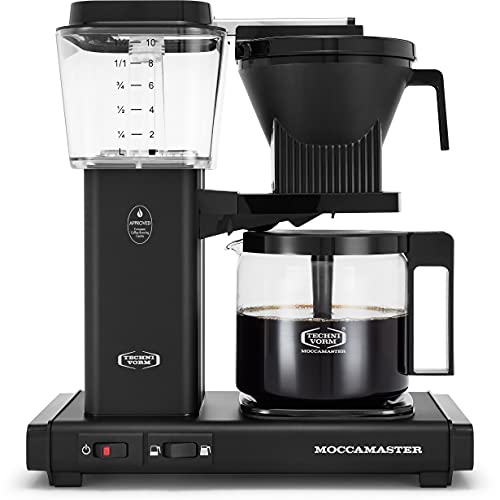
Moccamaster's reputation rests on doing one unglamorous thing properly: getting water to the right temperature and keeping it there. A copper boiling element heats water to the 92–96°C window the Specialty Coffee Association considers correct, and the machine holds it there through the whole brew rather than starting hot and fading. That is the difference between a machine that extracts your coffee and one that rinses it.
The KBGV Select adds the thing that catches most brewers out, which is half batches. Almost every drip machine is designed around a full carafe and quietly under-extracts when you brew four cups instead of ten, because the water passes through less coffee in less time. The selector switch changes both the brew speed and the hot-plate behaviour to suit, and it is the only widely available brewer certified for both amounts.
What you do not get is features. There is no clock, no timer, no app — you flip a switch. The drip-stop on the basket is manual, and leaving it closed with the carafe removed is a reliable way to flood your counter. The glass carafe sits on a hot plate, which is the machine's real compromise: even a gentle hot plate is still slowly cooking the coffee, so the last cup is never as good as the first. If that bothers you, the [thermal-carafe version](/best-thermal-carafe-brewers) solves it. What justifies the price is that this is a machine people keep for a decade, with parts you can actually buy.
The reference machine. Expensive, unsophisticated about features, and the only one here that has never been the reason a cup tasted bad.
Check price on Amazon →#2Most adjustable
Breville BDC400BSS Precision Brewer Drip Coffee Maker, Glass Carafe
Best for: People who want to change how the machine brews rather than accept one recipe
What we like
- PID temperature control lets you set the brew temperature rather than hoping
- Six modes including a genuinely usable cold-brew and iced setting
- My Brew mode exposes bloom time, flow rate and temperature as separate controls
- SCA certified in its Gold mode, so the defaults are not a compromise
- Works with both flat-bottom and cone filter baskets, which changes how it brews
What we don't
- The menu system is the most complex here and takes a while to stop consulting the manual
- More electronics than a Moccamaster means more that can eventually fail
- Cold brew mode ties the machine up for hours
- Bulky on a counter for its capacity
- Most owners settle on one mode and never touch the rest
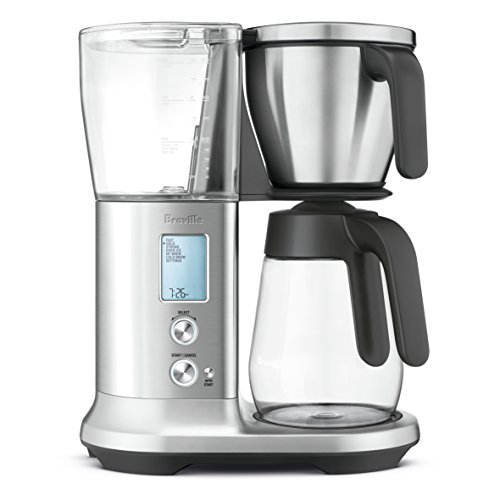
Most drip machines make every decision for you and hide them. The Precision Brewer does the opposite: bloom time, water temperature and flow rate are all exposed, so if a coffee is coming out sour you can raise the temperature or extend the bloom rather than guessing at the grind. That single quality is why it is the most interesting drip machine on the market for anyone who has already learned to taste the difference.
The defaults are not an afterthought. Gold mode is SCA certified, which means the out-of-the-box behaviour matches what the Moccamaster does automatically, and the machine will happily be used that way forever. Fast and Strong shift the balance in the obvious directions, iced brews concentrated over ice rather than just brewing hot and hoping, and the cold-brew mode genuinely works if you can spare the machine for the afternoon. Swapping between flat and cone baskets changes the shape of the bed and is a real adjustment rather than a packaging choice.
The cost is complexity. This is the one machine here where you will read the manual, and the one with the most electronics between you and hot water — which, over a decade, is also the most that can fail. It is also physically large. Most owners find one setting they like within the first month and never change it again, which is worth being honest about: if you know you are that person, the simpler machines above and below do the same job with fewer menus.
The machine for anyone who finds a single brew button frustrating. Its Gold mode is certified, and everything past that is yours to adjust.
Check price on Amazon →#3Best mid-range
OXO Brew 9-Cup Drip Coffee Maker, Programmable, Stainless Steel
Best for: The everyday machine for a household that wants certified brewing without Moccamaster money
What we like
- SCA certified, holding the brew between roughly 198 and 205°F
- Rainmaker shower head wets the whole bed instead of drilling one hole in it
- Double-wall thermal carafe with a mixing tube, so the last cup matches the first
- Single-cup and full-carafe modes that adjust the brew rather than just stopping early
- Programmable wake-up timer and a freshness indicator that shows how long ago it brewed
What we don't
- The single-dial interface is clever until you need to change two things at once
- Carafe lid is fiddly to clean thoroughly and traps residue if you rush it
- Owner reports of the heating element failing after a few years are not rare
- Louder than the simpler machines
- Nine cups is a modest capacity for a household of coffee drinkers
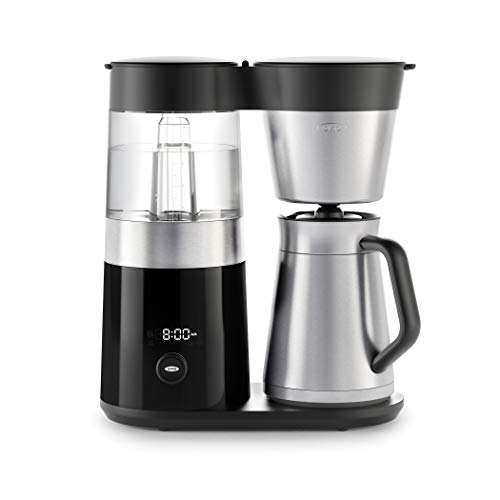
This is the machine that makes the strongest case on value, because it includes the two things that most affect the cup — a proper temperature range and a shower head that distributes water across the bed — plus the two things people actually use, which are a timer and a carafe that does not sit on a hot plate. The SCA certification is the shorthand for the first part; the rainmaker head is visible if you lift the lid mid-brew and watch it wet the whole surface rather than boring through the middle.
The thermal carafe matters more than the specification suggests. Coffee held on a hot plate is still being cooked and turns harsh within half an hour; in a double-wall carafe it simply cools slowly. OXO's internal mixing tube addresses the other thermal-carafe complaint, which is that the strong coffee brewed at the start and the weak coffee brewed at the end arrive in layers.
The irritations are real but small. The single-dial control is elegant until you want to change the time and the brew size in one go. The carafe lid has crevices that need attention. And the honest caveat is durability: owner reports of heater failure after a few years are common enough to notice, which is the gap between this and a Moccamaster that costs three times as much and lasts far longer than three times as long.
The sensible middle. Certified brewing, a thermal carafe and a timer, at a price that does not require thinking about it for a week.
Check price on Amazon →#4Best for big batches
Cuisinart DCC-3200 PerfecTemp 14-Cup Programmable Coffeemaker, Stainless Steel
Best for: Households, offices and anywhere that needs a lot of coffee at once and cannot justify a specialty machine
What we like
- Fourteen cups, which is genuinely more than most competitors will brew
- Brew-strength control that changes the flow rate rather than just the beep
- 1–4 cup setting that adjusts the brew for small batches instead of ignoring the problem
- Charcoal water filter built in, which helps a lot if your tap water is the limiting factor
- Cheap, widely stocked and easy to replace carafes and filters for
What we don't
- Not SCA certified, and the brew temperature is the usual mainstream compromise
- Glass carafe on a hot plate, so the coffee degrades quickly after brewing
- Owner reports of leaking from the base are the most common long-term complaint
- The permanent gold-tone filter lets through more sediment than paper
- Plastic construction under the stainless facing
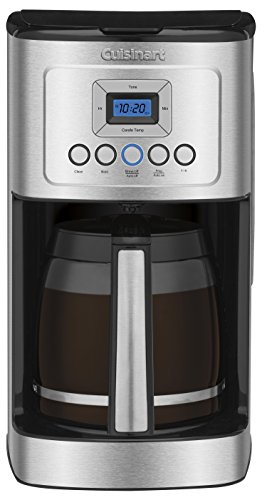
There is a specific job this machine does that none of the machines above it does: it makes fourteen cups at once, cheaply. If you are brewing for a household of four on a weekend morning or for a small office, that is the requirement, and specialty brewers with 40oz carafes simply do not meet it.
Within its class it is well specified. Brew-strength control genuinely alters how quickly water passes through the grounds rather than being a marketing switch, the 1–4 cup setting acknowledges the small-batch problem that most machines ignore, and the built-in charcoal filter is a real benefit if your tap water is heavily chlorinated — often a larger factor in a bad cup than anything the machine does.
What you are giving up is the two things at the top of this page. It is not certified, and it brews at the mainstream temperature that most machines settle on, which is a few degrees short of ideal and shows up as a slightly flat cup. And the glass carafe sits on a hot plate, so coffee that was acceptable at 7am is unpleasant by 8. The most common long-term owner complaint is leaking from the base after a couple of years. Buy it for capacity and price, and do not expect it to change how your coffee tastes.
The pragmatic choice for volume. It brews adequately rather than well, and it brews a lot.
Check price on Amazon →#5
Braun BrewSense 12-Cup Drip Coffee Maker, Black, KF7150BK
Best for: A first machine, a second machine, or replacing something that died on a budget
What we like
- Brews noticeably hotter than most machines at this price
- Twelve-cup capacity for the price of an eight-cup competitor
- Anti-drip system and a well-behaved carafe that pours without spilling
- Bold and regular strength settings that change the brew rather than the label
- Simple, legible controls and a 24-hour timer
What we don't
- Not SCA certified, and the shower head is a basic design
- Glass carafe on a hot plate again
- Plastic construction throughout and it feels it
- Owner reports of the carafe lid and basket hinge breaking with regular use
- Cleaning cycle is a prompt, not an automated process
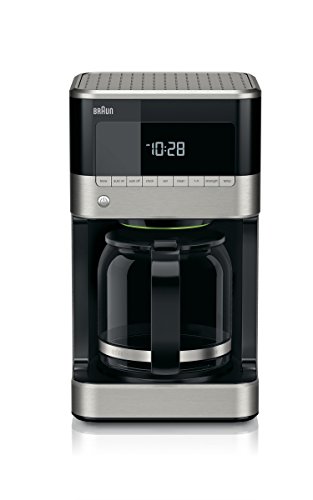
The useful question about a cheap drip machine is not whether it is as good as a Moccamaster but whether it is better than the machine beside it on the shelf, and the BrewSense is. The specific advantage is heat: it brews hotter than most machines in its price bracket, and since under-temperature brewing is the single most common failure of cheap drip machines, that is the right place for the money to have gone.
The rest is sensible rather than special. Twelve cups is generous, the strength settings do something, the carafe pours without dribbling down its own side, and the controls are the kind you understand without reading anything. For a great many people this is the whole requirement and the machines above are solving problems they do not have.
The limits are the usual ones for the price. There is no certification and no shower head worth the name, so bed saturation is uneven and the extraction is less consistent than the machines above. The glass carafe sits on a hot plate. It is plastic throughout, and the parts owners report breaking — the carafe lid, the basket hinge — are the plastic ones. Expect a few years rather than a decade, and if your coffee still disappoints after buying it, the [grinder](/best-coffee-grinders) is now the thing to fix.
The floor worth buying at. Hotter and better built than the supermarket machines beside it, without pretending to be a specialty brewer.
Check price on Amazon →Temperature is the whole argument
If you take one thing from this page, take this: the majority of inexpensive drip machines never get the water hot enough, and everything people dislike about automatic drip coffee follows from that. Under-temperature water extracts the sour, sharp compounds first and stops before it reaches the sweetness, so the cup tastes thin and acidic even at a generous dose.
Manufacturers almost never publish a real brew temperature, and the ones that do measure it at the boiler rather than at the coffee. This is why Specialty Coffee Association certification is worth paying attention to despite its limits — it is the only widely available signal that a machine was independently measured where it matters. What that certification does and does not cover is worth understanding properly, and we have set it out in full.
Look at the shower head
Lift the lid of a brewing machine and watch. A good one distributes water across the whole surface of the bed; a cheap one drips through a single hole in the centre and bores a channel straight down through the coffee.
The consequence is that half your dose is over-extracted and half is barely touched, and the two arrive in the same cup — bitter and sour simultaneously, which is the flavour people describe as simply “bad coffee”. No grind adjustment fixes it, because the problem is that different parts of the same bed are being brewed differently.
The hot plate is not storage
A hot plate is a heating element under a glass jug, and its effect on coffee is exactly what you would expect: it keeps brewing it. Volatile aromatics evaporate, bitter compounds continue to develop, and within about half an hour the coffee is noticeably harsher than what came out of the machine.
If you drink the pot immediately this does not matter. If two people work through it over an hour, it matters a great deal, and it is the strongest argument for a thermal carafe brewer even at some cost in convenience.
What a good machine cannot fix
A certified brewer at the correct temperature with perfect saturation will still make mediocre coffee from stale, badly ground beans. Drip is more forgiving than pour-over because the machine controls the variables you would otherwise control by hand, but it is not forgiving of the inputs.
The order of spending is the same as everywhere else on this site: fresh coffee first, a burr grinder second, the machine third. A basic brewer with a decent grinder beats a certified brewer with pre-ground coffee, reliably and by a wide margin.
Frequently asked questions
What does SCA certification actually test?
It tests the brewing itself: that water reaches the coffee within roughly 92–96°C, that contact time falls in the right window, that the bed is evenly saturated, and that the resulting brew lands inside the Golden Cup ranges for extraction yield and strength. It does not test build quality, durability, the carafe, or how pleasant the machine is to live with — a certified machine can still leak after two years. Treat it as proof that the brewing is right, not that the product is good.
Is an expensive drip machine actually worth it over a supermarket one?
It is worth it if your beans are good and your grinder is decent, and largely wasted otherwise. The expensive machine's advantage is correct temperature and even saturation, and those improve a cup that is already made from freshly ground, decent coffee. If you are brewing pre-ground supermarket coffee, the machine is not the limiting factor and a certified brewer will make a marginally better version of the same disappointing cup. Fix the coffee and the grinder first.
Glass carafe or thermal carafe?
Thermal, unless you pour the whole pot within about twenty minutes. A hot plate does not hold coffee, it continues to cook it, and the harsh, flat taste of coffee that has sat on a burner for an hour is a real and well-known phenomenon rather than fussiness. Thermal carafes trade that for a slightly awkward pour, more difficult cleaning, and the need to rinse them with hot water first so the carafe does not steal heat from the first cup.
Why does my drip coffee taste weak even at the right dose?
Three usual causes, in order of likelihood. The grind is too coarse, which is very common with pre-ground coffee sold for drip machines. The machine is not reaching brewing temperature, which is the standard failure of inexpensive brewers. Or the water is only touching part of the bed because the machine drips through a single point rather than showering the surface. Check the grind first because it is free to change, then consider whether the machine is the problem.
Do I need to descale, and how often?
Yes, and neglecting it is the most common reason a drip machine dies young. Scale coats the heating element, which makes the machine brew progressively cooler — so the cup degrades slowly enough that you blame the beans. Every one to three months depending on water hardness is the usual guidance, more often with hard water. If your machine has started brewing slowly or sounds louder than it did, scale is the first thing to check.
Does the paper filter matter?
It matters more than most people expect. A permanent gold-tone mesh filter lets oils and fine particles through, which gives a heavier body and more sediment; paper removes both and gives a cleaner cup. Neither is wrong, but if your coffee tastes muddy or leaves grit at the bottom, switching to paper is a one-dollar experiment. Bleached and unbleached filters taste the same once rinsed.