Best Thermal Carafe Brewers
A thermal carafe solves a specific problem: a hot plate does not store coffee, it keeps cooking it, and the cup you pour an hour after brewing is measurably harsher than the one you poured immediately. Swapping the glass jug for a vacuum-insulated one stops that — and introduces a new set of compromises around pouring, cleaning and heat loss that nobody mentions on the box. We compared these machines on brew temperature and Specialty Coffee Association certification, how well the carafe actually holds heat over two to four hours, whether it pours cleanly or dribbles, how easy it is to get a hand inside to clean, and long-term owner reports on the seals and heaters that decide how long these last.
As an Amazon Associate, Cafe & Crema earns from qualifying purchases. This never affects the price you pay. How we make money.
| Rank | Product | Score | Best for | Link |
|---|---|---|---|---|
| #1 | Bonavita 8 Cup Coffee Maker, One-Touch Pour Over Brewing with Thermal Carafe, SCA Certified, Stainless Steel (BV1900TS)Top pick | 9.2 | Anyone who wants certified brewing and a thermal carafe with no features attached and no premium paid for them | Check price → |
| #2 | Technivorm Moccamaster 79314 KBGT Thermal Carafe 10-Cup Coffee Maker, BlackBest built | 9.0 | Buying one drip machine and not thinking about drip machines again for a decade | Check price → |
| #3 | Breville BDC450BSS Precision Brewer Thermal Carafe, Brushed Stainless SteelMost adjustable | 8.6 | People who want to change the brew rather than accept one recipe, in a machine that also holds heat | Check price → |
| #4 | Zojirushi EC-YTC100XB 10-Cup Coffee Maker, Stainless Steel/BlackBest heat retention | 8.0 | Households where the pot is drunk gradually over three or four hours | Check price → |
| #5 | OXO Brew 8-Cup Coffee Maker, Single-Serve, Thermal Carafe, Stainless SteelBest for one or two | 7.6 | One or two people who sometimes want a mug and sometimes want a pot | Check price → |
#1 · Our PickTop pick
Bonavita 8 Cup Coffee Maker, One-Touch Pour Over Brewing with Thermal Carafe, SCA Certified, Stainless Steel (BV1900TS)
Best for: Anyone who wants certified brewing and a thermal carafe with no features attached and no premium paid for them
What we like
- SCA certified, with a 1500-watt heater that holds the 195–205°F window through the brew
- Pre-infusion mode wets the grounds and pauses, which almost no machine at this price does
- Genuinely one button — there is nothing to program and nothing to misconfigure
- Wide shower head saturates the whole bed rather than drilling through the middle
- Stainless-lined carafe holds heat well and does not impart a metallic taste
What we don't
- No timer at all, so it cannot have coffee waiting when you wake up
- The carafe lid must be seated exactly right or it drips down the side when pouring
- Eight cups is the whole capacity — there is no larger version of this machine
- Owner reports of heater failure after several years are common enough to plan for
- Utilitarian to the point of looking unfinished next to the Moccamaster
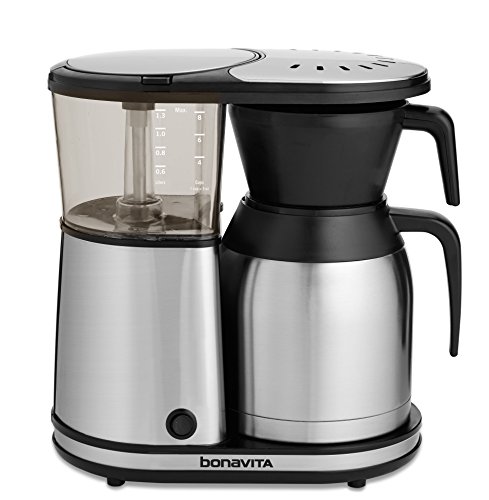
The BV1900TS has been the value recommendation in automatic drip for a decade, and the reason is that Bonavita spent the budget on the two things that change the cup and nothing else. A 1500-watt heater gets water into the correct range and holds it there, which is what the SCA certification attests to. A wide shower head puts that water across the whole bed. There is one button.
The pre-infusion mode is the feature worth knowing about. It wets the grounds and pauses before the main brew, which lets the carbon dioxide in fresh coffee escape rather than pushing water away from the bed — the same bloom that hand-pour recipes build in deliberately. Very few automatic machines at any price do this, and it is the clearest sign that the machine was designed by people who brew coffee.
The compromises are all convenience. There is no clock and no timer, so the machine cannot have coffee ready before you get to the kitchen — for some people that alone rules it out. The carafe lid needs to be seated correctly or it dribbles when you pour, which is a daily irritation rather than a fault. And it is only ever eight cups. The long-term concern is the heater: enough owners report failure after several years that it should factor into the price comparison against machines that cost considerably more and last considerably longer.
The best coffee per dollar in automatic drip. It brews properly, it holds properly, and it does absolutely nothing else.
Check price on Amazon →#2Best built
Technivorm Moccamaster 79314 KBGT Thermal Carafe 10-Cup Coffee Maker, Black
Best for: Buying one drip machine and not thinking about drip machines again for a decade
What we like
- Copper heating element that holds proper brewing temperature for the whole cycle
- Metal housing, hand-assembled, with replacement parts genuinely available years later
- Brews a full 40oz carafe in about six minutes rather than trickling
- Automatic drip-stop that halts the flow when the carafe is removed
- The machine most likely of these to still be working in ten years
What we don't
- Costs roughly three times the Bonavita for a similar cup
- No timer, same as the glass-carafe Moccamaster
- The carafe is good rather than exceptional at holding heat past two hours
- Tall enough not to fit under many wall cabinets
- Pouring requires a firm, deliberate tilt that takes a few days to get used to
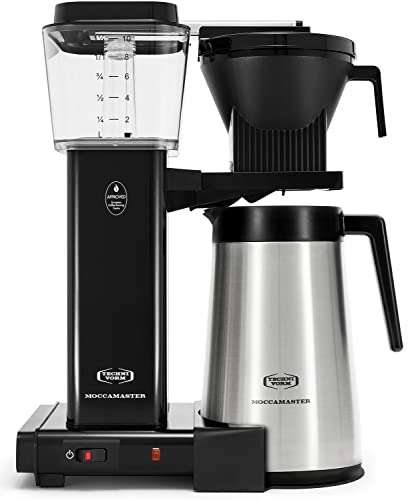
This is the thermal version of the machine that defines the category, and the case for it is not that it brews better than the Bonavita — the cups are very close — but that it is built to a completely different standard. Copper heating element, metal housing, hand assembly in the Netherlands, and a parts supply that means a failed component is a repair rather than a replacement machine. Over ten years that maths works out differently than the sticker price suggests.
Brewing is Moccamaster's usual: water into the correct window and held there, a full 40oz carafe in around six minutes, and no drama. The thermal version drops the hot plate entirely, which removes the glass Moccamaster's one real compromise. The drip-stop here is automatic rather than the manual slider on some models, which removes a genuine flooding hazard.
Where it is merely good rather than outstanding is heat retention. The carafe holds coffee comfortably hot for a couple of hours and then fades faster than the Zojirushi below, which is the specialist at exactly that. And, as with every Moccamaster, there is no timer — you switch it on. If a machine waiting for you at 6:45am is part of the requirement, this is the wrong machine regardless of how well it is made.
The durability argument, made in metal. It brews as well as the Bonavita and will outlive several of them.
Check price on Amazon →#3Most adjustable
Breville BDC450BSS Precision Brewer Thermal Carafe, Brushed Stainless Steel
Best for: People who want to change the brew rather than accept one recipe, in a machine that also holds heat
What we like
- PID temperature control with a temperature you actually set
- Six modes covering Gold, Fast, Strong, Iced, Cold Brew and a fully manual My Brew
- SCA certified in Gold mode, so the default is not a compromise
- 60oz capacity, larger than most thermal brewers
- Accepts both flat-bottom and cone baskets, which meaningfully changes the brew
What we don't
- The most complicated machine here to learn and the only one needing the manual
- More electronics than anything else on this page, and more to fail eventually
- Large footprint even by thermal-brewer standards
- Cold-brew mode occupies the machine for hours
- Most owners use one mode forever and pay for five they never touch
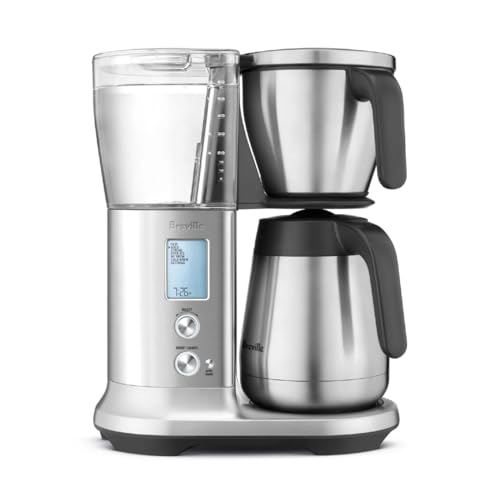
The Precision Brewer's argument is that every other machine on this page makes its decisions invisibly. Here the bloom time, water temperature and flow rate are exposed as separate controls, so a brew that comes out sour can be corrected by raising the temperature or lengthening the bloom rather than by guessing at the grind. For anyone who has learned to taste the difference between under- and over-extraction, that is the most useful feature in automatic drip.
The defaults are properly done. Gold mode is SCA certified, which means the machine used as a one-button brewer performs at the level of the two above it. Strong and Fast shift the balance predictably, Iced brews concentrated to survive dilution rather than brewing hot and hoping, and cold brew genuinely works if the machine can be spared. The 60oz capacity is larger than most thermal machines manage, and swapping between flat and cone baskets is a real change to the shape of the bed rather than a packaging choice.
The honest caveat is who this is for. It has the most electronics of anything here, which over a decade is the most that can fail, and it is physically large. Most owners settle on one mode within a month. If you suspect you are that person, the Bonavita brews the same quality of coffee with one button and considerably less money.
Adjustability plus a thermal carafe. If you will genuinely use the controls it is the most capable machine here; if not, you are paying for menus.
Check price on Amazon →#4Best heat retention
Zojirushi EC-YTC100XB 10-Cup Coffee Maker, Stainless Steel/Black
Best for: Households where the pot is drunk gradually over three or four hours
What we like
- Vacuum-insulated carafe that outlasts every other carafe here by a wide margin
- Brews around 200°F, which is inside the correct window even without certification
- Thumb-activated pour and a tapered carafe that pours cleanly one-handed
- Concentrated brew setting for iced coffee that survives dilution
- Zojirushi's build quality and long-term reliability record are excellent
What we don't
- Not SCA certified, so the brewing is good by specification rather than by verification
- The shower head is a simpler design than the certified machines above
- Carafe opening is narrow, which makes thorough cleaning awkward
- Controls are dated and the display is small
- Coffee stays hot for so long that the temptation is to drink it far past its best
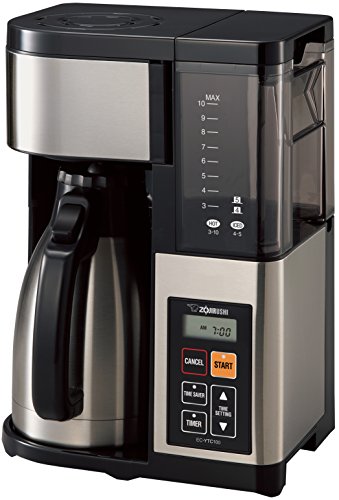
Zojirushi builds vacuum flasks for a living, and this is a drip machine attached to one of them. The practical difference is not subtle: where most thermal carafes are comfortably hot for two hours and lukewarm by three, this one is still properly hot well past that. If your household works through a pot slowly, that single quality outweighs most of what the machines above it do better.
The brewing is good rather than certified. Around 200°F is inside the range the SCA looks for, and Zojirushi's specification is credible given the company's record, but the machine has not been independently tested and the shower head is a simpler design than OXO's or Bonavita's. In practice it makes clean, decent coffee that is a step below the certified machines and well above the supermarket ones. The concentrated setting for iced coffee is properly thought through — it brews stronger so that melting ice does not leave you with brown water.
The irritations are physical. The carafe opening is narrow, so cleaning it properly means a bottle brush and patience, and residual coffee oils in a carafe will taint everything brewed into it afterwards. The controls look like they were designed in 2005. And there is a mild irony worth naming: coffee this well insulated is still four hours old at eleven o'clock, and heat is not freshness.
The carafe specialist. If keeping coffee genuinely hot until mid-morning is the requirement, nothing else here comes close.
Check price on Amazon →#5Best for one or two
OXO Brew 8-Cup Coffee Maker, Single-Serve, Thermal Carafe, Stainless Steel
Best for: One or two people who sometimes want a mug and sometimes want a pot
What we like
- SCA certified, holding roughly 198–205°F across both brew sizes
- Brews anything from a 10oz single cup to a 40oz carafe without under-extracting the small ones
- Rainmaker shower head wets the whole bed
- Compact enough for a small kitchen, unlike most thermal machines
- Single-serve mode brews straight into a mug, so nothing is wasted
What we don't
- Small-batch flexibility comes at the cost of a smaller maximum capacity
- The single-dial interface is elegant until you want to change two settings
- Carafe lid has crevices that need proper cleaning
- Heater failure after a few years appears in owner reports as it does for OXO's 9-cup
- Costs more per cup of capacity than anything else here
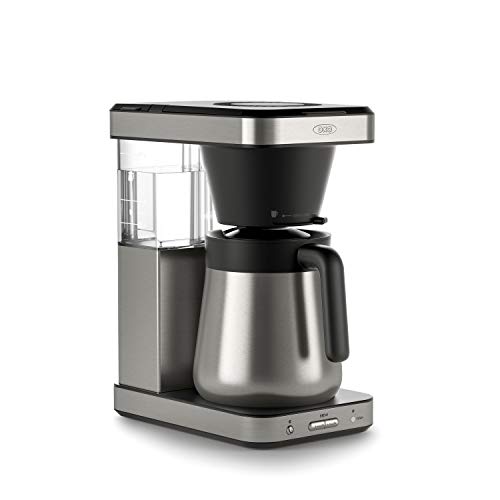
Almost every drip machine is designed around a full carafe and quietly under-extracts when you ask for less, because the same water passes through less coffee in less time. This is the problem most people actually have — the ten-cup machine used for three cups most mornings — and it is the problem this machine is built around. It brews certified at 10oz and certified at 40oz, which is a genuinely uncommon claim.
The single-serve mode brews straight into a mug rather than into a carafe you then decant from, which removes the waste and the washing-up from the common case. When you do want a pot, the thermal carafe is the same double-wall design as OXO's larger machine, with the mixing tube that stops the strong first runnings and the weak last ones arriving in layers. The rainmaker head does the distribution job properly.
The trade is capacity and price. Forty ounces is the ceiling, which is fine for two and tight for three, and per cup of capacity this is the most expensive machine on the page. The single-dial control is clever right up to the moment you want to set the time and the size together. And the durability question that hangs over OXO's 9-cup hangs over this one too — enough heater failures appear in long-term owner reports that it is worth weighing against a Moccamaster that costs more and lasts longer.
The machine that handles small batches honestly. Certified brewing at any volume, in the smallest thermal brewer worth owning.
Check price on Amazon →What the hot plate was doing to your coffee
A glass carafe sits on a heating element, and that element does not preserve coffee — it keeps brewing it. Aromatic compounds evaporate, bitter ones continue to develop, and the change is fast enough to notice: coffee that was good at 7:00 is noticeably harsh by 7:45.
This is the entire case for a thermal carafe. It does not make the coffee better; it stops the machine from making it worse. If you pour the whole pot within a few minutes, a glass carafe costs you nothing and the glass-carafe machines are cheaper and easier to clean. If two people work through a pot across a morning, the difference is large.
Preheat the carafe
This is the step no manual emphasises and it changes more than most specifications on the box. An empty stainless carafe at room temperature is a substantial lump of cold metal, and the first coffee into it spends its heat warming that metal rather than staying hot.
Fill it with hot tap water while the machine heats up, then empty it just before the brew starts. It takes ten seconds and it is the difference between a carafe that holds coffee for four hours and one that holds it for two.
Vacuum insulation, stainless lining, wide opening
Three things separate a good thermal carafe from a bad one, and only the first appears in marketing.
Vacuum insulation rather than a simple double wall. The gap between the two is the difference between four hours and ninety minutes.
A stainless interior rather than plastic. Plastic absorbs coffee oil, the oil goes rancid, and after a year everything you brew tastes faintly of everything you brewed before.
An opening you can get a hand into. A carafe you cannot clean properly will eventually ruin good coffee, and the narrow necks that help with heat retention are exactly the ones that make this hard. This is a genuine trade-off rather than a design failure, and it is worth deciding which side of it you want.
The carafe does not make the coffee
It is easy to shop this category on the carafe alone and end up with a machine that keeps mediocre coffee at a perfect temperature. The brewing tests are the same as for any other machine: does the water reach 92–96°C at the bed, and does it arrive across the whole surface instead of through one hole in the middle?
Three of the five machines here are Specialty Coffee Association certified, which is the practical shortcut for both questions — and what that certification does and does not cover is worth reading before you treat it as a guarantee of quality generally.
Hot is not fresh
A carafe good enough to hold coffee at drinking temperature until eleven o’clock creates a small trap: coffee that is still hot at eleven is still four hours old. Insulation slows cooling; it does not slow staling, and the aromatics that make fresh coffee taste alive are gone long before the temperature falls.
Brew a smaller pot more often if you can. And if the coffee still disappoints when it is fresh and hot, the machine was never the limiting factor — a burr grinder is where the next real improvement lives.
Frequently asked questions
Is a thermal carafe actually better than a glass one?
For anything other than pouring the whole pot immediately, yes. A hot plate is a heating element under a glass jug and it does not hold coffee so much as continue to brew it — aromatics evaporate, bitterness develops, and within about half an hour the difference is easy to taste. A thermal carafe simply lets the coffee cool slowly instead. The costs are a slightly more awkward pour, harder cleaning, and the need to preheat.
How long will coffee actually stay hot in a thermal carafe?
A good vacuum-insulated stainless carafe keeps coffee properly hot for two to four hours, and the spread between models is wide — the Zojirushi on this page is noticeably better than the rest, and cheap double-walled carafes fade within ninety minutes. Preheating with hot water before brewing adds a meaningful amount to any of them, because an empty steel carafe at room temperature absorbs a surprising amount of heat from the first coffee that hits it.
Do I need to preheat the carafe?
Yes, and it is the most useful habit on this page. Fill the carafe with hot tap water while the machine warms up, then empty it just before brewing. Skipping it means the first part of your brew is spent heating a lump of cold steel, which both cools the coffee and, on some machines, is enough to make the first cup taste noticeably flatter than it should.
Why does my thermal carafe make coffee taste stale or metallic?
Almost always residual coffee oil rather than the metal itself. Narrow-necked carafes are difficult to clean properly, oils build up in the film you cannot reach and go rancid, and everything brewed afterwards picks it up. A bottle brush, hot water and a periodic soak with a proper coffee-equipment cleaner fix it. If a carafe has a plastic interior rather than stainless, the same problem is worse and harder to reverse.
Can I use a thermal carafe brewer for a single cup?
You can, but most machines will under-extract it — a full-carafe brewer sends the same amount of water through much less coffee in much less time, so the result is weak and often sour. Some machines adjust for it explicitly: the OXO on this page brews certified at both 10oz and 40oz, and Moccamaster's KBGV Select does the same for half carafes. If small batches are your normal case, buy for that rather than assuming a large machine will scale down.
Are these machines harder to descale than glass-carafe ones?
The machine itself is the same — scale forms on the heating element regardless of what the coffee lands in, and neglecting it makes the machine brew progressively cooler until you blame the beans. The carafe is the extra job: mineral deposits and coffee oils both build up inside it, and the narrow openings that make thermal carafes hold heat also make them awkward to reach. Descale the machine every one to three months depending on water hardness, and clean the carafe far more often than that.