Best Manual Hand Grinders
Manual grinders trade motorized convenience for a simpler grinding system, which can make them attractive when portability, noise, counter space or fine adjustment matter more than throughput. The five grinders here cover very different jobs: the TIMEMORE C3 is the general-purpose starting point, the 1Zpresso J-Ultra is built around espresso adjustment, the Porlex entry is a legacy travel listing that requires model-generation checking, and the two HARIO grinders prioritize batch capacity or compact simplicity. Cafe & Crema's assessment is based on manufacturer documentation, serviceability information, and current market positioning; Cafe & Crema has not performed first-party testing of these five products.
| Rank | Product | Cafe & Crema Score | Best for | Link |
|---|---|---|---|---|
| #1 | TIMEMORE Chestnut C3 Manual Coffee GrinderTop pick | 9/10 | A first serious manual grinder for single-cup filter brewing with occasional espresso use | Check price → |
| #2 | 1Zpresso J-Ultra Manual Coffee GrinderBest for espresso | 9/10 | Espresso drinkers who specifically want very fine manual adjustment without an electric motor | Check price → |
| #3 | Porlex Mini Stainless Steel Coffee GrinderLegacy travel pick | 9/10 | Travel-focused buyers who confirm the exact Porlex generation before purchase | Check price → |
| #4 | Hario Skerton Pro Ceramic Manual Coffee GrinderBest for large batches | 8/10 | French press and batch filter brewing where a 100g grounds capacity is more useful than pocketable size | Check price → |
| #5 | Hario Mini-Slim Pro Ceramic Coffee MillCompact HARIO pick | 8/10 | Single-cup brewers who want HARIO's slim manual format with a stainless outer body | Check price → |
#1 · Our PickTop pick
TIMEMORE Chestnut C3 Manual Coffee Grinder
Best for: A first serious manual grinder for single-cup filter brewing with occasional espresso use
What we like
- 38mm CNC-machined S2C660 stainless-steel conical burrs
- TIMEMORE documents dual-bearing stability around the burr set
- Standard C3 capacity is 20 g, enough for many single-cup recipes
- Internal adjustment spans espresso through French press in the current C3 family
- TIMEMORE also offers ESP variants with a finer adjustment dial for espresso
What we don't
- Adjustment is internal rather than an external numbered ring
- Standard C3 capacity is 20 g; 30 g belongs to Max variants, not the base C3
- The classic C3 dial is coarser than TIMEMORE's ESP dial
- Switching frequently between distant brew settings requires keeping track of clicks
- A manual grinder still trades throughput for hand-cranking and compactness
TIMEMORE's current C3-series documentation gives the base grinder a 38mm S2C660 stainless-steel conical burr set and dual-bearing stability. The standard C3 uses an internal classic dial rated at 0.0833 mm per click, while C3 ESP variants use a finer 0.0233 mm per-click dial. That distinction matters: the family can reach espresso, but the ESP versions are the ones specifically given finer control for dialing it in.
Capacity is another point worth correcting. TIMEMORE lists **20 g for the standard C3 family** and 30 g for Max variants. Older copy on this page said 25g, which mixed generations and capacities. For a single filter cup, 20 g is workable; larger batch recipes may require a second load.
Choose the C3 when you want a compact general-purpose hand grinder and do not need the external espresso-focused adjustment of the J-Ultra. If espresso is the main job, compare this category with the [best espresso grinders](/best-espresso-grinders/) before deciding whether daily hand grinding is the workflow you want.
The strongest all-round starting point here because the current C3 combines 38mm stainless burrs, dual-bearing support and broad brew-range adjustment without pretending the base model has the finer ESP dial.
Check price on Amazon →#2Best for espresso
1Zpresso J-Ultra Manual Coffee Grinder
Best for: Espresso drinkers who specifically want very fine manual adjustment without an electric motor
What we like
- External adjustment with 8-micron movement per click
- 48mm coated burr set designed around espresso
- 35–40g grounds capacity
- Magnetic catch cup
- Tool-free routine disassembly with manufacturer cleaning guidance
What we don't
- Espresso fineness still means hand-cranking every dose
- External precision is unnecessary for buyers who only need broad filter settings
- Larger and more specialized than a compact travel grinder
- Manufacturer says not to wash the grinder with water
- More adjustment range means more settings to record when switching repeatedly between brew methods
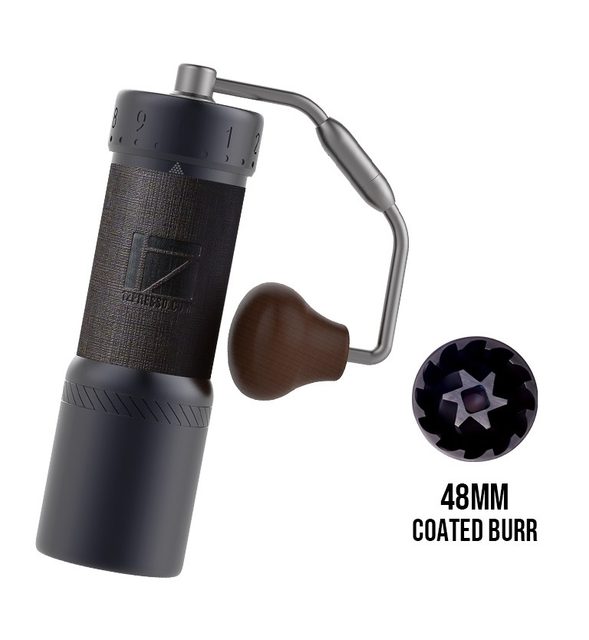
1Zpresso documents the J-Ultra at **8 microns of burr movement per click** with an external adjustment system and a 48mm coated burr set designed around espresso. Its current comparison page lists 35–40g capacity and a magnetic catch cup. Those are the features that separate it from the C3 more meaningfully than broad claims about one grinder being 'better.'
The external scale is especially useful when espresso is the main job because small changes can be made and revisited without counting from a hidden internal reference. The cost is workflow rather than a hidden specification: every espresso dose still has to be ground by hand. If you make several milk drinks back to back, an electric grinder can be the more practical system even when the J-Ultra offers excellent adjustment resolution.
Maintenance also has a clear boundary. 1Zpresso's J-Ultra manual says **do not clean the grinder with water** and recommends a brush and blower after disassembly. That is more precise guidance than treating every manual grinder as safely rinseable.
The espresso specialist here: 8-micron clicks, an external dial, 48mm coated burrs and a 35–40g magnetic catch cup make the workflow far more deliberate than a basic internal-click grinder.
Check price on Amazon →#3Legacy travel pick
Porlex Mini Stainless Steel Coffee Grinder
Best for: Travel-focused buyers who confirm the exact Porlex generation before purchase
What we like
- Compact cylindrical travel format associated with the Porlex Mini line
- Ceramic-burr architecture
- Porlex still documents replacement outer-burr compatibility across Mini I and Mini II
- Current Mini II successor retains the slim AeroPress-compatible concept
- Useful when portability matters more than large dose capacity
What we don't
- This ranked ASIN is a legacy Porlex Mini listing; current official specifications belong to the Mini II successor
- Do not assume the Mini II's approximately 37-micron click spacing applies to the older Mini
- Generation should be confirmed before ordering replacement parts
- Small-format hand grinding is slower for larger doses
- Current Porlex support and warranty terms depend on authorized-retailer status
Porlex currently sells the **Mini Grinder II**, while the Amazon ASIN preserved on this page is an older Mini listing. That distinction is important enough to state plainly. Cafe & Crema is not applying the Mini II's current 20g capacity, approximately 37-micron click spacing or redesigned-burr claims to the older ASIN as though they were the same product.
What the current Porlex documentation does support is continuity of the product family and some service parts. Porlex's replacement Outer Burr II page says the part fits Mini I and Mini II grinders, while the current Mini II retains the slim format that fits inside an AeroPress.
Keep this pick only if the specific listing and generation match what you intend to buy. For a new purchase where current published specifications matter, the Mini II is the current manufacturer-documented successor; for the legacy ASIN here, treat marketplace details as model-specific rather than borrowing newer specifications.
A legacy travel option rather than a current-spec benchmark; the Porlex format remains serviceable, but the older Mini listing should not inherit Mini II specifications without verification.
Check price on Amazon →#4Best for large batches
Hario Skerton Pro Ceramic Manual Coffee Grinder
Best for: French press and batch filter brewing where a 100g grounds capacity is more useful than pocketable size
What we like
- HARIO lists a 100g coffee-grounds capacity
- Ceramic burrs
- Wide borosilicate-glass bowl
- Aluminum handle
- HARIO describes the Pro as updated from the original Skerton to make adjustment easier and grinding more consistent
What we don't
- 100g capacity also means a larger grinder to store and travel with
- Glass bowl requires more care than an all-metal catch cup
- Adjustment is not an external numbered espresso-focused ring
- Ceramic-burr workflow is slower than a small high-speed steel-burr grinder in many uses
- Not the specialized choice for espresso dialing
HARIO's current Skerton Pro page documents a **100g coffee-grounds capacity**, ceramic burrs, an aluminum handle and a borosilicate-glass bowl. That large capacity is the practical reason it belongs in this list: most compact hand grinders are built around one-cup doses.
The manufacturer also describes the Pro as an upgrade from the original Skerton, primarily with the goal of easier adjustment and more consistent grinding. Cafe & Crema does not turn that manufacturer positioning into an unsupported claim about a specific internal stabilizer or measured particle distribution.
Choose the Skerton Pro when batch size is the constraint. If one-cup grind control matters more than capacity, the smaller C3 is the more focused all-round workflow.
The batch-capacity specialist: HARIO documents 100g capacity and a Pro revision aimed at easier adjustment and more consistent grinding.
Check price on Amazon →#5Compact HARIO pick
Hario Mini-Slim Pro Ceramic Coffee Mill
Best for: Single-cup brewers who want HARIO's slim manual format with a stainless outer body
What we like
- 24g coffee-grounds capacity
- Ceramic burrs
- Stainless-steel outer hopper and bottle
- Cast-aluminum handle
- Slim portable format
What we don't
- 24g capacity is oriented toward one-cup brewing
- Inner hopper still uses polypropylene
- Adjustment is not an external numbered precision ring
- Not designed around the fine adjustment resolution of an espresso specialist
- Compact manual format trades throughput for storage and portability
The current Mini-Slim Pro is materially different from the old description on this page. HARIO lists a **24g capacity**, ceramic burrs, a cast-aluminum handle, and stainless steel for the outer hopper and bottle. The inner hopper is polypropylene. Describing the whole grinder as 'plastic and glass construction' was therefore inaccurate.
Its case is straightforward: compact size and a single-cup capacity. It does not offer the external 8-micron espresso adjustment of the J-Ultra or the 100g batch capacity of the Skerton Pro.
Choose it when storage and portability are the priority within HARIO's current manual lineup. If you are buying mainly on grind-adjustment control, compare it with the C3 and the broader [best budget grinders under $150 guide](/best-budget-grinders-under-150/) before deciding.
A compact 24g grinder with ceramic burrs and a stainless outer body; a better description than the old copy that incorrectly called the Pro a plastic-and-glass grinder.
Check price on Amazon →Choose the workload before the burr material
Manual grinders make the most sense when the number of doses is small enough that hand cranking remains a feature rather than a chore.
For one filter cup, a 20–24g grinder can be completely practical. For a large French press, HARIO’s 100g Skerton Pro capacity changes the workflow more than a fine distinction between two burr materials. For espresso, adjustment resolution matters far more: the 1Zpresso J-Ultra is built around 8-micron clicks, while TIMEMORE reserves a finer adjustment dial for C3 ESP variants.
That is why this list contains several very different grinders rather than one universal winner for every brew method.
Current C3 capacity is 20 g, not 25 g
TIMEMORE’s current C3-series page separates standard and Max capacities clearly. The base C3, C3 Pro, C3 ESP and related standard-body models are listed at 20 g. Max versions are listed at 30 g.
The same documentation lists 38mm S2C660 stainless-steel burrs and dual-bearing stability across the family. It also separates the classic internal dial from the finer ESP dial, which is the meaningful distinction for someone shopping specifically for espresso.
If you want a compact general-purpose manual grinder, the base C3 is still the all-round pick here. If your priority is dialing espresso, do not treat the standard C3 and C3 ESP as identical adjustment systems.
J-Ultra is the espresso-specific workflow
1Zpresso positions the J-Ultra around espresso rather than generic brew-method coverage. The manufacturer documents an external adjustment ring, 8-micron movement per click, a 48mm coated burr set and a 35–40g catch cup.
That combination solves two practical espresso problems: making a very small adjustment and returning to a prior setting without counting from an internal dial. It does not remove the physical work of grinding fine coffee by hand.
For a household pulling several shots in succession, compare the J-Ultra with an electric option in the best espresso grinders guide. For one or two shots where noise and counter space matter, the manual workflow can still make sense.
Porlex needs generation-level checking
The Porlex listing in this roundup is older than the product Porlex currently documents.
The current successor is the Mini II, which Porlex describes with redesigned ceramic burrs, approximately 37-micron adjustment per click, an AeroPress-compatible body and about 20g capacity. Those figures belong to the Mini II; they are not silently transferred to the older Mini ASIN on this page.
There is still service continuity in the family: Porlex currently sells an Outer Burr II that it says fits both Mini I and Mini II. But before buying the legacy listing, confirm which generation the seller is actually shipping.
HARIO splits compact and batch use
HARIO’s current manual range makes the capacity trade-off unusually clear.
The Skerton Pro is listed at 100g of coffee grounds and uses a borosilicate-glass bowl. HARIO describes it as updated from the original Skerton with easier adjustment and more consistent grinding as design goals.
The Mini-Slim Pro is listed at 24g and uses a stainless-steel outer hopper and bottle with a cast-aluminum handle. Its inner hopper is polypropylene. That corrects the older version of this guide, which inaccurately described the Pro as a plastic-and-glass grinder.
Choose between them on batch size and storage first.
Decide whether the motor is worth more than compactness
A manual grinder is not automatically the better value and an electric grinder is not automatically the more serious tool. They optimize different parts of the workflow.
If you want to grind several doses back to back, start with the best coffee grinders. If the budget is constrained, compare the manual route with the best budget grinders under $150. If espresso is the job, compare manual fine adjustment with the best espresso grinders.
For the mechanics underneath those choices, burr grinders explained covers adjustment systems, burr geometry and retention without reducing the decision to a single material or marketing number.
Frequently asked questions
Is a hand grinder good enough to replace an electric one?
It can be for one or two doses when portability, noise or adjustment quality matter more than speed. The trade-off is labor: every dose has to be ground by hand. For repeated household drinks, an electric grinder may be the more practical workflow even if a manual grinder offers strong burrs or fine adjustment.
Can a hand grinder do espresso?
Yes when the grinder has enough fine-range adjustment to dial the shot. The J-Ultra is explicitly designed around espresso and uses 8-micron movement per click. TIMEMORE's current C3 family can reach espresso, but its ESP variants use a finer dial than the standard C3 and are the more purpose-built choice within that family.
How much coffee fits in these grinders?
The current manufacturer figures differ substantially: standard TIMEMORE C3 models are 20 g, 1Zpresso J-Ultra is 35–40g, HARIO Skerton Pro is 100g and HARIO Mini-Slim Pro is 24g. The Porlex ASIN ranked here is a legacy Mini listing, so Cafe & Crema does not substitute the current Mini II's approximately 20g capacity as though it were verified for that older listing.
Should I choose ceramic or steel burrs?
Do not use material alone as the decision. The C3 and J-Ultra use current steel or coated-metal burr designs, while Porlex and HARIO use ceramic burrs. Adjustment system, burr support, capacity, grind range and the brew method matter alongside material, and manufacturer claims about taste should not be treated as independent performance measurements.
How do I keep track of grind settings?
An external numbered system such as the J-Ultra makes returning to a setting straightforward. With an internal click dial such as the C3, record the click count or reference point for each brew method. That prevents switching methods from turning into a fresh dial-in every time.
How should I clean a manual grinder?
Follow the maker's instructions for the specific grinder and materials. 1Zpresso explicitly says not to clean the J-Ultra with water and recommends a brush and blower. Do not generalize that ceramic burrs or stainless outer bodies make the entire grinder safe to rinse, because bearings, shafts, coatings and internal plastics differ by model.
What is the current Porlex Mini?
Porlex currently documents the Mini Grinder II as the successor in its Mini line. The Amazon ASIN preserved in this guide is an older Mini listing, so current Mini II specifications such as its approximately 37-micron click spacing are not presented here as verified specifications for that legacy ASIN.
Sources & Evidence
Cafe & Crema's assessment is based on manufacturer documentation, independent testing, long-term owner reporting, serviceability information, and current market positioning.
Supports:Current C3-series 38mm S2C660 stainless-steel burrs, dual-bearing stability, internal adjustment, standard C3 20 g capacity, 30 g Max variants, classic and ESP dial resolution, and espresso-to-French-press positioning.
Supports:Current J-Ultra external adjustment, 8-micron movement per click, 48mm coated espresso burrs, 35–40g capacity, magnetic catch cup, and current product-family positioning.
Supports:J-Ultra disassembly, calibration and cleaning instructions, including the manufacturer warning not to clean the grinder with water and recommendation to use a brush and blower.
Supports:Current Mini II successor specifications: redesigned ceramic burrs, approximately 37-micron adjustment per click, AeroPress-compatible slim format, approximately 20g capacity, and Japanese manufacture. These Mini II specifications are not silently applied to the older Mini ASIN ranked on this page.
Supports:Current replacement outer burr availability and Porlex documentation that this spare part fits both Porlex Mini I and Mini II grinders.
Skerton Pro Ceramic Coffee Mill
Supports:Current Skerton Pro identity, 100g coffee-grounds capacity, ceramic burrs, aluminum handle, polypropylene hopper and borosilicate-glass bowl, plus HARIO's description of updates from the original Skerton.
Mini-Slim Pro Ceramic Coffee Mill
Supports:Current Mini-Slim Pro 24g capacity, ceramic burrs, cast-aluminum handle, stainless-steel outer hopper and bottle, polypropylene inner hopper, and portable-format positioning.