Best Moka Pots
A moka pot is a sealed boiler that pushes water up through a bed of coffee at somewhere around one and a half bar — about a sixth of what an espresso machine produces — and the drink that comes out is its own thing rather than a cheap espresso. The design has barely changed since 1933, so the buying decision is not about features. It is about material, because aluminium and stainless behave differently on the hob and in the sink; about whether your hob is induction, which rules out most of the category; and about gaskets and safety valves, which are consumable parts that decide whether a pot lasts three years or thirty. We compared these on build and seal quality, induction compatibility, how easy the gasket is to replace and buy, handle design and heat isolation, and owner reports on the failures that actually happen.
As an Amazon Associate, Cafe & Crema earns from qualifying purchases. This never affects the price you pay. How we make money.
#1 · Our PickTop pick
Bialetti Moka Express Iconic Italian Stovetop Espresso Maker, Natural Silver, 6 Cups
Best for: Anyone with a gas or electric hob who wants the classic moka cup without overthinking it
What we like
- The original design, in continuous production since 1933 and still the benchmark
- Gaskets, filter plates and funnels are cheap, standard and available everywhere
- Cast aluminium conducts heat quickly and evenly on gas
- Cheap enough that the coffee, not the pot, is where the money goes
- Six-cup size makes roughly two small cups, which suits most households
What we don't
- Aluminium is not induction compatible without a separate adapter plate
- The plastic handle sits close to the flame on a gas hob and can scorch if the flame is too wide
- Should never go in a dishwasher, and detergent strips the seasoning that keeps it tasting right
- The gasket hardens and needs replacing every year or two of regular use
- The bottom chamber discolours and pits over time, which is normal but looks alarming
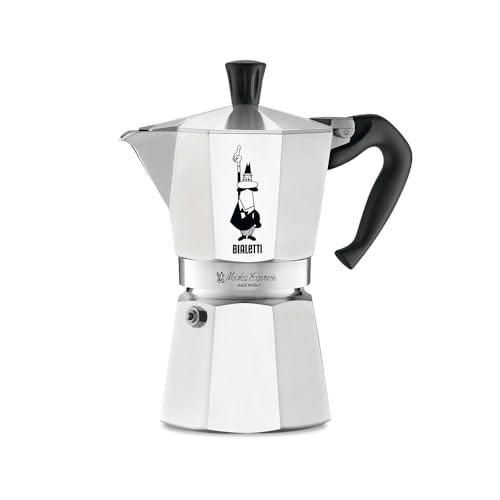
There is a reason this is the pot on the hob in half the kitchens in Italy. The Moka Express is cast aluminium, three parts, no coating and no cleverness, and the design has survived ninety years because nothing about it needed changing. On gas it heats fast and evenly, which is exactly what the method wants.
The practical argument is the parts. Gaskets, filter plates and funnels for the standard Bialetti sizes are sold everywhere, cost very little, and take thirty seconds to fit. A moka pot that stops sealing is a five-minute repair rather than a replacement, and that is what turns a cheap pot into a thirty-year one. Nothing in this comparison beats it on availability of spares.
The things to know before buying are all about aluminium. It will not work on an induction hob without an adapter plate. It should never see a dishwasher or washing-up liquid — rinse it with hot water and dry it, because detergent strips the coffee oils that keep an aluminium pot tasting clean and encourages a metallic edge. And it will darken and pit on the inside within a year, which is normal and not a fault. If any of that sounds like more maintenance than you want, the stainless pots below solve all three at a price.
The one everything else is measured against. Cheap, repairable, and still the most straightforward way to make good moka coffee.
Check price on Amazon →#2Best built
Cuisinox Roma Stovetop Espresso Maker COF-6R, 18/10 Stainless Steel Moka Pot, Induction Compatible, 6-Cup
Best for: Induction hobs, and anyone who wants a moka pot they will never have to think about again
What we like
- Heavy-gauge 18/10 stainless with a thick induction base — works on every hob type
- Dishwasher safe and completely indifferent to detergent, unlike aluminium
- Nothing in the coffee path can pit, corrode or impart a metallic taste
- Handle is well isolated from the body and stays cool on gas
- Backed by a 25-year warranty, which is unusual in this category at any price
What we don't
- Costs several times the Moka Express for a broadly similar drink
- Stainless heats more slowly and less evenly than aluminium on gas
- Gaskets are a Cuisinox part rather than a generic Bialetti one, so plan ahead
- Heavier and more awkward to pour than the aluminium pots
- The mirror finish shows every fingerprint and water spot
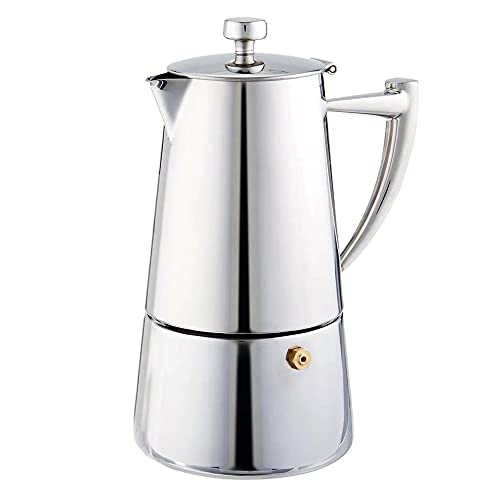
The Roma is what a moka pot looks like when it is built for a lifetime rather than for a price. Heavy 18/10 stainless throughout, a thick sandwiched base that works on induction, mirror-polished inside and out, and a 25-year warranty that says more about the construction than any specification does.
What it buys you is the removal of every aluminium annoyance at once. It goes in the dishwasher. Detergent does not harm it. Nothing pits, nothing discolours, and no metallic edge develops in the cup after a year of use. If you have an induction hob, it is one of very few pots here that works at all — most of the category is aluminium and simply will not heat.
The honest counterpoints are cost and conduction. Stainless does not spread heat the way cast aluminium does, so on a gas ring it is a little more prone to hot spots and wants a lower flame and a bit more patience. And it costs several times a Moka Express to produce a drink that most people would not distinguish blind. The case for it is the twenty-five years, the dishwasher and the induction hob — not the coffee. One planning note: the gasket is a Cuisinox part, not the generic Bialetti size sold in every supermarket, so buy a spare when you buy the pot.
The one to buy if your hob is induction or you want to put it in the dishwasher. Everything aluminium is fussy about, this simply is not.
Check price on Amazon →#3Best crema
Bialetti New Brikka Moka Pot, Stovetop Coffee Maker Producing a Crema-Rich Espresso, 2 Cups (3.4 oz), Aluminum and Black
Best for: Someone who wants the thickest, most espresso-like cup a stovetop pot can produce
What we like
- Weighted pressure valve holds back the brew until a genuinely higher pressure builds
- Produces a real layer of crema that no standard moka pot can manage
- Thicker, more concentrated cup that stands up to milk better than standard moka
- Same familiar three-part construction and the same easy cleaning
- The redesigned version fixed most of the sputtering the original was known for
What we don't
- The valve is fussier about heat — too high and it spits, too low and it stalls
- Two cups is genuinely two small cups, and there is no large version worth having
- Aluminium, so no induction and no dishwasher
- The valve assembly is another part to keep clean and eventually replace
- Costs meaningfully more than a standard Moka Express of the same size
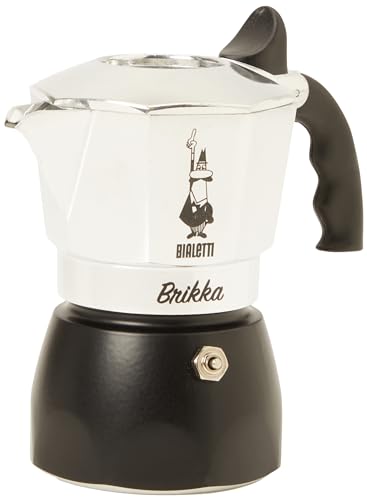
The Brikka is Bialetti's answer to the complaint that moka coffee has no crema. A weighted valve sits on top of the column and holds the brew back until the pressure in the boiler climbs past what a standard pot reaches, then releases it in a burst. The result is a genuinely thicker cup with a layer of foam on top — not espresso crema, but far closer than anything else on this page.
The drink is the reason to buy it. It is denser and more concentrated than standard moka, which makes it the pot that survives being cut with hot milk rather than disappearing into it. Anyone who has been disappointed that a moka pot does not make [espresso](/best-espresso-machines-under-500) will find this the closest a stovetop gets, at a fraction of the price and none of the counter space.
It is also the fussiest thing here to run. The valve wants a specific, low heat: too much and it sputters violently, too little and the pressure never builds and it stalls. Finding that setting on your particular hob takes a few attempts. The redesigned New Brikka is much better behaved than the original, which had a reputation for spraying, but it remains less forgiving than a Moka Express. Being aluminium, it also carries the usual restrictions — no induction, no dishwasher, no detergent — and the valve is one more component to keep clean.
The one moka pot that genuinely does something different. Fussier to run, and the reward is a cup with actual crema.
Check price on Amazon →#4Best stainless value
Bialetti Venus Stovetop Espresso Coffee Maker, 6-Cup, 18/10 Stainless Steel, Induction Compatible
Best for: An induction hob on a budget, or anyone who wants stainless without the Cuisinox price
What we like
- Induction compatible and dishwasher safe at well under the Cuisinox's price
- 18/10 stainless including the funnel and filter plate, so nothing corrodes
- Ergonomic handle that stays cool and pours more comfortably than the classic shape
- Uses standard Bialetti gaskets, which are cheap and sold everywhere
- No metallic taste and no seasoning routine to keep up with
What we don't
- Thinner gauge than the Cuisinox, and it feels it in the hand
- Base is less thick, so heat distribution on gas is the weakest here
- The lid hinge and knob are the parts owners report failing
- Stainless takes longer to come up to temperature than aluminium
- Finish scratches and clouds more readily than the Cuisinox's
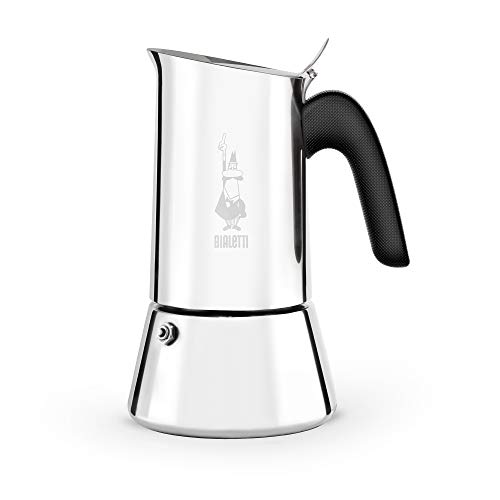
The Venus is Bialetti's stainless line, and it exists for people who want induction compatibility and dishwasher tolerance without paying for a Cuisinox. 18/10 throughout, including the funnel and filter plate, with an ergonomic handle that is a genuine improvement on the classic angular one — it stays cooler and pours with more control.
The practical wins are the same as the Roma's. It works on induction, which most of this category does not. It survives the dishwasher and detergent, so there is no seasoning routine and no anxiety about washing-up liquid. And because it is a Bialetti, it takes the standard gaskets that any supermarket or hardware shop stocks, which the Cuisinox does not.
Where the saving shows is in the metal. The gauge is thinner and the base is less substantial than the Cuisinox's, so on a gas ring it heats less evenly and wants a smaller flame and more attention. It scratches and clouds where the Roma stays mirror-bright. And the lid hinge and knob are the components that turn up in owner reports as the first thing to fail. None of that changes the coffee much — it changes how the pot feels and how long it stays looking new.
Most of the stainless argument for much less money. Thinner and less refined than the Cuisinox, and still the sensible mid-range choice.
Check price on Amazon →#5Best for one cup
Bialetti Moka Express Iconic Stovetop Espresso Maker, Moka Pot 1 Cup (2 oz / 60 ml), Aluminium, Silver
Best for: One person making one small strong coffee, or a second pot for travel
What we like
- Brews a single small cup properly rather than under-filling a larger pot
- Tiny — takes almost no cupboard space and travels easily
- Cheapest pot here by a clear margin
- Same standard parts and the same repairability as its larger siblings
- Heats and brews in a couple of minutes
What we don't
- One cup means about 60ml — smaller than most people picture
- The small boiler heats fast and is the easiest pot here to scorch
- Aluminium, so no induction, no dishwasher and no detergent
- Fiddly to fill and to handle when hot, with very little to hold on to
- Too small to be the only moka pot in a household of more than one
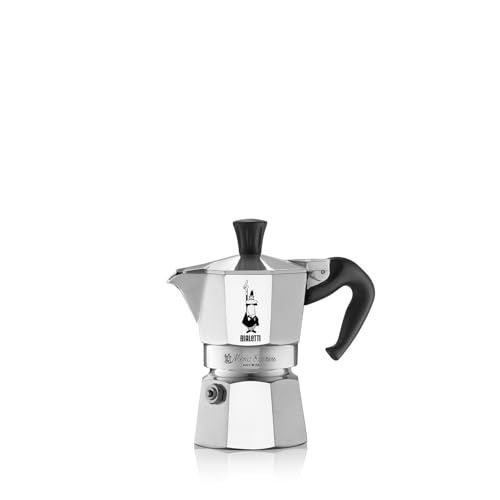
Moka pots do not scale down. Half-filling a six-cup pot changes the ratio of water to coffee and the way pressure builds, and the result is thin and often burnt-tasting. The correct fix is a smaller pot, and this is the smallest Bialetti makes.
It brews roughly 60ml, which is one small strong cup — the size an Italian kitchen means by *un caffè*, not the mug most people are picturing. Within that limitation it does exactly what the six-cup does: same construction, same standard consumables, same easy repair, at the lowest price on this page. It is also small enough to throw in a bag, which makes it a reasonable travel pot for anyone who cannot face hotel coffee.
The drawbacks are all a consequence of the size. A small boiler comes up to temperature quickly and scorches the coffee if the flame is anything but low, so it is less forgiving than the larger pots. There is very little to hold on to when it is hot. And in a household of two it is simply the wrong size — brewing twice in a row is slower and worse than brewing once in a six-cup. Buy it as the pot for one, or as the second pot, not as the only one.
The right answer to a real problem — a moka pot only brews well when it is full, and this is the full pot for one.
Check price on Amazon →What a moka pot actually does
Water in the sealed bottom chamber is heated until the steam above it builds enough pressure to push the water up through a funnel, through a basket of coffee, and out into the top chamber. That is the whole mechanism, and it has not changed since 1933.
The pressure it reaches is around one to one and a half bar. An espresso machine works at nine. That gap is why a moka pot cannot make espresso and why expecting it to is the most common way people end up disappointed with a perfectly good pot.
What it makes instead is a strong, syrupy, dark-tasting coffee with very little clarity and a great deal of body — its own category, and one worth about ten pounds’ worth of equipment to access.
Aluminium or stainless, and why your hob decides
Almost every classic moka pot is cast aluminium, and aluminium is not magnetic. On an induction hob it will not heat at all, which eliminates most of the category before you have compared anything else.
If you have induction, you are choosing between a stainless pot with a magnetic base or an interface disc under an aluminium one. The disc works and is what most people with an existing pot end up using; it also heats slowly and unevenly, which makes the brew harder to control.
Beyond the hob, the material decides the maintenance. Aluminium conducts heat better and costs far less, but it must never meet a dishwasher or washing-up liquid — detergent strips the coffee oils that keep it tasting clean and leaves a metallic edge behind. Stainless is indifferent to all of it and simply costs more.
The three things that ruin moka coffee
Too much heat. A high flame extracts too fast and scorches the brew as it arrives. A low, patient flame is the single biggest improvement most people can make, and it is free.
Cold water at the start. Filling the boiler with cold water means several minutes on the hob while the coffee sitting in the basket above slowly roasts. Start with water just off the boil and the brew is moving in under a minute. Handle the pot with a cloth.
Waiting for the gurgle. When the stream changes from steady brown to a pale, spitting hiss, the water is through and what follows is steam pulling bitterness out of the spent grounds. Take it off the heat at that point and run the base under a cold tap to stop it.
Fill it, level it, and do not tamp it
A moka pot brews well only when it is full. Water to just below the safety valve, basket filled level and struck off with a finger — no packing, no pressing.
Tamping is the instinct people bring from espresso and it is wrong here. The basket is designed for water to pass through loose grounds at low pressure; compressing it chokes the flow, pushes pressure against the safety valve and produces bitter coffee and sputtering.
The same logic applies to the size of pot. Half-filling a six-cup makes thin, burnt coffee, and there is no technique that fixes it. If you usually want one cup, buy a one-cup pot.
The gasket and the safety valve
These are the only two parts that matter for the life of a moka pot, and both are routinely ignored.
The gasket is a rubber ring that hardens with heat and stops sealing after a year or two. Steam escaping from the join, a pot that takes much longer than it used to, or weak coffee are all the same symptom. Replacements cost almost nothing and fit in under a minute — which is what makes a cheap aluminium pot a thirty-year object rather than a disposable one.
The safety valve in the boiler wall releases pressure if the basket blocks. It should be checked occasionally to make sure it is clear, and it should never be painted over, taped or otherwise defeated. A blocked moka pot with a working valve vents steam; a blocked one without is a genuine hazard.
Where the pot sits among the manual methods
A moka pot is the strong, dark end of the manual brewing spectrum, and it does not replace the other two. For a fuller comparison of what each one is actually good at, see French press, AeroPress and moka compared.
And as with everything else on this site, the pot is not the limiting factor. Fresh coffee ground evenly on a burr grinder improves a ten-pound Moka Express more than a hundred pounds of stainless steel will.
Frequently asked questions
Is moka pot coffee actually espresso?
No. A moka pot brews at roughly 1 to 1.5 bar of pressure, while espresso is defined at around 9 bar, and that difference changes the drink fundamentally — a moka pot cannot produce true crema, cannot extract the same range of compounds, and gives a heavier, less clear cup. It is a strong, concentrated coffee in its own right, closer to a very intense filter brew than to a shot. Judged as espresso it always disappoints; judged as moka coffee it is excellent and costs a fraction as much.
What grind should I use in a moka pot?
Finer than filter, coarser than espresso — roughly the texture of table salt. Espresso-fine grounds choke the basket, build pressure against the safety valve and produce bitter, over-extracted coffee; filter-coarse grounds let water rush through and give something thin and sour. Fill the basket level and do not tamp it. Tamping a moka basket restricts flow in a way the design does not account for and is a common cause of sputtering and bitterness.
Should I start with hot or cold water?
Hot, ideally just off the boil. Starting with cold water means the pot sits on the heat for several minutes while the boiler comes up to temperature, and during that time the coffee in the basket above is slowly roasting, which is where the burnt taste that people blame on the method actually comes from. Preheated water gets the brew moving in under a minute. Use a cloth to handle the pot, because the base will be too hot to assemble bare-handed.
Why does my moka coffee taste burnt or bitter?
Usually heat, then grind. Too high a flame extracts too fast and scorches both the grounds and the brew as it arrives; a low, patient flame is the single biggest improvement most people can make. Take the pot off the heat when the flow turns from a steady brown stream to a pale, gurgling sputter — everything after that point is bitter. After that, check the grind is not too fine, that you have not tamped it, and that the pot has not been washed with detergent, which leaves a taste of its own.
Can I use a moka pot on an induction hob?
Only if it is stainless steel with a magnetic base — aluminium pots will not heat at all. The Cuisinox Roma and the Bialetti Venus on this page both work directly on induction. An interface disc placed between the hob and an aluminium pot is a workable fallback and is what most people with an existing Moka Express end up using, but it heats more slowly and less evenly than a proper induction-compatible pot, which makes controlling the brew harder.
How often do I need to replace the gasket?
Every one to two years with regular use, and sooner if the pot lives on a hot hob daily. The gasket is a rubber ring that hardens, shrinks and stops sealing, and the symptoms are steam escaping from the join, coffee taking much longer to come up, or the pot brewing weakly. Replacements cost very little and take under a minute to fit. Standard Bialetti sizes are sold nearly everywhere; less common brands may need ordering, which is worth checking before you buy.
How should I clean a moka pot?
Rinse all three parts with hot water and dry them thoroughly, then leave the pot disassembled so it does not trap moisture. For aluminium pots that is the whole routine — no dishwasher and no washing-up liquid, because detergent strips the oils that season the metal and leaves a lasting metallic taste. Stainless pots tolerate detergent and the dishwasher without complaint. Whatever the material, check that the safety valve is not blocked and lift out the filter plate periodically to clear the grounds trapped underneath it.