Best Budget Coffee Grinders Under $150
Under $150 the question stops being which grinder is best and becomes which compromises you are willing to accept. Every grinder at this price gives something up — grind uniformity at the coarse end, adjustment resolution at the fine end, build quality, capacity, or your time. What none of them should give up is the burrs themselves, because the gap between any burr grinder and a blade grinder is larger than the gap between the cheapest and most expensive grinder on this page. We compared the grinders most consistently recommended at this price on burr type and support, adjustment range and usability, dosing, and long-term owner reports on the failures that actually end a cheap grinder's life.
As an Amazon Associate, Cafe & Crema earns from qualifying purchases. This never affects the price you pay. How we make money.
| Rank | Product | Score | Best for | Link |
|---|---|---|---|---|
| #1 | TIMEMORE Chestnut C3 Manual Coffee GrinderTop pick | 9.4 | One or two cups a day, on the smallest budget that still buys a genuinely good grind | Check price → |
| #2 | OXO Brew Conical Burr Coffee GrinderBest electric | 8.8 | Households making several cups a day who want to press a button rather than crank | Check price → |
| #3 | Capresso Infinity Conical Burr GrinderBest value | 7.8 | Drip and pour-over on the tightest electric budget | Check price → |
| #4 | Bodum BISTRO Burr Coffee GrinderBest on a counter | 7.6 | Small kitchens where the grinder stays visible, and anyone bothered by static | Check price → |
| #5 | Cuisinart Supreme Grind Automatic Burr MillCheapest with real burrs | 7.0 | Replacing a blade grinder when the budget is genuinely at its floor | Check price → |
#1 · Our PickTop pick
TIMEMORE Chestnut C3 Manual Coffee Grinder
Best for: One or two cups a day, on the smallest budget that still buys a genuinely good grind
What we like
- CNC stainless steel conical burrs, better than anything electric at this price
- Double-bearing axle keeps the burrs centred, which is what actually produces a consistent grind
- Costs a fraction of the budget, leaving room for a scale or a better brewer
- Silent, and there is almost nothing in it to break
- Packs for travel, so it doubles as a second grinder
What we don't
- You crank it — roughly a minute per dose, every time
- 25g capacity means grinding twice for a large French press
- Internal adjustment with no numbered scale to return to
- Poor fit for a household making several cups each morning
- Not repairable in the way a Baratza is
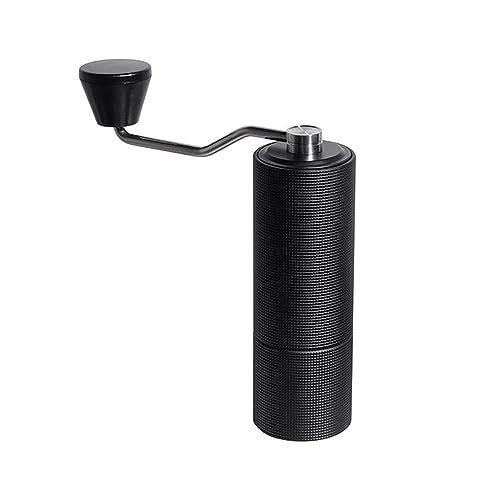
This is the awkward finding of any budget grinder comparison: below roughly $100, the grinder that produces the best coffee is the one without a motor. The reason is simple accounting. An electric grinder at this price has to fund a motor, a housing, a hopper, a timer and a retail margin out of the same money, and the burrs get what is left. The C3 spends it all on CNC-machined stainless steel conical burrs and a double-bearing axle to hold them straight, and the result is a grind that is visibly and audibly more uniform than the electric grinders below it.
The bearing is the part worth understanding. Cheap grinders of every kind fail the same way: the burr shaft has play in it, the gap between the burrs changes as the beans push through, and the grinder produces several particle sizes at once regardless of where you set it. Two bearings holding that shaft is the fix, and it is why the C3 outperforms grinders with nominally similar burrs. Twenty-five grams covers a full pour-over or press dose, and it works through them briskly.
What you pay is your own effort — roughly a minute of cranking per dose, every morning. That is pleasant for one cup and tiresome for four, and it is the entire decision. If you make coffee for a household, buy the OXO below and accept the slightly worse grind. If you make one or two cups for yourself, this is not a compromise pick; it is the best coffee on this page, and it leaves most of the budget unspent.
The honest answer to what grinds best under $150, provided you accept that it grinds when you turn it. Nothing electric at this price competes on the parts that touch coffee.
Check price on Amazon →#2Best electric
OXO Brew Conical Burr Coffee Grinder
Best for: Households making several cups a day who want to press a button rather than crank
What we like
- Stainless steel conical burrs, a genuine step above the ceramic burrs common at this price
- One-touch start with a timer that remembers your last setting
- Stepped dial covers espresso through French press with usable increments for filter
- Sealed hopper keeps beans from staling on the counter
- OXO's warranty and customer service are unusually good for the category
What we don't
- Coarse settings are its weak point, which matters most for French press
- Static makes grounds cling to the container, especially in dry air
- Timed dosing drifts as beans age, so you still want a scale
- Retains a few grams internally, slowing down adjustments
- Not enough fine-range resolution to dial espresso properly
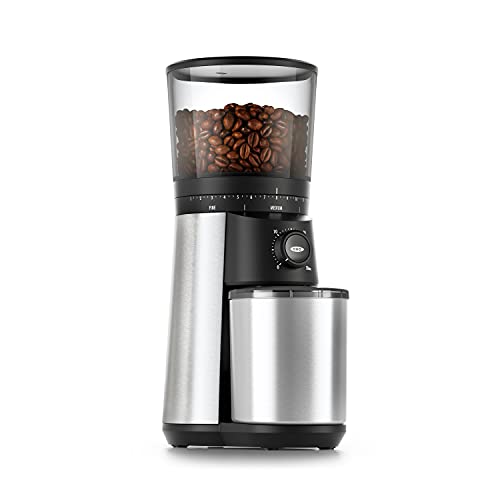
If the C3 above is the best grind at this price and the answer is nonetheless no, this is what you buy. The OXO is the electric grinder that most consistently earns recommendations under $150, and the reason is that it gets the important things right and is honest about the rest. The burrs are stainless steel conical rather than ceramic, which grinds faster and holds up better at the coarse end. The dial runs from espresso to French press with enough usable increments across the filter range that you can actually tune a pour-over rather than choosing between two wrong settings.
Day to day it behaves well. One-touch start with a timer that remembers your last setting means the morning routine is a single button, and the sealed hopper keeps beans from going stale in the open air. OXO's warranty support has a better reputation than most of the category, which matters more than it should at a price where things do fail.
The limits are real and worth knowing before you buy. Coarse settings produce a wider spread of particle sizes than fine ones, which is unfortunate given that French press is exactly where coarse grinding matters. Static is a nuisance in dry air — grounds cling to the container and puff out when you remove it. The timer doses by time rather than weight, and beans change density as they age, so the same eight seconds delivers a different mass in week three than in week one; keep a scale. And while the dial reaches espresso fineness, it does not offer enough steps in that range to dial a shot, which is a different problem covered in our [espresso grinder roundup](/best-espresso-grinders).
The default electric grinder under $150, and the right pick for anyone who will not hand-grind. Good burrs, sensible controls, honest limits at the coarse end.
Check price on Amazon →#3Best value
Capresso Infinity Conical Burr Grinder
Best for: Drip and pour-over on the tightest electric budget
What we like
- Steel conical burrs at a price where ceramic and worse is the norm
- Slow-turning geared motor limits heat and static compared with faster grinders
- Sixteen settings grouped into four ranges, which is easy to navigate
- Long enough on the market that its reliability record is genuinely known
- Consistently one of the cheapest ways to get steel conical burrs
What we don't
- Adjustment works by twisting the hopper, so a full hopper makes it awkward
- Timer dial is imprecise, more a rough guide than a dose
- Coarse settings are noticeably less uniform than the OXO's
- Plastic construction throughout feels its price
- Small ground container relative to the hopper
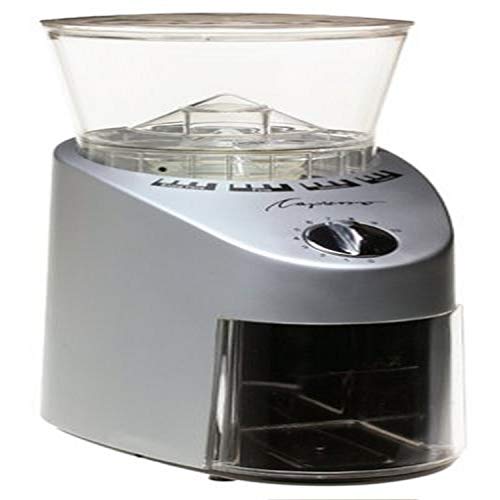
The Infinity has been sold in essentially this form for long enough that its reputation is settled rather than speculative, which is worth something in a category full of grinders that fail in year two. What it offers is steel conical burrs and a geared-down motor at a price where the competition is generally ceramic burrs and a fast, hot motor. Turning slowly means less heat into the grounds and less static building up, and the difference in how much coffee ends up on the counter is noticeable.
The control scheme is simple in a useful way. Sixteen settings are grouped into four labelled ranges — from extra fine to coarse — so finding roughly the right neighbourhood takes no expertise, and moving within the range is a small twist. For drip and pour-over, which is what most people buy this grinder for, it does the job without drama.
It is clearly built to a price. Adjustment happens by twisting the hopper against the body, which is awkward when the hopper is full and impossible to do precisely. The timer dial is a rough approximation rather than a dose, so a scale is not optional. Coarse settings are less uniform than the OXO's, so French press is not its strength. And the construction is plastic throughout in a way you feel every time you handle it. Buy it because it is cheap and its burrs are steel, which are the two things that matter most at the bottom of this market.
The cheapest electric grinder here that is genuinely worth owning. Steel burrs and a slow motor at a price where neither is expected.
Check price on Amazon →#4Best on a counter
Bodum BISTRO Burr Coffee Grinder
Best for: Small kitchens where the grinder stays visible, and anyone bothered by static
What we like
- Borosilicate glass grounds catcher substantially reduces static cling
- Twelve settings marked clearly on the body, easy to read and return to
- Stainless conical burrs rather than ceramic
- Timer dial doses by time without needing a second button
- Genuinely good-looking in a category that mostly is not
What we don't
- Owner reports of gear and motor failures are more common than for the grinders above
- Small capacity in both hopper and catcher
- Glass catcher breaks if dropped
- Coarse settings are its weakest range
- Rubberised finish degrades over years of handling
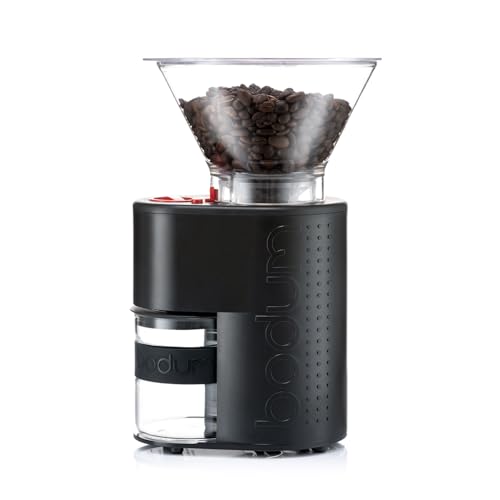
Static is the most consistently irritating thing about cheap electric grinders. Grounds cling to the plastic container, puff into the air when you pull it out, and end up on the counter rather than in the brewer. The Bistro's answer is a borosilicate glass catcher, and it works — noticeably less clings, and what does is easy to tap loose. If that annoyance is what drives you to replace a grinder, this is the one designed around it.
The rest is sensibly done. Twelve settings are marked on the body where you can read them, which makes returning to a previous setting trivial and puts it ahead of grinders whose adjustment is a matter of counting. The burrs are stainless conical, the timer dial doses in one motion, and the whole thing looks like an object rather than an appliance, which matters in a kitchen where the grinder never goes in a cupboard.
The reservation is durability. Owner reports of gear and motor failures after a year or two appear more often for the Bistro than for the OXO or the Capresso, and that is the reason it sits here rather than higher. Capacity is small at both ends, the glass catcher is breakable in a way plastic is not, coarse grinding is its weakest range, and the rubberised finish does not age gracefully. Buy it for the static and the looks, with clear eyes about the trade.
The static fix and the best-looking grinder here, held back by a reliability record that is merely acceptable rather than good.
Check price on Amazon →#5Cheapest with real burrs
Cuisinart Supreme Grind Automatic Burr Mill
Best for: Replacing a blade grinder when the budget is genuinely at its floor
What we like
- The lowest price here, often by a wide margin
- Genuine burrs, which puts it categorically ahead of any blade grinder
- Large hopper and grounds chamber relative to its size
- Slide dial covers fine to coarse in eighteen positions
- Widely available and easy to replace if it fails
What we don't
- Grind uniformity is the weakest here, particularly at coarse settings
- Well-documented tendency to clog and jam, requiring regular cleaning
- Static is heavy, with grounds clinging throughout the chamber
- Plastic construction and a short expected life
- Dosing by cups rather than weight is imprecise in both directions
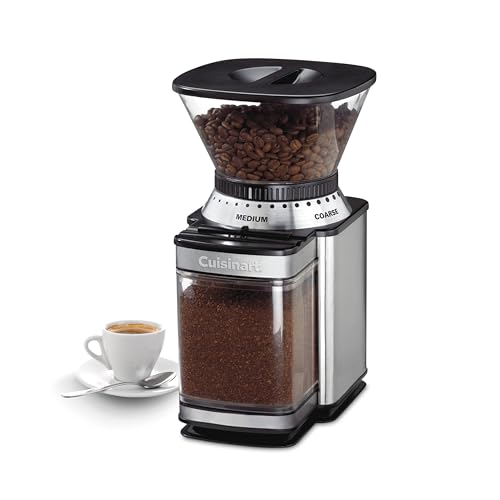
There is one situation where this grinder is the correct purchase: you currently own a blade grinder, or buy pre-ground, and the budget will not stretch past the bottom of the market. In that comparison it wins clearly, because it has actual burrs and therefore selects a particle size instead of chopping at random. That is the largest single improvement available in coffee, and it is available here for very little.
It has practical virtues too. The hopper and grounds chamber are large for the size, the slide dial spans fine to coarse across eighteen positions, and it is stocked everywhere, which means replacing it when it dies is easy and cheap.
Everything else is where the money went missing. Grind uniformity is the weakest on this page, and it falls apart at coarse settings, which rules out French press as a serious use. The clogging is well documented across years of owner reports — grounds pack into the chute and the chamber, and it needs brushing out regularly to keep working. Static is heavy. The construction is plastic and the expected life is short. Dosing is by cups, which is a volume approximation of a weight measurement and imprecise in both directions. If you can reach the Capresso above, or the C3 at the top, do that instead. If you cannot, this still beats what you are using now.
Worth owning only in comparison to a blade grinder, which it beats decisively. Against everything above it, the compromises are large.
Check price on Amazon →The awkward truth about this price bracket
At the top of this page is a grinder with no motor, and it is there because it grinds better than everything below it. That is not a quirk of these particular products; it is arithmetic. An electric grinder under $150 has to pay for a motor, a gearbox, a housing, a hopper, a timer and a retailer’s margin before anything reaches the burrs. A hand grinder pays for burrs, an axle and a crank. The money goes where the coffee is.
Which means the honest framing of a budget grinder purchase is not “which is best” but “how much of your own effort are you willing to substitute for money”. One cup a day, and the substitution is easy. Four cups, and it stops being a substitution and starts being a chore you will abandon.
Coarse is where cheap grinders fail
Every grinder on this page performs better at medium settings than at coarse ones, and that is worth knowing before you buy, because it inverts the usual assumption that coarse grinding is the easy case. It is not. Producing large particles uniformly requires the burrs to stay precisely parallel under load, and cheap grinders flex. The result is a French press dose containing both boulders and dust, which brews thin and bitter at once.
If French press or cold brew is your main method, this is the specification to weigh most heavily, and it is the strongest argument for spending toward the top of the bracket rather than the bottom. If you brew drip or pour-over, the differences narrow considerably and price becomes a reasonable way to choose.
What you cannot buy at this price
Espresso, essentially. Every grinder here reaches espresso fineness, and none has enough adjustment steps inside that range to move a shot from nineteen seconds to twenty-seven without overshooting into a choked machine. That is a resolution problem rather than a fineness problem, and it is not solved by spending a little more within this bracket — it is solved by buying a grinder designed around the espresso range, which is what best espresso grinders covers.
You also cannot buy longevity here. Expect three to five years, expect the motor or the gears to go before the burrs, and treat a budget grinder as a consumable rather than an heirloom. If you want the specifications behind any of this — what alignment is, why retention matters, why the number of settings on the box is misleading — burr grinders explained works through them. If your budget can stretch further than this page assumes, best coffee grinders covers the tier above, and best manual hand grinders goes deeper into the option that wins here.
Frequently asked questions
Is a $150 grinder actually better than a $50 one?
Usually, but not by as much as the price suggests, and not in a straight line. Moving from a blade grinder to any burr grinder is transformative. Moving from a cheap burr grinder to a good one is a real but smaller improvement, mostly visible at coarse settings and in how much grind quality varies between doses. The one place the extra money buys something categorical is espresso, where cheap grinders lack the adjustment resolution to dial a shot at all — but that takes more than $150 anyway.
Should I buy a manual grinder to save money?
Under $100 the answer is genuinely yes on grind quality alone, because none of the price went into a motor and all of it went into burrs. The question is whether you will keep doing it. A minute of cranking for one cup is pleasant; the same routine for four cups every morning is how hand grinders end up in drawers. Match it to your household honestly rather than to your intentions.
Are ceramic burrs a dealbreaker at this price?
Not a dealbreaker, but steel is generally the better buy when it is available in budget. Ceramic is harder and resists wear well, does not corrode, and is fine for filter brewing; it also tends to cut more slowly and to be less uniform at coarse settings in the grinders where you actually find it. Since coarse uniformity is exactly what cheap grinders struggle with, steel is worth prioritising if the price is similar.
Can any of these grind for espresso?
They will all reach espresso fineness, and none of them will let you dial a shot properly. The problem is resolution, not range: espresso needs many small steps within the fine range so you can move a shot from too fast to correct, and budget grinders spread a handful of steps across the whole span from espresso to French press. The practical experience is one setting that gushes and the next that chokes the machine, with nothing usable in between.
Why do my grounds fly everywhere?
Static, which builds up as beans are crushed and is worse in dry air and with light roasts. It is a nuisance rather than a fault, and there are two effective fixes. A glass or metal grounds container holds far less charge than plastic, which is the design difference behind one grinder on this list. The other is the Ross Droplet Technique: stir a single drop of water into the beans before grinding, which is enough to dissipate the charge and not enough to affect the coffee.
How long should a budget grinder last?
Three to five years of daily use is a reasonable expectation, with the motor, gears or plastic housing failing before the burrs wear out. The main things you control are cleaning — brushing out old grounds prevents the clogging that kills the cheapest grinders — and not forcing it when it jams. If you expect a decade, that is a different price bracket, and it usually means buying a grinder with genuinely available spare parts rather than a better-built sealed one.