Best Manual Hand Grinders
A hand grinder spends none of its cost on a motor, and that single fact is why it wins on a budget. Below roughly $100, a manual grinder typically offers better burrs and finer adjustment than any electric grinder at the same price, because the whole budget went into the parts that touch coffee. What you pay instead is a minute or two of cranking per dose, and more at espresso fineness. That trade is excellent for one or two cups a day, poor for a household of four, and the reason manual grinders occupy a permanent niche rather than a temporary one. We compared the hand grinders most consistently recommended by home brewers on burr material and geometry, adjustment mechanism and resolution, capacity, and long-term owner reports on the parts that actually fail — burr wobble, handle attachment and axle bearings.
As an Amazon Associate, Cafe & Crema earns from qualifying purchases. This never affects the price you pay. How we make money.
| Rank | Product | Score | Best for | Link |
|---|---|---|---|---|
| #1 | TIMEMORE Chestnut C3 Manual Coffee GrinderTop pick | 9.4 | Anyone buying their first serious grinder, manual or electric, on a budget under $100 | Check price → |
| #2 | 1Zpresso J-Ultra Manual Coffee GrinderBest for espresso | 9.2 | Espresso at home without buying an electric grinder, or anyone who wants repeatable settings | Check price → |
| #3 | Porlex Mini Stainless Steel Coffee GrinderBest for travel | 8.6 | Travel, camping, the office, and anyone who already owns an AeroPress | Check price → |
| #4 | Hario Skerton Pro Ceramic Manual Coffee GrinderBest for large batches | 8.4 | French press and batch pour-over, where 100g doses make small grinders tiresome | Check price → |
| #5 | Hario Mini-Slim Pro Ceramic Coffee Mill | 7.6 | The smallest possible budget, or a backup grinder to leave in a bag | Check price → |
#1 · Our PickTop pick
TIMEMORE Chestnut C3 Manual Coffee Grinder
Best for: Anyone buying their first serious grinder, manual or electric, on a budget under $100
What we like
- CNC-machined stainless steel S2C conical burrs, a clear step above ceramic at the price
- Double-bearing axle keeps the burr centred, which is the main failure of cheap hand grinders
- 25g capacity handles a full pour-over or French press dose in one go
- Grinds noticeably faster than the ceramic-burr grinders below
- Costs less than most electric grinders that come nowhere near its grind quality
What we don't
- Adjustment is internal, so you count clicks blind rather than reading a scale
- No numbered reference point to return to after switching brew methods
- Capable at espresso but not designed for it — the ESP variants exist for that
- Aluminium body picks up marks
- Nothing about it is repairable in the way a Baratza is
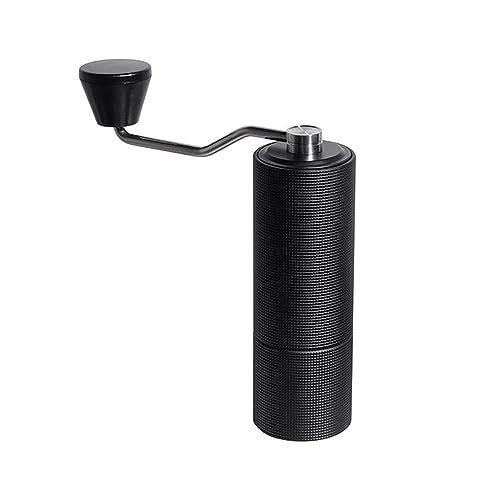
Hand grinders used to be a compromise you accepted for travel. The C3 is a large part of why that stopped being true. Its burrs are CNC-machined stainless steel in Timemore's S2C conical pattern, which is a meaningfully different proposition from the ceramic burrs that dominated cheap manual grinders for years — faster, more uniform, and better at the coarse settings where ceramic tends to produce boulders.
The part that does not appear in marketing and matters most is the double-bearing axle. The characteristic failure of an inexpensive hand grinder is burr wobble: the central shaft has play in it, so the gap between the burrs varies as you crank, and the grinder produces several particle sizes at once no matter where you set it. Two bearings holding the shaft is the fix, and it is why the C3 grinds more consistently than grinders costing more. Twenty-five grams of capacity covers a full pour-over or press dose without refilling, and it works through them quickly enough that the cranking stays pleasant.
The main irritation is the adjustment. It is internal — you remove the catch cup and turn a nut against detents you can feel but not see — so switching from French press to pour-over means counting clicks and trusting your memory rather than reading a number. Write your settings down. It will reach espresso fineness, but it is not built around that range and Timemore sells C3 ESP variants for people who need it. The aluminium body marks, and nothing here is user-repairable. Against those, at this price, nothing else is close.
The grinder that made hand grinding the obvious budget answer. Better burrs than any electric grinder near the price, and the bearing design that makes them count.
Check price on Amazon →#2Best for espresso
1Zpresso J-Ultra Manual Coffee Grinder
Best for: Espresso at home without buying an electric grinder, or anyone who wants repeatable settings
What we like
- Eight-micron adjustment increments, finer resolution than most electric grinders at any price
- External numbered adjustment ring you can read and return to exactly
- 48mm coated conical burrs designed for espresso as well as filter
- 35–40g capacity, enough for a large filter dose
- Magnetic grounds cup that seats and releases cleanly
What we don't
- Costs several times the C3 above
- At around 700g it is heavy for something described as portable
- Espresso fineness takes real effort and time by hand
- Overkill for anyone brewing only filter coffee
- 1Zpresso's support network is thinner than the established electric brands'
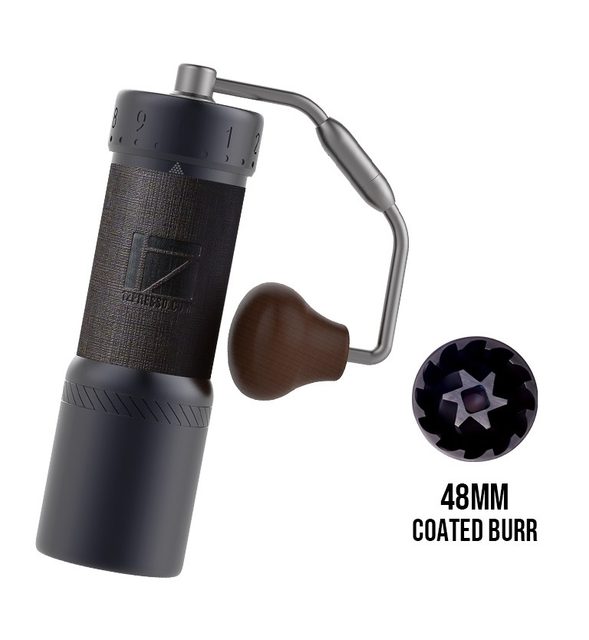
Espresso is where hand grinders traditionally fell apart, not because they could not grind fine but because they could not be adjusted precisely enough to steer a shot. The J-Ultra's answer is eight-micron increments on an external, numbered ring — resolution finer than most electric grinders offer at any price, and readable, so you can move from an espresso setting to a pour-over setting and return to exactly where you were. Anyone who has counted clicks blind on an internally adjusted grinder will understand immediately why that matters.
The rest is built to match. The 48mm coated conical burrs are designed for espresso as well as filter, capacity runs to 35–40g so a large pour-over dose fits in one load, and the magnetic grounds cup seats and releases without the fiddling that thread-on cups involve. For a household pulling one or two shots a day, it removes the argument for spending several times as much on an electric espresso grinder.
The costs are money and effort. It is several times the price of the C3, and around 700g, which makes "portable" a stretch — this travels in a bag rather than a jacket. Grinding to espresso fineness by hand is genuine work: expect the better part of a minute of firm cranking per dose, every morning, which is the thing most likely to send you back to an electric grinder eventually. And if you only brew filter, you are paying for resolution you will never use. Buy it for espresso, or for the numbered ring, and not otherwise.
The hand grinder that outresolves most electric grinders. If you pull espresso and cannot spend electric-grinder money, this is the answer.
Check price on Amazon →#3Best for travel
Porlex Mini Stainless Steel Coffee Grinder
Best for: Travel, camping, the office, and anyone who already owns an AeroPress
What we like
- Stainless steel body that survives being thrown in a bag
- Fits inside an AeroPress chamber, which is why it is the standard travel pairing
- Ceramic conical burrs that will not rust or corrode
- Removable handle secured by a silicone band, so nothing snags in a bag
- Long enough on the market that its failure modes are well documented
What we don't
- Around 20g capacity, so a large dose needs two loads
- Stepped adjustment with no numbered scale to return to
- Narrow body is awkward to hold steady while cranking
- Slower than steel-burr grinders at the same settings
- Not a serious espresso grinder despite reaching fine settings
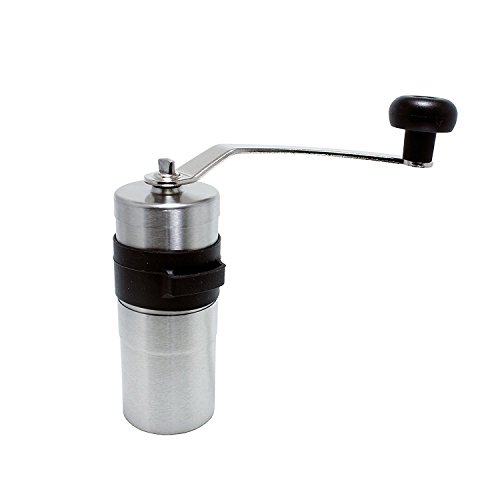
The Porlex Mini's reputation rests on a physical coincidence that turned into a standard: it fits inside an AeroPress chamber. That makes the pair a single object in a bag, and it is the reason this grinder appears in more travel kits than any other. The body is stainless steel rather than plastic, which is what lets it be treated that way, and the ceramic conical burrs neither rust nor mind being packed damp.
As a grinder it is competent rather than exceptional, and competent is the right target for the job. For AeroPress, pour-over and French press away from home it produces a grind that is clearly a burr grind, with none of the boulder-and-dust character that would make travel coffee not worth the effort. The handle detaches and is held by a silicone band around the body, so there is nothing sticking out to catch on the inside of a bag.
The compromises follow from the size. Capacity is around 20g, so anything larger than a single generous cup means grinding twice. Adjustment is stepped via a nut beneath the burr, with no numbers, so returning to a previous setting means counting from fully closed each time. The narrow body is genuinely awkward to grip while cranking — most owners end up holding it against their body — and ceramic burrs are slower than the steel ones on the C3. It reaches espresso fineness without offering enough resolution to dial a shot. As a travel grinder none of that matters much; as your only grinder at home, the C3 is the better buy.
The travel grinder other travel grinders are compared against. Small capacity and coarse adjustment are the price of a package that survives a rucksack.
Check price on Amazon →#4Best for large batches
Hario Skerton Pro Ceramic Manual Coffee Grinder
Best for: French press and batch pour-over, where 100g doses make small grinders tiresome
What we like
- Around 100g capacity, by far the largest here — enough for a full French press
- Redesigned burr stabilising plate fixes the original Skerton's biggest flaw
- Ceramic conical burrs that are easy to wash and will not corrode
- Wide glass base sits stably on a counter while you crank
- Hario is a long-established brand with genuinely available spare parts
What we don't
- Adjustment is via a nut beneath the burr with no numbered reference
- Coarse settings are its weakness, which matters for French press specifically
- Glass base breaks if dropped, unlike the metal grinders above
- Slower than the steel-burr grinders at every setting
- Not usable for espresso
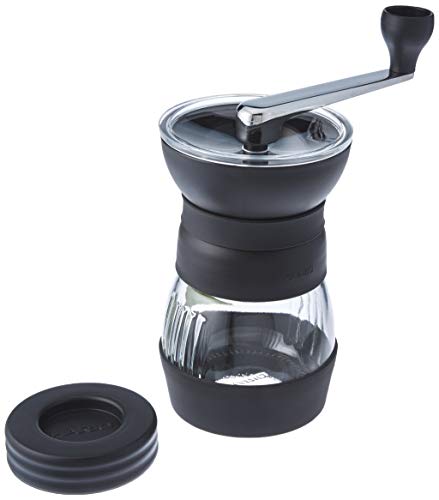
The original Hario Skerton was widely bought and widely complained about, and the complaint was specific: the burr shaft was supported only at the top, so it wobbled under load, the gap between the burrs varied as you cranked, and the results at coarse settings were unpredictable. The Pro revision added a stabilising plate that holds the lower burr in place, and it is the reason this grinder is on the list while its predecessor is not.
What it offers that nothing else here does is capacity. Around 100g in the base means a full French press or a batch of pour-over in a single load, where the C3 needs four loads and the Porlex five. The glass base sits wide and stable on a counter, which makes long grinding sessions much less tiring than holding a narrow metal cylinder. Ceramic burrs wash easily and do not corrode, and Hario's spare parts are genuinely obtainable.
It is still a ceramic-burr grinder with unnumbered adjustment, and both show. Coarse settings remain its relative weakness, which is awkward given that French press is exactly what its capacity suits it for — expect a wider particle spread there than the C3 produces. Adjustment is a nut with no scale, so returning to a setting means counting from closed. The glass base is breakable in a way stainless is not, and it grinds more slowly than steel burrs at every setting. Buy it for volume; buy the C3 for grind quality.
The hand grinder for people who make a lot of coffee at once. The Pro revision fixed the wobble that made the original frustrating.
Check price on Amazon →#5
Hario Mini-Slim Pro Ceramic Coffee Mill
Best for: The smallest possible budget, or a backup grinder to leave in a bag
What we like
- The lowest price here by a clear margin
- Light and slim enough to pack almost anywhere
- Ceramic conical burrs, so it is a real burr grinder rather than a blade novelty
- Around 24g capacity, enough for a single generous cup
- Rubberised grip on the body makes it easier to hold than its size suggests
What we don't
- Plastic and glass construction that flexes under load
- Slowest grinder here by some distance
- Adjustment is coarse and unnumbered
- Single-cup capacity only
- Nothing about it will outlast the metal grinders above
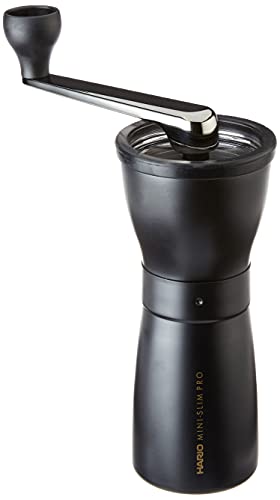
There is a real category of purchase where the question is not which grinder is best but whether a burr grinder is affordable at all, and the Mini-Slim Pro exists for it. It has ceramic conical burrs, which puts it on the right side of the only line in grinding that really matters, and it costs less than a couple of bags of good coffee. For someone currently using pre-ground or a blade grinder, it is a larger improvement than any of the more expensive grinders here would be over the C3.
It is also genuinely slim, which is its other purpose. It packs into places the Porlex will not, weighs almost nothing, and the rubberised section on the body makes it easier to hold while cranking than the dimensions suggest.
Everything else is what the price implies. The body is plastic and glass and flexes under load, which you feel as the burrs shifting slightly when you push through a dense bean. It is the slowest grinder here — a single cup takes real patience — and the capacity of around 24g means one cup is all you get per load. Adjustment is coarse and unnumbered. It will not last like a stainless grinder. Buy it if the budget is genuinely fixed at this level, or as a second grinder that lives permanently in a bag, and upgrade to the C3 when you can.
The cheapest grinder in this article that is genuinely worth owning. It clears the burr-grinder bar and nothing more, which at this price is the correct ambition.
Check price on Amazon →The bearing matters more than the burrs
The specification that separates a good hand grinder from a frustrating one is rarely printed on the box. If the central shaft is held only at the top, it flexes under load, the gap between the burrs varies as you crank, and the grinder produces a mixture of particle sizes no matter where you set it — the exact failure a burr grinder is supposed to eliminate. Double bearings, or a stabilising plate holding the lower burr, is the fix. It is why the C3 outperforms grinders with nominally similar burrs, and why the Skerton Pro is on this page while the original Skerton is not.
Numbered adjustment is worth paying for
Most hand grinders adjust by turning a nut beneath the burr against detents you can feel but not see. That works fine if you brew one way with one coffee. The moment you switch between pour-over and French press, or between two bags, you are counting clicks from fully closed and trusting your memory — and if you lose count, you rediscover your setting over several disappointing brews. An external numbered ring turns that into reading a number. It is the single largest usability difference in this category and the main thing the expensive grinders here are selling.
Where hand grinding stops making sense
The economics are excellent up to a point and then reverse. Below about $100 a hand grinder beats any electric grinder on grind quality, because all of the money went into burrs. Above roughly $250, electric grinders with good burrs become available and the labour stops being worth the saving. And at any price, volume breaks the argument: a household making four cups every morning is doing four minutes of cranking a day, which is how most hand grinders end up in a drawer. If that is your situation, the best coffee grinders covers the electric options, best budget grinders under $150 covers the cheap end of them, and burr grinders explained covers why any of these specifications matter in the first place.
Frequently asked questions
Is a hand grinder good enough to replace an electric one?
For one or two cups a day, comfortably. Below about $100 a hand grinder generally produces a better and more consistent grind than an electric grinder at the same price, because none of the budget went into a motor, a housing or a timer. Where it stops working is volume and repetition: grinding for four people, or pulling espresso every morning, turns a pleasant minute into a chore you will come to resent. The honest rule is that hand grinders win on quality per dollar and lose on quality per minute.
How long does hand grinding actually take?
For filter coffee, roughly thirty to sixty seconds for a single dose on a steel-burr grinder, and longer on ceramic burrs, which cut more slowly. Espresso is a different proposition: the fine setting means much more resistance, and a single dose takes closer to a minute of firm effort. Capacity matters too, since a 20g grinder brewing a 40g French press dose means doing the whole thing twice.
Are ceramic burrs worse than steel?
Not worse in principle, but usually slower and less uniform at coarse settings in the grinders where you find them. Ceramic is harder than steel and resists wear well, does not corrode, and washes easily — genuine advantages, particularly for a travel grinder that might get packed damp. Steel cuts faster and tends to hold up better at the coarse end, which is where cheap ceramic grinders most often disappoint. At these prices the distinction largely tracks price, and if you can reach steel it is generally the better buy.
Can a hand grinder do espresso?
Some can, and the constraint is adjustment resolution rather than fineness. Nearly any burr grinder reaches espresso particle sizes; what espresso needs is enough small steps within that range to move a shot from too fast to correct without overshooting into choked. Grinders with numbered external adjustment in single-digit micron increments manage that better than most electric grinders. Grinders with a coarse unnumbered nut beneath the burr do not, regardless of how fine they will go.
How do I keep track of my grind settings?
On a grinder with a numbered external ring, note the number. On one with internal adjustment, close the burrs fully, then count detents outward, and write the count down for each brew method — this is the only reliable reference point, because there is nothing else to measure against. Keep the note somewhere permanent rather than in your head, because after a couple of bean changes you will not remember whether pour-over was fourteen clicks or sixteen, and rediscovering it costs several brews.
How do I clean a hand grinder?
Disassemble it, brush the burrs and the chamber, and reassemble — for most grinders here that means unscrewing the handle and lifting out the upper burr, which takes a couple of minutes. Ceramic burrs can be rinsed and dried thoroughly; steel burrs are better brushed dry, since standing water invites corrosion in the shaft and bearings. Do it every few weeks, and more often with oily dark roasts, whose residue goes rancid and taints later brews.