Best Cold Brew Makers
Cold brew is coffee steeped in cold water for twelve hours or more, and the brewing is so forgiving that no device on this page can really get it wrong. What separates them is everything around the brewing: whether you get concentrate to dilute or a jug ready to drink, how cleanly the grounds are filtered out, how much fridge space is occupied while it steeps, and — the part nobody warns you about — how unpleasant it is to dispose of a kilogram of saturated coffee grounds. We compared these on filtration, capacity against fridge footprint, how many pieces have to be washed, whether the filters are reusable or a recurring cost, and the drainage or decanting step where most of the mess happens.
As an Amazon Associate, Cafe & Crema earns from qualifying purchases. This never affects the price you pay. How we make money.
| Rank | Product | Score | Best for | Link |
|---|---|---|---|---|
| #1 | OXO Good Grips Cold Brew Coffee Maker, 32 oz, Iced Coffee Maker with Carafe, Brews Cold Brew ConcentrateTop pick | 9.0 | Someone who makes cold brew weekly and wants a clean concentrate with the least mess | Check price → |
| #2 | Toddy Cold Brew System, Cold Brew Coffee Maker with Reusable Filters, Glass Decanter and StopperBest for big batches | 8.8 | Households that drink cold brew daily through summer and want to brew once a week | Check price → |
| #3 | Hario Mizudashi Cold Brew Coffee Pot, 1000ml, BlackBest ready-to-drink | 8.4 | One or two people who want cold brew ready to pour straight from the fridge | Check price → |
| #4 | Takeya Deluxe Cold Brew Coffee Maker, BPA-Free Tritan Pitcher with Airtight Leakproof Lid and Fine-Mesh Filter, 1 Quart, BlackBest for the fridge door | 7.8 | Small fridges, shared kitchens, and anyone who has already broken one glass carafe | Check price → |
| #5 | Bodum Bean Cold Brew Coffee Maker Set, 1.5 L / 51 oz, White | 7.2 | Someone who wants to try cold brew properly without buying a single-purpose device | Check price → |
#1 · Our PickTop pick
OXO Good Grips Cold Brew Coffee Maker, 32 oz, Iced Coffee Maker with Carafe, Brews Cold Brew Concentrate
Best for: Someone who makes cold brew weekly and wants a clean concentrate with the least mess
What we like
- Rainmaker lid distributes water evenly instead of dumping it on one spot
- Brew-release switch drains slowly into the carafe with no lifting or pouring
- Paper filter above the mesh gives a genuinely clean concentrate
- Borosilicate carafe with a lid, so the concentrate stores in the same vessel it drains into
- The whole assembly comes apart, which keeps it from going rancid
What we don't
- Paper filters are a recurring cost, and the mesh alone is noticeably less clean
- The brewing container is tall and awkward to fit in a busy fridge
- Draining takes several minutes and cannot be rushed without clouding the result
- 32oz of concentrate is a lot of hardware for the volume it produces
- More pieces to wash than any other maker here
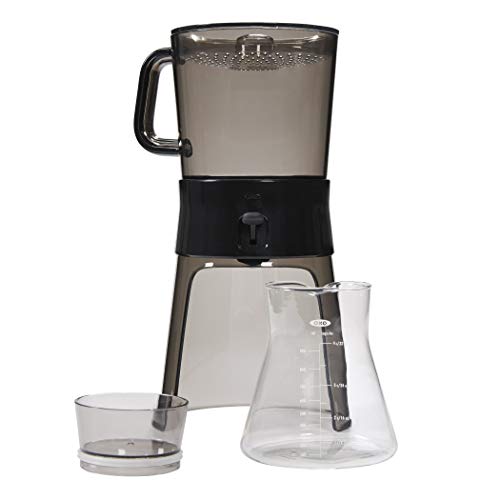
Most cold brew makers are a jar with a filter in it. OXO's is the one that has clearly been designed by someone who noticed where the process is irritating. The rainmaker lid spreads the water across the whole bed rather than boring a channel through it, which is the same problem [shower-head design solves in a drip machine](/best-drip-coffee-makers) and the reason a stirred jar can extract unevenly.
The drain switch is the other half. Instead of lifting a saturated filter basket out and dripping across the counter, you sit the brewing container on the carafe and flip a switch, and it drains slowly through the paper filter over several minutes. The result is a concentrate with very little sediment, poured straight into the vessel you will store it in. Nothing else here handles that step as cleanly.
The costs are space and consumables. The brewing container is tall, and it occupies a serious amount of fridge shelf for twelve to twenty-four hours — or you brew at room temperature on the counter, which works but shortens the useful window. The paper filters are an ongoing purchase, and skipping them for the mesh alone gives a noticeably cloudier result. There are also more parts to wash here than in a jar, which is the price of the design doing more.
The most thought-through design in the category. The rainmaker and the drain switch solve the two annoying parts of cold brew.
Check price on Amazon →#2Best for big batches
Toddy Cold Brew System, Cold Brew Coffee Maker with Reusable Filters, Glass Decanter and Stopper
Best for: Households that drink cold brew daily through summer and want to brew once a week
What we like
- Brews a large batch of concentrate in one go — enough for a week for most households
- Thick felt filter plus optional paper produces the cleanest cup in this comparison
- The commercial-standard system, essentially unchanged for fifty years
- Glass decanter with a stopper stores the concentrate properly
- Simple, replaceable consumables that are cheap and easy to find
What we don't
- The felt filter must be rinsed thoroughly and stored wet in the fridge or it spoils
- Bulky — the brewing container and the decanter both need somewhere to live
- The rubber stopper is fiddly and the classic failure point of the design
- Takes over a fridge shelf, or brews on the counter and shortens the shelf life
- Disposing of a full batch of saturated grounds is genuinely unpleasant
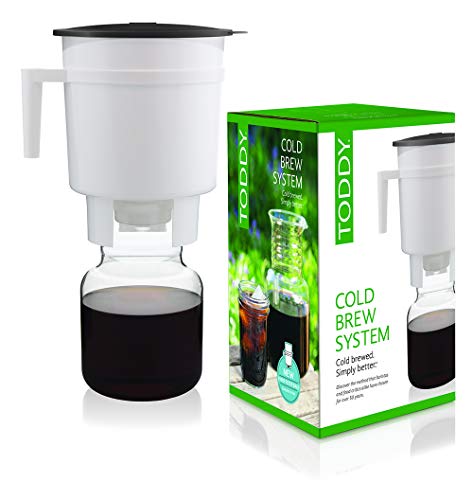
Toddy has been the commercial standard for cold brew since the sixties, and the system sold for home use is the same design at a smaller scale. A brewing bucket with a stoppered hole in the bottom, a thick felt filter that sits over it, and a glass decanter underneath. Load coffee and water, wait twelve to twenty-four hours, pull the stopper, and let it drain.
The filtration is what keeps it recommended. A felt pad is a far more effective filter than any mesh, and paper filters can be added above it for a concentrate that is essentially clear. For anyone who has found cold brew from a mesh jug slightly muddy, this is the fix. The batch size is the other argument — this makes enough concentrate to last most households a week, which turns cold brew from a project into a routine.
The felt filter is also the reason people give up on it. It cannot be allowed to dry out with coffee in it; it has to be rinsed thoroughly after every batch and stored damp in a sealed bag in the fridge, and one forgotten cycle means buying a new one. The rubber stopper is fiddly and eventually leaks. And the system is bulky in a way the jugs on this page are not. It rewards a household that brews every week and punishes one that brews occasionally.
The original, and still the best filtration and the best batch size. Living with the felt filter is the tax.
Check price on Amazon →#3Best ready-to-drink
Hario Mizudashi Cold Brew Coffee Pot, 1000ml, Black
Best for: One or two people who want cold brew ready to pour straight from the fridge
What we like
- Brews at drinking strength, so there is no dilution to work out
- Slim and rectangular, designed to stand in a fridge door
- Only three parts, all of which rinse clean in seconds
- Fine mesh basket lifts straight out with the grounds inside it
- Cheap enough to own two and keep one always brewing
What we don't
- No concentrate, so it cannot be stretched with milk or ice without weakening
- Mesh-only filtration leaves more fines than any paper-filtered maker here
- One litre disappears quickly in a two-person household
- Glass, and the thin walls do not tolerate being knocked about
- The plastic lid and basket discolour over time
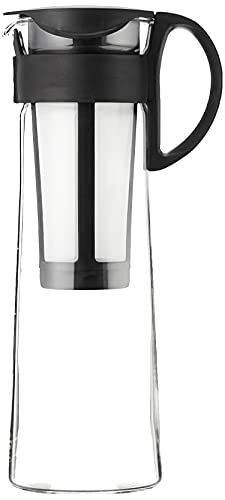
The Mizudashi is a glass carafe with a tall mesh basket down the middle, and that is the entire product. Fill the basket with coarse coffee, fill the carafe with water, put it in the fridge overnight, lift the basket out in the morning. There is nothing to learn and nothing to go wrong.
What makes it worth choosing over the concentrate makers is that it brews at drinking strength. There is no ratio to remember and no dilution to get wrong — you pour it over ice and drink it. For anyone who found cold brew concentrate to be an extra step every morning, that is the whole appeal. The slim rectangular shape is deliberate too: it stands in a fridge door where a Toddy or an OXO cannot.
The compromises are filtration and volume. A fine mesh is not a paper filter, so the result carries more fines than an OXO or a Toddy — noticeable if you have drunk both, unremarkable if you have not. And a litre at drinking strength is roughly three glasses, which in a household of two means brewing every day or two rather than weekly. Both of those are fair trades for something this cheap and this easy to clean, and the cleaning is where most cold brew makers actually fail over time.
The simplest thing that works. Brews to strength, cleans in seconds, and fits where nothing else does.
Check price on Amazon →#4Best for the fridge door
Takeya Deluxe Cold Brew Coffee Maker, BPA-Free Tritan Pitcher with Airtight Leakproof Lid and Fine-Mesh Filter, 1 Quart, Black
Best for: Small fridges, shared kitchens, and anyone who has already broken one glass carafe
What we like
- Airtight, leakproof lid means it can be shaken and laid on its side
- Tritan rather than glass, so it survives being dropped or over-tightened
- Fits a standard fridge door shelf and pours one-handed
- Fine-mesh stainless filter is reusable with no consumables at all
- Dishwasher safe, unlike most of the alternatives here
What we don't
- Plastic will pick up coffee oil and stain over time regardless of how well it is washed
- Mesh filtration only, and the cup shows it
- One quart is a small batch, at drinking strength or a weak concentrate
- The filter basket is narrow, which packs the grounds and slows extraction
- Nothing about the design improves the coffee — it improves the handling
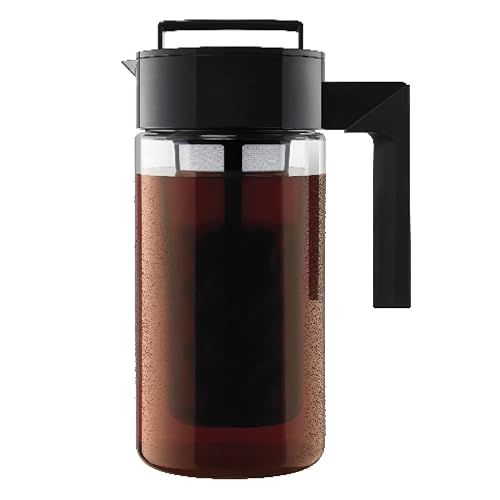
Takeya's cold brew maker is a Tritan pitcher with a mesh filter basket that screws into the lid, and its argument is entirely about handling rather than brewing. The lid genuinely seals, so the pitcher can be shaken to saturate the grounds and laid on its side in a packed fridge without leaking — two things no other maker on this page will tolerate.
It is also the one that will not break. Glass carafes are the usual way a cold brew maker ends, especially in a shared kitchen or a house with children, and Tritan removes that failure mode entirely. It goes in the dishwasher. The filter is reusable stainless mesh with no paper and no felt, so once bought there is nothing further to buy.
The honest limitations are the filter and the plastic. Mesh alone lets fines through, and the narrow basket packs the grounds tightly enough that extraction is less even than in a maker where the coffee sits loose. Plastic, however good, gradually takes on coffee oil and colour, and a two-year-old Takeya looks it. If the coffee itself is the priority, the OXO and the Toddy both produce a cleaner cup; if getting cold brew into a small fridge without incident is the priority, this is the one.
The practical, unbreakable option. Filtration is basic, but nothing here is easier to live with.
Check price on Amazon →#5
Bodum Bean Cold Brew Coffee Maker Set, 1.5 L / 51 oz, White
Best for: Someone who wants to try cold brew properly without buying a single-purpose device
What we like
- 1.5 litres, the largest capacity here outside the Toddy
- Two lids — a sealed one for the fridge and a plunger lid for pressing
- Borosilicate beaker in a silicone sleeve that survives ordinary knocks
- Works as a straightforward French press as well, which few cold brew makers do
- Cheapest way into cold brew that is not a mason jar
What we don't
- Plunger filtration is a mesh disc, so it is the least clean cup on this page
- Pressing coarse grounds after twelve hours produces noticeable sediment
- Tall and wide — needs a proper shelf, not a door
- The silicone sleeve stains and holds smells
- Swapping between two lids is fiddlier than it sounds at seven in the morning
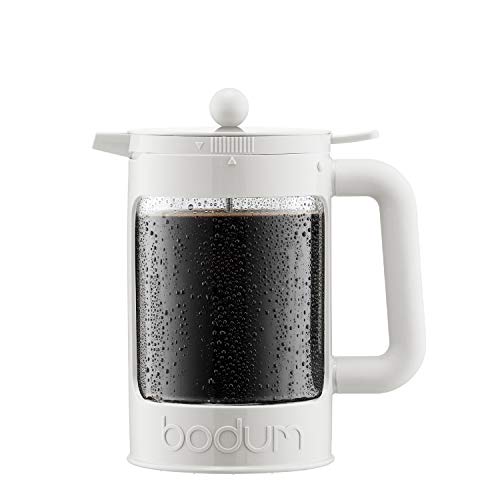
The Bean is Bodum applying the press design to cold brew: a borosilicate beaker in a silicone sleeve, a sealed lid for the twelve hours in the fridge, and a plunger lid for the morning. Coarse coffee and cold water go in together, the whole beaker steeps, and you press rather than lift a basket out.
The advantages are capacity and price. At 1.5 litres it makes a genuinely useful amount, more than double the Hario or the Takeya, and it costs less than any of the dedicated makers here. It also doubles as an ordinary [French press](/best-french-presses) for hot coffee, which is a real argument if counter space is limited and you were considering both.
The cost is in the cup. Pressing means the grounds are compressed against a mesh disc at the end of a long steep, and the sediment that results is the most of anything here — noticeably more than the Hario's lift-out basket and in a different league from the Toddy's felt. Decanting through a paper filter fixes it and adds a step. The beaker is also large in both dimensions, so it needs a shelf rather than a door, and the silicone sleeve will stain. As a way to find out whether cold brew is part of your routine, it is hard to beat; as the thing you use for years, the OXO is a better cup.
A large French press with a fridge lid. Perfectly good coffee, the muddiest cup here, and the least money.
Check price on Amazon →Cold brew is the easiest coffee to make and the easiest to store badly
There is no temperature to hit, no pour to control and no timing to be precise about. Coarse coffee sits in cold water for most of a day and comes out sweet, low in acid and heavy in body. It is the most forgiving brewing method there is.
What that means for shopping is that none of the devices on this page will meaningfully out-brew another. Buy on the parts of the process that actually annoy people: getting the grounds out cleanly, fitting the thing in a fridge, and washing it afterwards.
Concentrate or ready-to-drink
This is the real fork in the category, and it decides which maker suits you more than any spec does.
Concentrate is brewed at roughly 1:4 or 1:5 and diluted when you pour. A small volume of liquid lasts a week, stores compactly, and makes an iced latte that still tastes of coffee once milk and ice are in the glass. The cost is a decision every morning about how much water to add.
Ready-to-drink is brewed at roughly 1:8 or 1:10 and poured straight over ice. Nothing to work out, but a litre is three glasses and it occupies a litre of fridge for a full day to make them.
If you drink cold brew black and occasionally, ready-to-drink is simpler. If you drink it daily or with milk, concentrate wins easily.
The filter is what you are actually buying
Every maker here holds the grounds back. The difference is what happens to the particles small enough to pass through.
Felt and paper — the Toddy, and the OXO with its filters in — give a clean, almost tea-like cup. Fine mesh gives something cloudier with more texture, and a layer of fines that settles in the bottom of the glass. It is the same trade-off that separates a paper-filtered dripper from a French press, and neither answer is wrong.
If cold brew has ever struck you as muddy rather than smooth, that is the mesh, and it is fixable — either by buying a paper-filtered maker or by decanting through a filter afterwards.
Grind coarse, and grind evenly
The one variable that changes cold brew more than the equipment is the grind, and the instinct to compensate for cold water by grinding finer is exactly wrong.
Over twelve hours, fine particles over-extract and dissolve, producing harshness and a permanent cloudiness that no filter on this page removes. Coarse and even is what you want, which is a demand on the grinder rather than the brewer — a blade grinder produces dust alongside boulders, and the dust ends up in the glass. A burr grinder is the upgrade that improves cold brew most.
Weigh the coffee, too. Coarse grounds are mostly air, and measuring by scoop is the usual reason a batch comes out weak.
The grounds are the part nobody mentions
A full batch of cold brew leaves behind a kilogram or so of wet, heavy coffee grounds, and getting rid of them is genuinely the least pleasant part of the process.
They must not go down the sink — saturated coffee grounds are one of the more reliable ways to block a drain. The makers with a lift-out basket or a drainable brewing container handle this far better than the ones you have to upend over a bin. It is a small thing that decides whether you keep brewing.
What to buy first
If you are trying cold brew for the first time, you already own something that works. A French press at a 1:8 ratio in the fridge overnight makes real cold brew, and a large jar with the grounds strained through a paper filter makes it too.
Buy a dedicated maker once you know you want it weekly — at that point the cleaner filtration, the fridge-shaped body and the tidier way of separating the grounds are worth the money. Buy the grinder before any of them.
Frequently asked questions
How long should cold brew steep?
Twelve to twenty-four hours is the usual window, and where you land inside it is a matter of taste rather than correctness. Twelve hours in the fridge gives a lighter, more acidic result; eighteen to twenty-four gives the heavy, chocolatey character most people associate with cold brew. Room-temperature brewing extracts faster, so eight to twelve hours is closer to the mark and the result should go into the fridge promptly afterwards. Past about twenty-four hours the gains stop and the coffee starts to pick up flat, woody notes.
What ratio of coffee to water should I use?
For a concentrate, roughly 1:4 to 1:5 by weight — around 200g of coffee to a litre of water — then dilute the finished concentrate one to one or one to two when you serve it. For ready-to-drink cold brew, roughly 1:8 to 1:10, which is about 100g to a litre and needs no dilution at all. Weighing matters more here than in hot brewing because there is no taste feedback until the following day, and a scoop of coarse grounds varies enormously in weight.
Is cold brew less acidic than hot coffee?
Measurably, yes, though the difference is smaller than the marketing suggests. Cold water extracts fewer of the acids that hot water pulls out readily, which is why cold brew tastes smoother and rounder and why it is often recommended to people who find hot coffee harsh on the stomach. It is not acid-free, and it is usually stronger than hot coffee before dilution, so the caffeine content per glass can be considerably higher than expected.
How long does cold brew keep in the fridge?
Concentrate keeps well for about one to two weeks in a sealed container in the fridge; ready-to-drink cold brew is best inside a week and noticeably duller after three or four days. Both keep better if the grounds were removed promptly rather than left in, and better again if the container actually seals — coffee absorbs fridge smells readily. If it was brewed at room temperature, treat the timelines as shorter.
What grind size does cold brew need?
Coarse, similar to French press or slightly coarser. Cold water extracts slowly, so the instinct is to grind finer to compensate — but fines over a twelve-hour steep produce harshness and a cloudy, silty result that no filter here fully removes. If your cold brew tastes muddy rather than smooth, grind coarser before you change anything else. As with every method on this site, an even grind from a burr grinder matters more than the exact setting.
Can I make cold brew in a French press or a jar?
Yes, and for a first attempt it is the sensible thing to do. A French press with coarse coffee at a 1:8 ratio, left in the fridge overnight and pressed in the morning, produces perfectly good cold brew — the mesh filter simply lets more sediment through than a dedicated maker. A large jar with the grounds strained through a cloth or paper filter works too. The dedicated makers on this page buy you cleaner filtration, a tidier way to separate the grounds, and a shape that fits a fridge.
Why does my cold brew taste weak and watery?
Almost always the ratio, and specifically measuring by volume rather than weight — coarse grounds are mostly air, so a scoop weighs far less than it appears to. Weigh the coffee. If the ratio is right, the next suspects are too short a steep, a grind so coarse it barely extracted, or diluting a concentrate more heavily than the recipe assumed. Brewing in the fridge rather than at room temperature also slows extraction, so a recipe written for a counter brew will come out thin overnight in the cold.