Best French Presses
A French press is four parts and no electronics, which means almost nothing about the brewing can go wrong and almost everything about the ownership can. The differences that matter are the filter — how much sediment reaches the cup and whether the mesh keeps its shape after a year — and the body, because a glass beaker loses heat during the steep and breaks when it is knocked against a tap. We compared these on filtration quality, heat retention across a four-minute brew, how many pieces have to be washed, whether replacement parts are actually sold, and long-term owner reports on the failures that end a press's life: cracked glass, warped mesh, and plungers that stop sealing against the wall.
As an Amazon Associate, Cafe & Crema earns from qualifying purchases. This never affects the price you pay. How we make money.
#1 · Our PickTop pick
Bodum 34oz Chambord French Press Coffee Maker, High-Heat Borosilicate Glass, Polished Stainless Steel – Made in Portugal
Best for: Anyone buying their first serious press, or replacing a supermarket one that has started to disappoint
What we like
- The design the whole category copies, in production and supported since 1958
- Borosilicate beaker, stainless frame and a plunger assembly that all come apart for cleaning
- Every part is sold separately, so a broken beaker is a few pounds rather than a new press
- 34oz brews roughly three mugs, which is the size most households actually want
- Made in Portugal rather than assembled from the cheapest available parts
What we don't
- Glass loses heat through a four-minute steep and much more in a cold kitchen
- The three-piece mesh filter passes more fines than either Espro on this page
- Beaker breakage is the single most common way these end, usually against a tap
- The frame hides the beaker's lower half, so you cannot see how clean it is
- Cheap copies of the same design sell for a third of the price and look identical
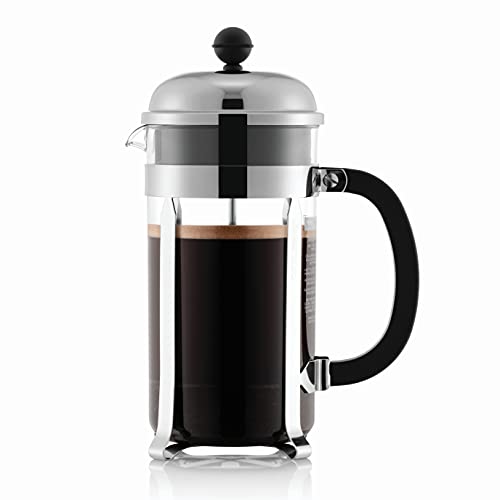
The Chambord is the shape everyone pictures when they hear French press, and it has stayed there because the design is genuinely well resolved. The beaker is borosilicate rather than soda-lime, so it tolerates boiling water poured onto a cold glass. The frame protects it. The plunger assembly unscrews into four pieces, all of which can be washed properly — which matters more than it sounds, because trapped coffee oil in a filter assembly is the usual reason a press starts producing bitter, muddy coffee after a year.
The part that separates it from visually identical copies is the parts supply. Bodum sells replacement beakers, replacement mesh, replacement cross plates and replacement lids, and sells them for years. A dropped beaker is a cheap repair rather than a bin. Nothing else in this comparison at this price has that.
What it does not do is filter finely or hold heat. The mesh is a good example of the classic three-piece design and it still passes a layer of fines that settles in the bottom of the cup — some people read that as body, others as sludge. And glass is glass: over a four-minute steep in a normal kitchen the temperature drops enough to matter, which is why the recipe on this site starts with a pre-warmed beaker. Both are inherent to the design rather than faults, and both are exactly what the two Espros and the Frieling are selling solutions to.
The reference French press. Not the cleanest cup here and not the most durable, but the best-balanced and the easiest to keep alive.
Check price on Amazon →#2Cleanest cup
ESPRO P7 French Press, 32oz, Polished, Stainless Steel Coffee Maker, Double Micro-Filter, Vacuum Insulated
Best for: People who like immersion brewing but not the sediment, and who want coffee still hot an hour later
What we like
- Double micro-filter produces a cup with visibly less sediment than any mesh press
- The filter seals against the wall, so pressing genuinely stops the extraction
- Vacuum-insulated stainless body holds brewing temperature through the steep
- Unbreakable in normal use, which makes it the sensible choice for a shared kitchen
- Doubles as a serving flask — coffee stays hot for hours after pressing
What we don't
- The most expensive press here by a wide margin
- The two-stage filter is more parts to rinse, and they must be separated to clean properly
- You cannot see the brew, so timing and level are entirely by feel
- The cleaner cup loses some of the heavy body that people buy a press for
- Replacement filters are a consumable cost the glass presses do not have
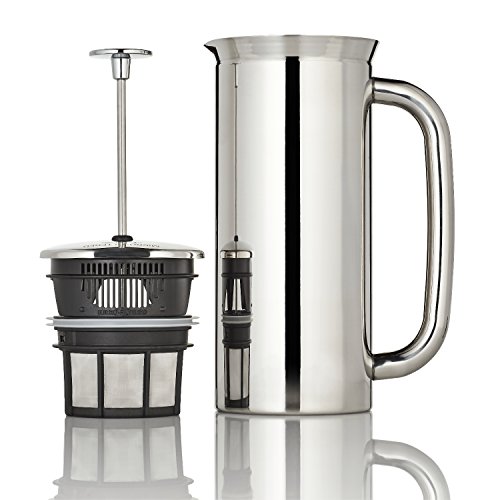
Espro's filter is the only meaningful innovation in this category in decades. Instead of one mesh disc that lets fines through and lets water slip around the edge, there are two filters nested together with a seal that presses against the beaker wall. The practical results are two: far less sediment in the cup, and a press that actually stops brewing when you press it, rather than continuing to over-extract while it sits.
The second half of the argument is the body. Vacuum-insulated stainless holds the brew close to the temperature you poured, which removes the biggest inconsistency in glass-press brewing — the same recipe tasting different in a cold kitchen. It also means the press works as a flask afterwards, which for anyone who brews once and drinks over an hour is worth as much as the filtration.
The honest counter-arguments are price and character. This costs several times a Chambord, and the mesh sediment it removes is, for some drinkers, the point of a French press — the heavy, slightly silty body that no other method produces. The cup here is cleaner and a little lighter, closer to a well-made immersion brew than to the classic press. And there is a small usability cost to a solid body: no watching the bloom, no seeing the level, and two filter pieces to separate every time you wash it.
The engineering answer to both of the French press's real problems. Whether it is worth the price depends on how much the sludge bothers you.
Check price on Amazon →#3Best built
Frieling Double-Walled Stainless Steel French Press Coffee Maker, Brushed, 36 oz (1 Liter)
Best for: A press that lives on the counter of a busy kitchen and is never treated gently
What we like
- 18/10 stainless throughout, double-walled, with no glass anywhere in the design
- Dual-screen filter passes noticeably less sediment than a single mesh
- Holds heat far better than glass and pours cleanly from a well-shaped spout
- Dishwasher safe, which none of the glass presses on this page really are
- The most likely press here to survive a decade of daily use unchanged
What we don't
- Not vacuum insulated — the double wall helps but does not match the Espro P7
- No sight of the brew at all, and the volume markings are inside the beaker
- Heavier than it looks when full, which makes one-handed pouring awkward
- Filtration is better than mesh but short of the Espro's sealed double filter
- Costs enough that the Chambord plus a decade of replacement beakers is competitive
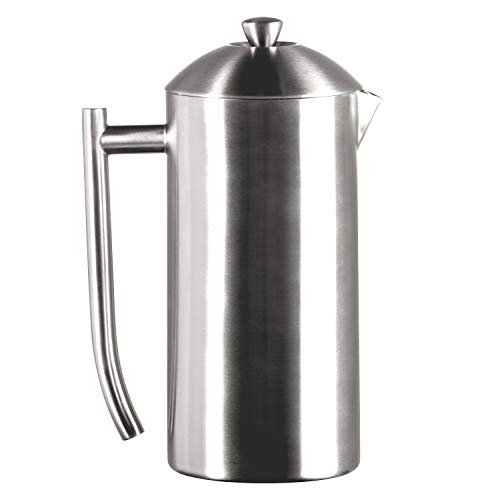
Frieling's press is built like a piece of restaurant equipment, which is the appeal. 18/10 stainless inside and out, a double wall between them, and a dual-screen filter that catches meaningfully more fines than the single mesh in a conventional press. There is no glass to crack, no plastic to hold coffee oil, and the whole thing goes in the dishwasher — which no glass press with a plastic-collared frame really tolerates.
Heat retention is where it earns its place between the Chambord and the P7. A double wall is not a vacuum, so it does not hold coffee hot for hours the way the Espro does, but through a four-minute steep it holds the brewing temperature far more consistently than any glass beaker, and that consistency shows up as a cup that tastes the same in January as it does in July.
The compromises follow from the construction. You brew blind — no watching the crust form, no seeing the level — and the volume marks are stamped inside the beaker where they are hard to read once the coffee is in. It is heavy when full. And while the dual screen is a real improvement on standard mesh, it is not sealed against the wall, so some fines still make it through and the press keeps extracting gently after plunging. If the sediment is the thing you are trying to eliminate rather than reduce, the P7 is the machine that actually does it.
The durability pick. Better filtration and much better heat retention than glass, without the Espro's price or its consumables.
Check price on Amazon →#4Best value filtration
ESPRO P3 French Press Coffee Maker, 32oz, Black, Double Micro Filter, Borosilicate Glass
Best for: Anyone who wants the clean Espro cup without paying for the insulated body
What we like
- The same sealed double micro-filter as the P7, at a fraction of the price
- Borosilicate beaker in a protective cage, so you can still watch the brew
- Pressing genuinely halts extraction rather than slowing it
- Optional paper filters drop the sediment to pour-over levels
- Lighter and easier to pour than any of the stainless presses here
What we don't
- Glass body means the heat retention of a Chambord, not of a P7
- The cage covers most of the beaker, so the view is partial at best
- Two filter pieces to disassemble and rinse after every brew
- Paper filters are a recurring cost and slow the plunge noticeably
- Glass still breaks, and the cage protects it less than Bodum's full frame
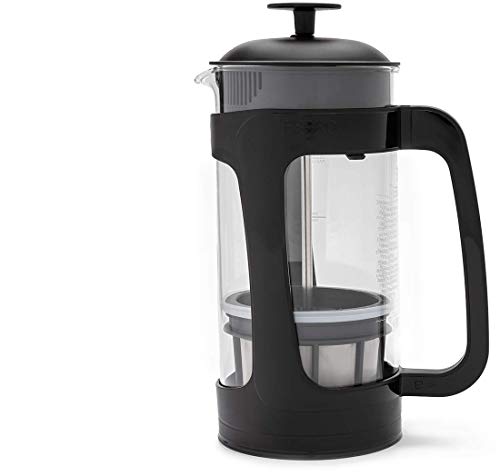
The P3 is the P7's filter in an ordinary body, and since the filter is what makes an Espro worth buying, that is a reasonable trade. The same two nested micro-filters with the same wall seal produce the same substantial reduction in sediment, and the same clean stop to the extraction when you press. Against a Chambord the difference in the bottom of the cup is obvious.
What you give up is the flask. This is borosilicate glass in a plastic cage, so the brew cools during the steep exactly as it does in any glass press, and the coffee does not stay hot afterwards. In exchange you get something the P7 cannot offer — a partial view of the brew, useful when you are still learning what a properly saturated bed looks like — and a much lighter press that pours easily.
The optional paper filters are worth knowing about. Dropped in above the micro-filter they take the cup down to something close to pour-over clarity, at the cost of a slower plunge and an ongoing consumable. Most owners try them, use them for a while, and settle back on the metal filters alone. The routine cost is that the two-piece filter has to be separated and rinsed properly every time, and a press left in the sink overnight with coffee trapped between the discs is how an Espro starts tasting stale.
The filter is the reason to buy an Espro, and this is the cheapest way to get it. Accept glass-press heat loss in exchange.
Check price on Amazon →#5
Bodum 34oz Brazil French Press Coffee Maker, High-Heat Borosilicate Glass, Black – Made in Portugal
Best for: A first press, a second press for the office, or a spare that will be treated badly
What we like
- Same borosilicate beaker and same filter assembly as the Chambord, in a cheaper shell
- Costs a fraction of everything else here and brews a comparable cup
- Bodum's replacement parts fit it, so it is repairable like the Chambord
- Plastic frame is lighter and less prone to scratching a countertop
- A completely adequate way to find out whether you like immersion brewing
What we don't
- Plastic frame and handle feel cheap and will discolour over a few years
- Same mesh filtration as the Chambord, so the same sediment in the cup
- Same glass heat loss, with a frame that insulates even less
- Handle is mounted to the plastic body rather than a metal frame, and it is the usual failure point
- Nothing about it will still look good in five years
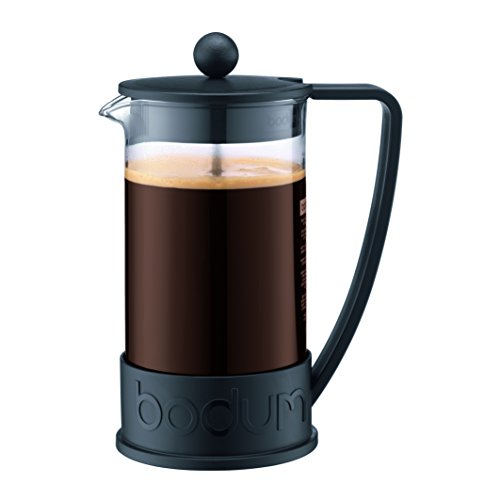
The Brazil is Bodum selling the same brewing hardware in a cheaper package. Same borosilicate beaker, same three-piece mesh assembly, same 34oz capacity — the difference is a moulded plastic frame instead of a stainless one. Since the frame does not touch the coffee, the cup is essentially the Chambord's cup.
That makes it the sensible entry point. Immersion brewing is not for everyone; the body is heavy and the sediment is real, and finding out costs very little here. If you keep it, Bodum's replacement beakers and filter parts fit, so it stays repairable rather than disposable — which is more than can be said for most presses at this price.
Where it shows the saving is over time. The plastic frame scuffs, discolours and eventually looks tired, and the handle is bonded to that plastic rather than to a metal cage, which is the part owners report failing. It also insulates a little worse than the Chambord's open steel frame, which does the cup no favours. None of that is a reason not to buy it as a first press. It is a reason to expect to replace it with something better rather than to keep it for a decade.
The Chambord's brewing at a third of the price, wrapped in plastic that will not age well. As a starter press it is hard to argue with.
Check price on Amazon →Four parts, two problems
A French press has no pump, no heater and no timer, which means there is almost nothing to break and almost nothing to get wrong in the brewing. Water and coffee sit together for four minutes; a mesh disc separates them at the end. That simplicity is the entire appeal.
It also means the differences between presses come down to two things, and every press on this page is an answer to one or both. The first is filtration — how much fine sediment reaches the cup, and whether pressing actually stops the extraction. The second is heat — whether the brew holds temperature for four minutes in a real kitchen.
Everything else is packaging.
The sediment question
A standard mesh filter is a strainer. It stops the grounds and lets the fines through, and those fines are what give press coffee its characteristic heavy body — and its silty last inch.
Whether that is a feature depends entirely on you. Plenty of people brew a press specifically because no other method produces that texture, and a pour-over dripper with a paper filter is the opposite extreme. If you want immersion body without the sludge, Espro’s sealed double filter is the only design here that meaningfully delivers it.
What is not a matter of taste is where fines come from. A blade grinder produces dust alongside boulders, and no filter on this page can hold that dust back. Sludge that appeared when you switched beans is a grind problem, and a burr grinder fixes it more completely than any press will.
Pressing does not always stop the brew
This is the part most instructions skip. In a conventional mesh press, plunging pushes the grounds down but does not seal them off — water still circulates around the edge of the disc and through it, so a pot left standing keeps extracting and turns bitter.
Two practical consequences. Pour the whole pot into cups or a flask as soon as you press it rather than leaving it in the beaker. And if you regularly drink the second cup twenty minutes later, either brew less or buy a press with a sealed filter, where pressing genuinely ends the extraction.
Glass loses more heat than you think
Near-boiling water poured into a room-temperature glass beaker drops several degrees on contact and keeps dropping through the steep. In a cold kitchen that is enough to move a brew from balanced to sour, and it is the reason the same recipe seems to work in summer and fail in winter.
Rinsing the beaker with hot water first removes most of it and costs ten seconds. An insulated stainless press removes all of it, holds the coffee hot afterwards, and cannot be broken against a tap — which is why two of the five presses here are metal.
What to buy first
If your press coffee is disappointing, the press is rarely the reason. The order that actually improves the cup is fresh coffee, then an even grind, then the brewer — the same order that applies to every other method on this site.
A Chambord with a decent hand grinder makes better coffee than an Espro P7 with pre-ground supermarket beans, and it is not close. Buy the press for the sediment and the heat retention you want to live with; buy the grinder for the coffee.
For how immersion brewing compares with the two other manual methods worth owning, see French press, AeroPress and moka compared.
Frequently asked questions
What grind size should I use in a French press?
Coarse — the texture of raw sugar or slightly coarser. Anything finer produces a mass of fines that slip through the mesh, keep extracting after you press, and turn the last third of the pot bitter. More important than the setting is the consistency: a burr grinder produces a narrow range of particle sizes, while a blade grinder produces both boulders and dust at once, and the dust is exactly what a mesh filter cannot stop. If your press coffee is muddy and harsh, the grinder is the likelier culprit than the press.
How long should coffee steep in a French press?
Four minutes is the standard starting point for a coarse grind, and it is a starting point rather than a rule. If the cup tastes thin and sour, the coffee is under-extracted — grind finer or steep longer. If it tastes bitter and drying, go coarser or shorter. What matters more than the exact number is that you press and pour at the end of it: coffee left sitting on the grounds in a mesh press keeps extracting, and a pot poured twenty minutes after brewing tastes noticeably worse than the first cup.
Why is there always sludge at the bottom of my cup?
Because a standard mesh filter is a strainer, not a filter — it holds back the grounds and lets the fine particles through. Some of that is inherent to the method and is what gives press coffee its body. The rest usually comes from grinding too fine or from a blade grinder producing dust. If it bothers you, a sealed double filter like Espro's removes most of it, a paper filter above the mesh removes nearly all of it, and pouring the last inch of the pot away removes the worst of it for free.
Is a stainless French press better than a glass one?
It holds heat much better and it does not break, which are the two things that actually end a press's life. What you give up is the ability to watch the brew, and — with a plain double wall rather than a vacuum — a little less insulation than the marketing implies. Glass has one real advantage beyond price: you can see exactly how clean it is, and a press you can inspect is a press you are more likely to keep clean.
Do I need to pre-warm the press?
With a glass press, yes, and it makes more difference than most people expect. Pouring near-boiling water into a cold glass beaker costs several degrees immediately and several more over the steep, which is enough to push a brew from balanced to sour. Rinse the beaker with hot water while the kettle finishes, tip it out, then dose and brew. With an insulated stainless press the effect is much smaller, though rinsing still helps.
How do I actually clean a French press properly?
Take the plunger apart. The filter assembly unscrews into three or four pieces on almost every press, and the coffee oil that collects between them is what makes an old press produce bitter, stale-tasting coffee no matter how fresh the beans are. Rinse everything after each use and dismantle it properly at least weekly. For the grounds, scrape them into the bin or compost with a spatula rather than washing them down the sink, where they will eventually block the trap.
Can I make cold brew in a French press?
Yes, and it is the cheapest way to start. Use a coarse grind at roughly a 1:8 ratio of coffee to water, stir, cap it, and leave it in the fridge for 12 to 18 hours before pressing. The mesh filter will let more sediment through than a dedicated cold brew maker, so decant it through a paper filter if you want it clean. The limitation is capacity and fridge space rather than quality — a 34oz press makes a modest amount of concentrate and occupies a shelf while it does.