Best Water Filters and Descalers
Coffee is about ninety-eight per cent water, and the minerals in that water do two things at once: they carry flavour out of the coffee, and they precipitate out onto the inside of your machine as limescale. Filters address the first problem, descalers address the damage from the second, and mineral supplements exist because water stripped of everything makes flat, hollow coffee. Nothing on this page is glamorous and all of it decides how long a machine lasts. We compared these on what they actually remove or dissolve, whether they are safe for aluminium and for the plastics used in home machines, cost per use rather than cost per bottle, how much water they treat before a replacement is due, and how honest the manufacturer is about contact time and rinsing.
As an Amazon Associate, Cafe & Crema earns from qualifying purchases. This never affects the price you pay. How we make money.
| Rank | Product | Score | Best for | Link |
|---|---|---|---|---|
| #1 | Urnex Liquid Dezcal Descaler, 33.6 oz Bottle, Activated Descaling Solution for Coffee and Espresso MachinesTop pick | 9.2 | Almost any home espresso machine, drip brewer or pod machine on a regular descaling schedule | Check price → |
| #2 | Durgol Universal Multipurpose Descaler, 2 Bottles of 500ml, Fast-Acting Limescale RemoverFastest on heavy scale | 8.8 | A machine that has gone a long time without descaling, or anyone who wants the job done in ten minutes | Check price → |
| #3 | ZeroWater 10-Cup Ready-Pour Water Filter Pitcher with 5-Stage Ion Exchange Filtration and Water Quality MeterBest for hard water | 8.4 | Hard-water households who want scale gone and are willing to add minerals back for taste | Check price → |
| #4 | Third Wave Water Espresso Profile Mineral Supplement, 12 Capsules for 12 GallonsBest for flavour control | 8.0 | People chasing repeatability in espresso who already grind and weigh carefully | Check price → |
| #5 | Amazon Basics 10-Cup Water Filter Pitcher with Filter Cartridge, BPA-Free | 7.6 | Soft or moderately hard water, where taste is the problem and scale is not yet | Check price → |
#1 · Our PickTop pick
Urnex Liquid Dezcal Descaler, 33.6 oz Bottle, Activated Descaling Solution for Coffee and Espresso Machines
Best for: Almost any home espresso machine, drip brewer or pod machine on a regular descaling schedule
What we like
- Citric-acid based rather than sulphamic, so it is safe for aluminium boilers and the plastics used in home machines
- Liquid, which means no undissolved powder sitting in a tank and no grit in a pump
- One litre treats many cycles, giving the lowest cost per descale of anything here
- Approved or recommended by a long list of machine manufacturers, which matters for warranty terms
- Rinses out readily, so the two or three flush cycles afterwards are genuinely enough
What we don't
- Slower than the aggressive sulphamic descalers on very heavy scale
- The bottle is large and awkward to store, and it has a shelf life once opened
- No dosing cap, so measuring is done with a kitchen jug
- Heavily scaled machines may need two consecutive treatments
- Not a cleaner — it does nothing about coffee oil, which is a separate product
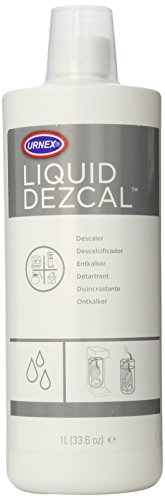
Dezcal is the descaler most machine manufacturers point owners toward, and the reason is chemistry rather than marketing. It is citric-acid based, which dissolves calcium carbonate effectively while remaining safe for aluminium components and for the plastics and seals used throughout home machines. The aggressive alternative — sulphamic acid — works faster and is explicitly unsafe for aluminium, which is a problem because plenty of boilers and thermoblocks are exactly that.
The liquid format matters more than it sounds. Powder descalers have to fully dissolve before the machine runs, and undissolved granules drawn into a pump or left sitting in a tank are a genuine failure mode. A liquid mixes instantly and rinses clean, which is why two or three flush cycles afterwards actually clear it rather than leaving a sour taste in the next four coffees.
At a litre, this is the cheapest per treatment of anything on this page by a distance — the single-dose sachets sold at three times the price per descale are the same active ingredient. The trade-offs are storage and speed. It is a big bottle to find room for, it does not keep indefinitely once opened, and on a machine that has been neglected for two years a citric descaler may need running twice where a harsher one would clear it in a single pass. It also does nothing about coffee oil; [that is a different product entirely](/descaling-and-water-maintenance).
The default answer. Safe for the widest range of machines, cheapest per use, and the one manufacturers name.
Check price on Amazon →#2Fastest on heavy scale
Durgol Universal Multipurpose Descaler, 2 Bottles of 500ml, Fast-Acting Limescale Remover
Best for: A machine that has gone a long time without descaling, or anyone who wants the job done in ten minutes
What we like
- Works noticeably faster than citric descalers — usually a single short cycle rather than a soak
- No dilution required; it goes into the tank neat, which removes a step and a measuring error
- Two 500ml bottles, so one lives by the machine and one stays in the cupboard
- Food-safe and rinses without leaving a taste, which is not universal in fast descalers
- Also clears kettles, shower heads and steam irons, so nothing goes to waste
What we don't
- Undiluted means it disappears far faster per treatment than a concentrate does
- Stronger acid demands attention to contact time — leaving it in overnight is not the plan
- More expensive per descale than Dezcal
- The universal formula is not the espresso-specific one, which some machine warranties name explicitly
- Strong smell during the cycle
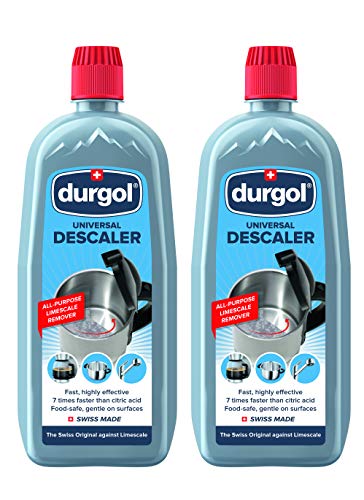
Durgol's argument is time. Where a citric descaler wants a soak and often a second pass, this goes into the tank undiluted, runs through, and clears scale in a single short cycle. For a machine that has been quietly furring up for a couple of years, that is a meaningful difference — the first descale on a neglected machine is the one most likely to fail with a gentle product.
Going in neat also removes the most common user error in descaling, which is getting the dilution wrong. There is no ratio, no measuring jug and no partially dissolved powder. It is food-safe, and it rinses cleanly enough that the usual two flush cycles do the job rather than leaving the next several drinks tasting of chemistry.
The economics are the catch. Undiluted means a 500ml bottle covers far fewer treatments than a litre of concentrate, and the cost per descale lands well above Dezcal. The other thing worth knowing is that this is the Universal formula rather than the espresso-specific one — chemically similar, but some manufacturers name a particular product in their warranty documentation and it is worth checking yours before choosing. And because it works faster, contact time matters: follow the stated timing rather than leaving it to sit, particularly on a machine with aluminium anywhere in the water path.
Fast and effective on scale that a gentler descaler struggles with. You pay for the speed in volume.
Check price on Amazon →#3Best for hard water
ZeroWater 10-Cup Ready-Pour Water Filter Pitcher with 5-Stage Ion Exchange Filtration and Water Quality Meter
Best for: Hard-water households who want scale gone and are willing to add minerals back for taste
What we like
- Five-stage ion exchange removes effectively all dissolved solids, not just chlorine and taste
- Includes a TDS meter, so you can actually measure your water instead of guessing
- Reduces scale formation dramatically because there is very little left to precipitate
- Ready-pour spout means it dispenses without lifting the lid or waiting for the reservoir to empty
- Filters are widely stocked and the meter tells you exactly when one is finished
What we don't
- Filters exhaust far faster than a standard carbon pitcher, especially in hard-water areas
- Water at near-zero TDS makes flat, hollow coffee unless minerals are added back
- Filtering is slow — a full reservoir takes several minutes to pass through
- Ongoing filter cost is the highest of any pitcher option
- The pitcher is bulky in a fridge and the reservoir needs frequent refilling
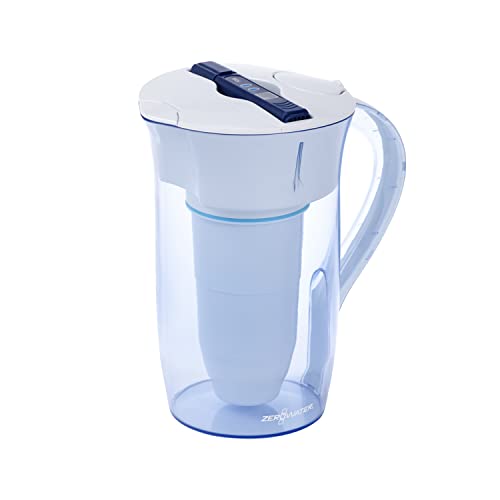
A standard carbon pitcher improves the taste of tap water by removing chlorine. It does very little about the dissolved calcium and magnesium that form limescale, which is why people in hard-water areas descale just as often after buying one. ZeroWater's five-stage ion exchange is different in kind: it removes essentially all dissolved solids and takes the reading close to zero, and the included TDS meter lets you confirm it rather than take it on trust.
For a machine, that is genuinely protective. Scale forms when minerals come out of solution onto hot metal, and water with almost no minerals in it has almost nothing to deposit. In a hard-water area this can shift descaling from a quarterly chore to an annual one, and prolong the life of a boiler considerably.
The complication is that it works too well for flavour. Coffee needs some mineral content — calcium and magnesium bind to the compounds being extracted, and water at zero TDS produces coffee that tastes thin, flat and strangely hollow. The specialty target is roughly 75 to 150 ppm, not zero. The sensible use is therefore ZeroWater plus a mineral supplement, which is a two-product routine. It is also the most expensive pitcher to run: the filters exhaust quickly, and in genuinely hard water they exhaust very quickly. The meter is honest about it, which some owners find alarming.
The only pitcher here that genuinely strips the minerals that cause scale. That is also its problem.
Check price on Amazon →#4Best for flavour control
Third Wave Water Espresso Profile Mineral Supplement, 12 Capsules for 12 Gallons
Best for: People chasing repeatability in espresso who already grind and weigh carefully
What we like
- Turns distilled or RO water into a repeatable, known mineral profile every single time
- The espresso profile targets a higher mineral content than the classic one, which suits the method
- Removes water as a variable entirely, which matters when dialling in a shot
- Tiny — a box of capsules takes no cupboard space at all
- No scale risk from the profile itself, unlike hard tap water
What we don't
- Requires buying or making distilled or RO water, which is an ongoing cost and a logistical hassle
- Meaningless with tap water — adding minerals to already mineral-rich water makes it worse
- One capsule treats a full gallon, so part-gallon batches need dividing or wasting
- The difference is real but subtle, and it will not rescue stale beans or a bad grinder
- Cost per litre is the highest of anything on this page
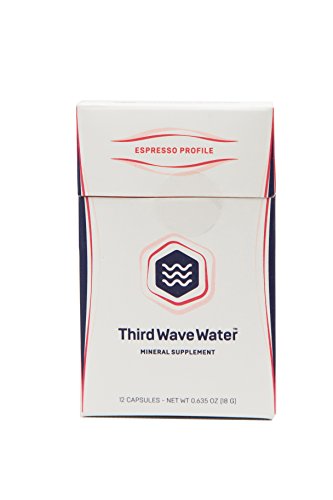
Third Wave Water is a mineral capsule that dissolves into a gallon of distilled or reverse-osmosis water to hit a specific target profile. The espresso version is formulated for a higher mineral content than the classic filter version, on the reasoning that espresso extracts under pressure in half a minute and benefits from more to work with.
What it buys is repeatability. Tap water changes seasonally, varies between regions and is different in every rental you move into, and it is the single largest uncontrolled variable in most home setups. Starting from distilled water and adding a known quantity of minerals removes it. For anyone already [weighing doses and timing shots](/espresso-dial-in-grind-dose-yield), that is the last inconsistency left, and it also means no scale beyond what the profile itself contains.
The caveats are unavoidable. It only works from distilled or RO water — added to ordinary tap water it raises an already high mineral content and makes both the coffee and the scaling worse. That means buying bottled distilled water regularly or owning an RO unit, which is a real cost and a real hassle. Each capsule does a full gallon, so smaller batches mean splitting a capsule by eye or wasting it. And the honest scale of the improvement is subtle: it is a refinement for a setup that is already good, not a fix for anything upstream of it.
The last variable to control, not the first. Genuinely works, and only if you start from distilled water.
Check price on Amazon →#5
Amazon Basics 10-Cup Water Filter Pitcher with Filter Cartridge, BPA-Free
Best for: Soft or moderately hard water, where taste is the problem and scale is not yet
What we like
- Takes standard Brita-compatible cartridges, so filters are available everywhere and cheap
- Costs a fraction of the branded pitchers using the same filter format
- Removes chlorine and improves taste noticeably, which is most of what people actually want
- 10-cup reservoir is a sensible size for filling a machine tank
- No meter, no cycles, nothing to learn
What we don't
- Carbon filtration barely touches the calcium and magnesium that form scale
- Does not reduce descaling frequency in a hard-water area in any meaningful way
- Plastic build feels every bit as cheap as it is, and the lid fits loosely
- Filter life indicator is a timer, not a measurement of actual use
- Pouring with a full reservoir is drip-prone
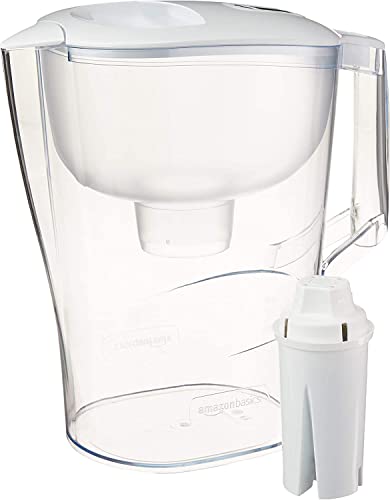
This is a standard carbon pitcher that takes the same cartridges as the market leader at a considerably lower price, and for the job most people actually want doing, it is enough. Chlorinated tap water makes coffee taste faintly of swimming pool, and activated carbon removes chlorine effectively and immediately. If that is your complaint, this solves it for the price of a couple of bags of coffee.
The filter format is the practical argument. Brita-compatible cartridges are stocked in every supermarket, they are cheap, and there is no proprietary lock-in. The 10-cup reservoir fills a machine tank in one or two goes, and there is nothing to configure.
Where it needs to be honest is scale. Activated carbon adsorbs chlorine, chloramine and organic compounds; it does very little to dissolved calcium and magnesium, which are the minerals that come out of solution onto a hot boiler wall. Owners in hard-water areas who buy a carbon pitcher expecting to stop descaling are consistently disappointed, and the descaling schedule should not change at all on the strength of one. Treat this as a taste product. If scale is the problem, that is ion exchange or a plumbed softener, and it costs more. The build quality is also exactly what the price implies — the lid is loose and it drips when full.
Fixes the taste of chlorinated tap water for very little money. Do not expect it to protect the machine.
Check price on Amazon →Coffee is mostly water, and your water is not neutral
A cup of coffee is around ninety-eight per cent water by weight. Whatever is dissolved in it is in the cup, and whatever precipitates out of it is inside your machine.
That gives two separate jobs. Filters control what goes in. Descalers remove what has already come out of solution and stuck to the inside of a boiler. Buying one does not remove the need for the other, and the most common mistake in this category is assuming a filter jug means you can stop descaling.
Find out what is in your water first
Every decision here follows from a single number, and it takes seconds to get. Water suppliers publish hardness by postcode, and a cheap TDS meter reads it directly.
- Below about 100 ppm — soft. Scaling is slow. A carbon pitcher for taste is all you need.
- 100 to 200 ppm — moderate. Descale on schedule, filter for taste, and stop worrying.
- Above 200 ppm — hard. Scale accumulates fast, and filtration that removes minerals rather than just chlorine begins to pay for itself.
Buying a descaling routine without knowing which of these you are in is guessing at a problem you can measure.
Carbon filters do not stop limescale
This is worth stating plainly because the packaging rarely does.
Activated carbon adsorbs chlorine, chloramine and organic compounds. It makes tap water taste much better, and if your coffee tastes faintly of swimming pool that is the fix. It does very little to dissolved calcium and magnesium — and those are the minerals that come out of solution onto a hot boiler wall as scale.
Removing hardness means ion exchange, reverse osmosis or a plumbed softener. All of them cost more, and all of them create the opposite problem.
Water with nothing in it makes bad coffee
Strip the minerals out completely and the coffee goes flat, thin and oddly hollow. Calcium and magnesium bind to the compounds being extracted; without them the extraction is less efficient and the cup has no weight.
The widely used specialty target is roughly 75 to 150 ppm total dissolved solids, not zero. If you filter aggressively — ion exchange or RO — plan on adding minerals back, either with a supplement or by cutting the filtered water with some tap water. This is the reason ZeroWater and Third Wave Water end up in the same shopping basket.
Check what your machine is made of before you buy a descaler
Descalers split into two chemistries and it is not a matter of preference.
Citric acid is slower and safe across aluminium, brass, stainless and the plastics used in home machines. Sulphamic acid works considerably faster and is explicitly unsafe for aluminium, which appears in plenty of boilers and thermoblocks — including in machines whose manuals do not make it obvious.
Most manufacturers name an approved product somewhere in the manual, and using something else can matter if you ever make a warranty claim. When in doubt, citric. It is also the cheaper chemistry per treatment.
Descaling is not cleaning
A machine can be completely free of scale and still make bitter, stale coffee, because scale and coffee oil are different problems in different parts of the machine.
Descaler moves through the water path: tank, pump, boiler, pipework. Coffee oil accumulates where the coffee is — the group head and shower screen on an espresso machine, the basket and spray head on a drip brewer. It goes rancid, and rancid oil is a far more common cause of a machine that has started tasting bad than limescale is.
Both jobs, on their own schedules. The full maintenance routine covers what each machine type actually needs and how often.
What this is worth spending on
If your water is soft, buy a carbon pitcher and a bottle of citric descaler and stop reading.
If your water is hard, the descaler is the non-negotiable part — it is the cheapest thing you can do to keep a machine alive, and hard water is the most common cause of death for home espresso machines. Filtration comes second and mineral supplements a distant third.
And if the choice is between better water and a better grinder, the grinder wins comfortably. Water is the last variable worth controlling, not the first.
Frequently asked questions
How often should I descale my coffee machine?
Every one to three months in hard water and every three to six in soft, though the honest answer is that it depends on volume as much as hardness — a machine pulling six shots a day scales faster than one pulling two. Many machines have a descale indicator, and most of them are counting cycles rather than measuring anything, so treat it as a reminder rather than a diagnosis. Signs you have left it too long include slower flow, a noisier pump, water that no longer reaches temperature, and a steam wand that has lost pressure.
Can I descale with vinegar or citric acid powder instead?
You can, and plenty of people do, but there are reasons the commercial products exist. Vinegar is weak, so it needs long contact time, and the smell is extremely persistent — it takes many more flush cycles to clear than a purpose-made descaler, and residual vinegar in a boiler taints coffee for days. Loose citric acid powder is the right chemistry but has no corrosion inhibitors, which commercial descalers include specifically to protect seals and metal surfaces. On an inexpensive drip machine either is fine. On an espresso machine with a warranty, use what the manufacturer names.
Does a Brita filter stop limescale?
Not meaningfully. Standard carbon filters adsorb chlorine and organic compounds, which improves taste noticeably, but they do very little to the dissolved calcium and magnesium that form scale. If you have hard water and want to slow scaling, you need ion exchange, reverse osmosis, or a plumbed softener — and having done that, you will want to add minerals back for flavour. A carbon pitcher is a taste product, not a protection product.
What water is best for coffee?
Filtered water with moderate mineral content — the widely used specialty target is roughly 75 to 150 ppm total dissolved solids, with a balance of calcium and magnesium and low chlorine. Minerals matter because they bind to the flavour compounds being extracted; distilled water makes coffee that tastes flat and hollow, and heavily mineralised water makes it dull and chalky as well as scaling the machine. If your tap water tastes good to drink, it is usually a reasonable starting point once the chlorine is filtered out.
Is descaling the same as cleaning?
No, and machines need both. Descaling dissolves mineral deposits from inside the water path — the boiler, the pump and the pipework. Cleaning removes coffee oil and grounds from the parts the coffee touches, which on an espresso machine means backflushing the group head with a detergent such as Cafiza, and on a drip machine means the basket and the shower head. Rancid coffee oil is a more common cause of bitter, stale-tasting coffee than scale is, and no descaler touches it.
How much water do I need to flush after descaling?
At least two full tanks, and three is safer. Descaler left in the boiler makes the next several drinks taste sour or metallic, and on machines with a steam wand you should run steam and hot water through as well so the whole path is cleared rather than just the brew route. If the water coming out still smells of anything at all, keep going. Liquid descalers generally rinse out faster than powders.
Should I use distilled water in my espresso machine?
Not on its own. Distilled water makes flat, hollow coffee because there are no minerals to carry the extraction, and in machines that measure water level by conductivity it can prevent the level sensor working at all. Distilled water is the correct starting point only if you are adding a mineral supplement back to a known profile. For everything else, filtered tap water at moderate hardness is the better answer.
Will hard water actually kill my machine?
It is the most common cause of death for home espresso machines, yes. Scale builds as an insulating layer inside the boiler, which makes heating slower and less accurate, then narrows the pipework, and eventually blocks solenoid valves and the pump. The failure is gradual, so it usually presents as a machine that has become slow and weak rather than one that stops. Descaling on schedule is the single cheapest thing you can do to extend a machine's life.